Xiaomi has recently returned to making tablets, and its products quickly became popular in this segment of mobile devices. While people are increasingly abandoning the brand’s smartphones, the Chinese iPad alternative outperforms competitors in every parameter. The HyperOS shell has been excellently adapted for wide screens, long-term update support has been introduced, and the sound and build quality have long been beyond reproach. On top of all that, the Xiaomi Pad 8 and Pad 8 Pro have been released — new tablets that will definitely be very popular in 2026, but will make you wonder: which model is actually better?
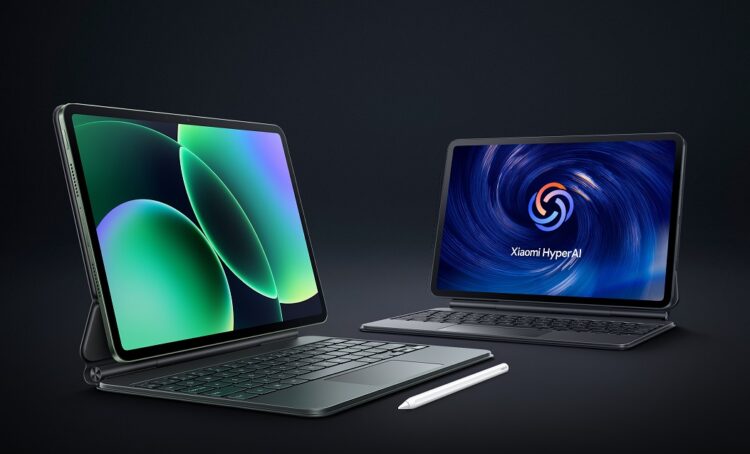
The tablets look similar on the outside, but all the differences are inside. Image: Xiaomi
Where to Buy Xiaomi Pad 8
Xiaomi Pad 8 and Xiaomi Pad 8 Pro have appeared and are currently available at the following prices depending on memory capacity:
- Xiaomi Pad 8 (8/256 GB) — from 27,493 ₽;
- Xiaomi Pad 8 (12/256 GB) — from 31,078 ₽;
- Xiaomi Pad 8 Pro (8/256 GB) — from 37,960 ₽;
- Xiaomi Pad 8 Pro (12/512 GB) — from 43,817 ₽.
To celebrate the launch, discounts are available on the new Xiaomi tablets, although compared to the Xiaomi Pad 7, their price may seem high. But it’s important to understand two things. First, this is a new generation. Second, at the end of 2025, a memory crisis hit, which noticeably increased the cost of mobile devices.
Overall, if you evaluate the Xiaomi Pad 8 tablet and its Pro version in the context of the market, it looks quite attractive. But we’ll talk about that later — for now, let’s compare the two new Xiaomi models against each other.
Differences Between Xiaomi Pad 8 and Pad 8 Pro
The difference between Xiaomi Pad 8 and Xiaomi Pad 8 Pro lies in their positioning. The standard model is the base option, while the Pro version is the advanced variant. And comparing the specs immediately reveals their key differences.
| Specs | Xiaomi Pad 8 | Xiaomi Pad 8 Pro |
|---|---|---|
| Display | 11.2 inches, IPS (3200×2136), 144 Hz | 11.2 inches, IPS (3200×2136), 144 Hz |
| Main Camera | 13 MP | 50 MP |
| Front Camera | 8 MP | 32 MP |
| Processor | Snapdragon 8s Gen 4 | Snapdragon 8 Elite |
| Memory | 8/256 or 12/256 GB | 8/256 or 12/512 GB |
| Battery | 9200 mAh | 9200 mAh |
| Charging | 45 W | 67 W |
The main difference between the tablets is the processor. While the Xiaomi Pad 8 runs on the sub-flagship Snapdragon 8s Gen 4 chip, the Xiaomi Pad 8 Pro packs the full flagship Snapdragon 8 Elite under the hood. The performance difference between the two solutions reaches 33%.
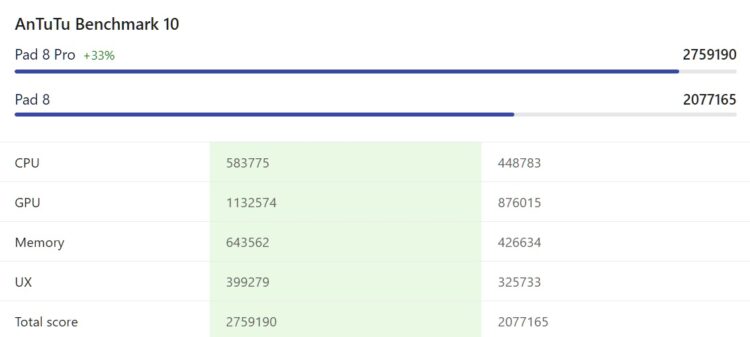
Xiaomi Pad 8 Pro is more powerful, but only in games. Source: nanoreview.net
However, during everyday use, noticing any advantage of the Pro version will be incredibly difficult. After all, both tablets use the same standards of RAM (LPDDR5X) and storage (UFS 4.1), and the difference is only slightly noticeable in games and other resource-intensive tasks like video rendering.
That said, it’s important to note several less significant advantages of Xiaomi Pad 8 Pro:
- higher-quality cameras;
- faster charging;
- availability of a 512 GB version.
Is it worth paying an extra 10 thousand rubles for this? The answer to this question will be given later, but first let’s figure out why the choice for the best tablet of 2026 comes down specifically to Xiaomi devices.
Why Xiaomi Pad 8 Is the Best Tablet of 2026
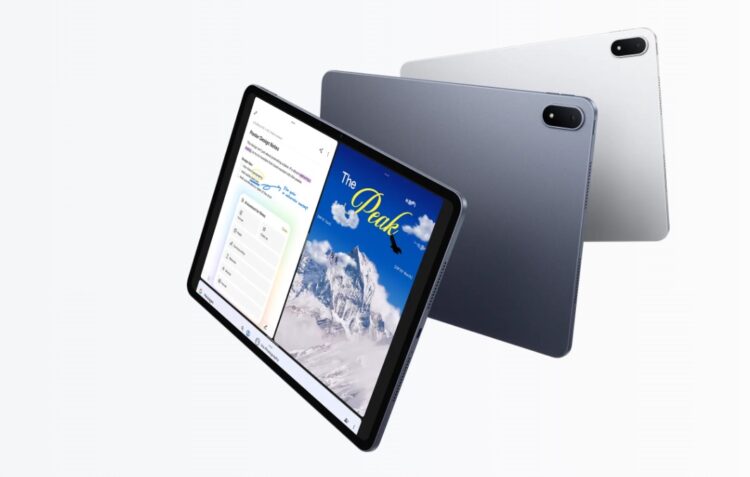
Let’s look at the direct competitors. For example, the OnePlus Pad 3 is available — a really great tablet with a Snapdragon 8 Elite chip. But the Xiaomi Pad 8 Pro with the same processor costs 10 thousand less, offering roughly the same specs otherwise.
OnePlus Pad 3 is great, but expensive. Image: OnePlus
The OnePlus Pad Go, whose price in the 256 GB version is comparable to the Xiaomi Pad 8’s price, is a lower-tier device due to its mediocre Helio G99 chip and cost-cutting on virtually every component. And all the other offerings are either openly budget models or exclusive to the Chinese market, which aren’t adapted for other regions (no Google services and often no Russian language support).
In Russia, the tablet situation is more interesting, but equally telling. There are flagship Samsung models priced up to 100 thousand rubles and HUAWEI tablets without Google services with their semi-closed ecosystem. Perhaps the HONOR Magic Pad 2 looks decent, but even that, with a processor weaker than the Xiaomi Pad 8’s, costs around 50 thousand rubles.
Which Tablet to Buy: Xiaomi Pad 8 or Pad 8 Pro
But the choice between Xiaomi Pad 8 and Pad 8 Pro is also quite obvious. Paying 10 thousand more for a small boost in charging speed and a chip whose slight advantage can only be felt in games isn’t very smart. The Xiaomi Pad 8 is just as fast, and its screen, sound, and battery are identical.
Therefore, right now it can be confidently said that the base Xiaomi Pad 8 is the best Android tablet of 2026. Try to argue with that.