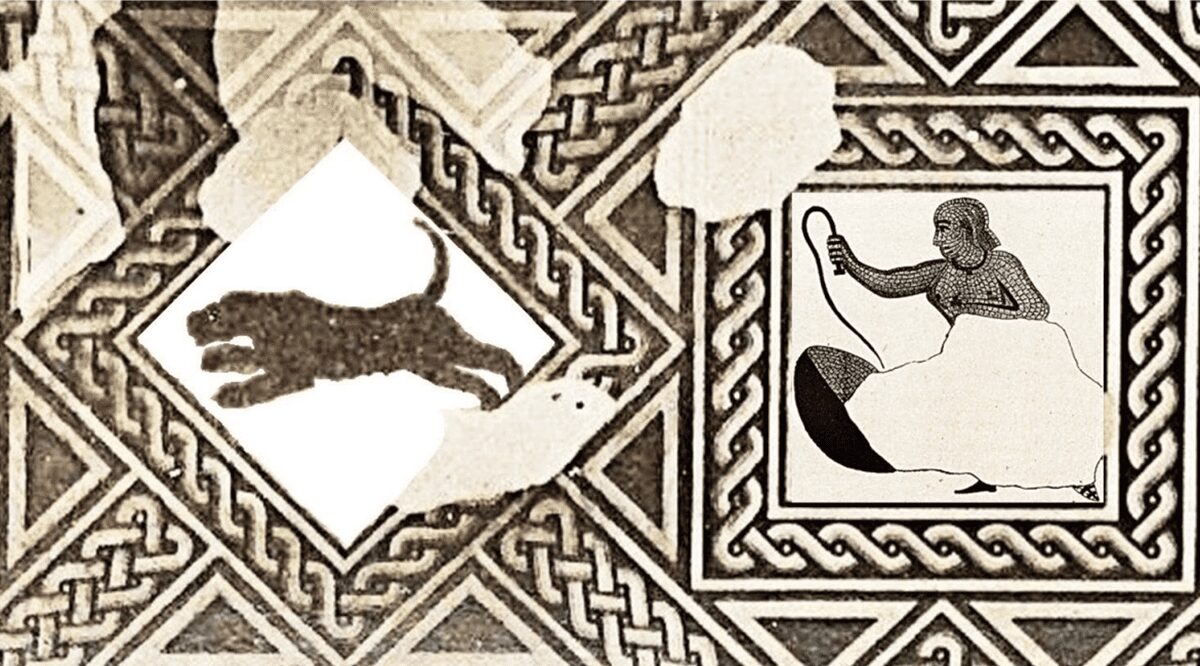
Fragment of a 3rd-century Roman mosaic with two medallions depicting a leopard and a woman. Source: The International Journal of the History of Sport, 2026.
For over a hundred years, a drawing lay in a forgotten book from 1862, while the original mosaic was destroyed by artillery fire during World War I. Now a sports historian from the University of California, Berkeley claims that one of the medallions on this mosaic depicts a woman fighting a leopard. If he is right, this is the first visual evidence in history of the existence of a venatrix — a professional female hunter of wild beasts in the Roman arena.
The Ancient Roman Mosaic in Reims: The Story of Its Discovery and Loss
In 1860, French archaeologist Jean Charles Loriquet discovered a magnificent 3rd-century CE mosaic in Reims. It likely decorated the floor of a banquet hall belonging to a wealthy Roman patron. The mosaic featured 35 medallions — each with a vivid scene: gladiators, wild animals, hunters. Loriquet carefully sketched the find and published the drawings in a book two years later.
In 1917, during World War I, artillery bombardment completely destroyed the mosaic. Physically, only one fragment survived — a medallion depicting a male gladiator. Everything else is known only from Loriquet’s drawings.
It was these forgotten drawings that became the starting point for a new discovery. Loriquet’s book had been gathering dust on shelves for over a century until it caught the attention of Alfonso Mañas — a sports historian from the University of California, Berkeley.
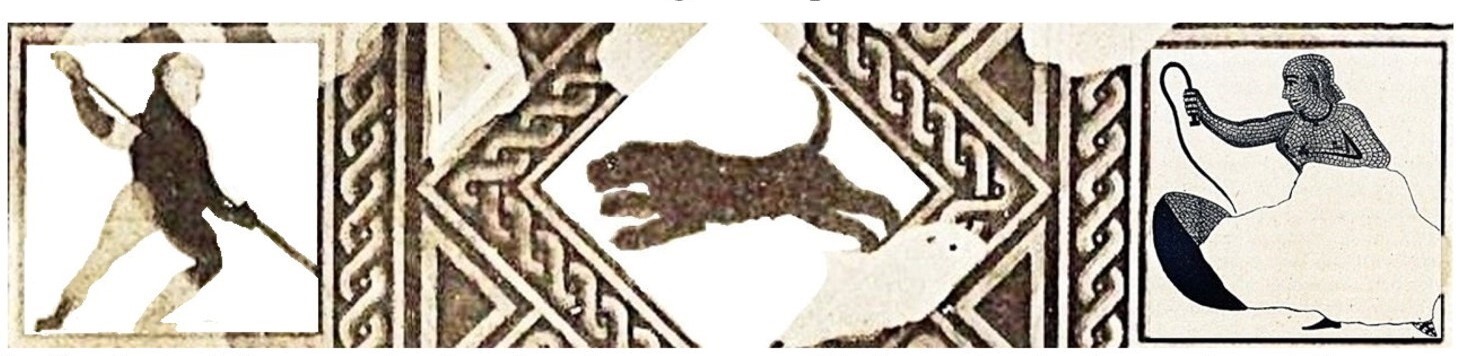
Fragment of the mosaic depicting a hunter with a pole, a leopard, and a woman. Image source: tandfonline.com
Were There Female Fighters in Ancient Rome: What the Mosaic Analysis Revealed
One of the medallions depicts a person standing face-to-face with a leaping leopard. Previous researchers had always assumed the figure was male. Some called it an “agitator” — a person with a whip who supposedly enraged beasts before a fight. Others saw a paegniarius — an arena clown who entertained the crowd with comic scuffles during breaks between bouts.
Historian Alfonso Mañas in his study systematically rejected both interpretations. A paegniarius wore a heavy protective arm guard and, besides a whip, carried a stick — the figure on the mosaic has nothing of the sort. And the role of “agitator,” according to the researcher, is not confirmed by any reliable sources about Roman arenas.
But the key detail is not the occupation — it’s the sex. Mañas noted that the artist deliberately depicted the figure bare from the waist up, with a clearly rendered breast. This sharply contrasts with all other medallions on the mosaic, where male fighters are depicted with flat chests. According to the researcher, the mosaicist specifically laid out the breast shape from individual pieces of smalt — this is not an accidental stroke but a deliberate choice.
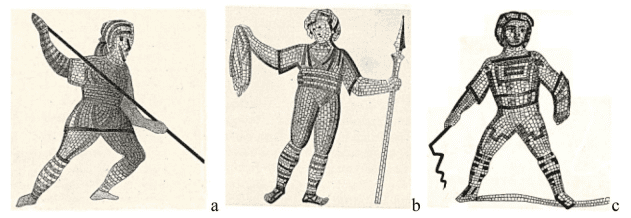
Flat chests of other figures on the mosaic (clearly male). (a) Loriquet, 1862: plate IX, No. 13. (b) Loriquet, 1862: plate XII, No. 21. (c) Loriquet, 1862: plate XVI, No. 33. Image source: tandfonline.com
Why Women in the Ancient Roman Arena Fought Bare-Chested
To a modern reader, this sounds strange, but there was a practical reason for the nudity. Roman arenas were enormous — spectators in the distant rows simply couldn’t make out the facial features of the fighters. The only reliable way to show the crowd that a woman was in the arena was to bare her chest. Moreover, as Mañas notes, this had an overtly erotic undertone that was part of the spectacle.
Female gladiators also fought without helmets — again, so the audience could immediately see their sex. For Roman society, where women wore heavy stolas (long dresses from neck to feet), the appearance of a half-naked woman in the arena was a deliberate violation of norms. This underscored the low social status of the performers: arena artists belonged to the category of infames — people with a reputation lower than that of slaves.
Female Hunters in the Arena: Who Were They Really
In Ancient Rome, there existed the practice of damnatio ad bestias — an execution in which the condemned were thrown to wild beasts. Women were stripped for additional humiliation. But Alfonso Mañas is convinced: the woman on the mosaic is not a condemned prisoner.
Why? The condemned were never given weapons. They were tied to posts or simply pushed onto the arena sand empty-handed. But the figure on the medallion stands confidently: in her right hand — a whip, in her left — apparently the handle of a dagger. This is an armed professional.
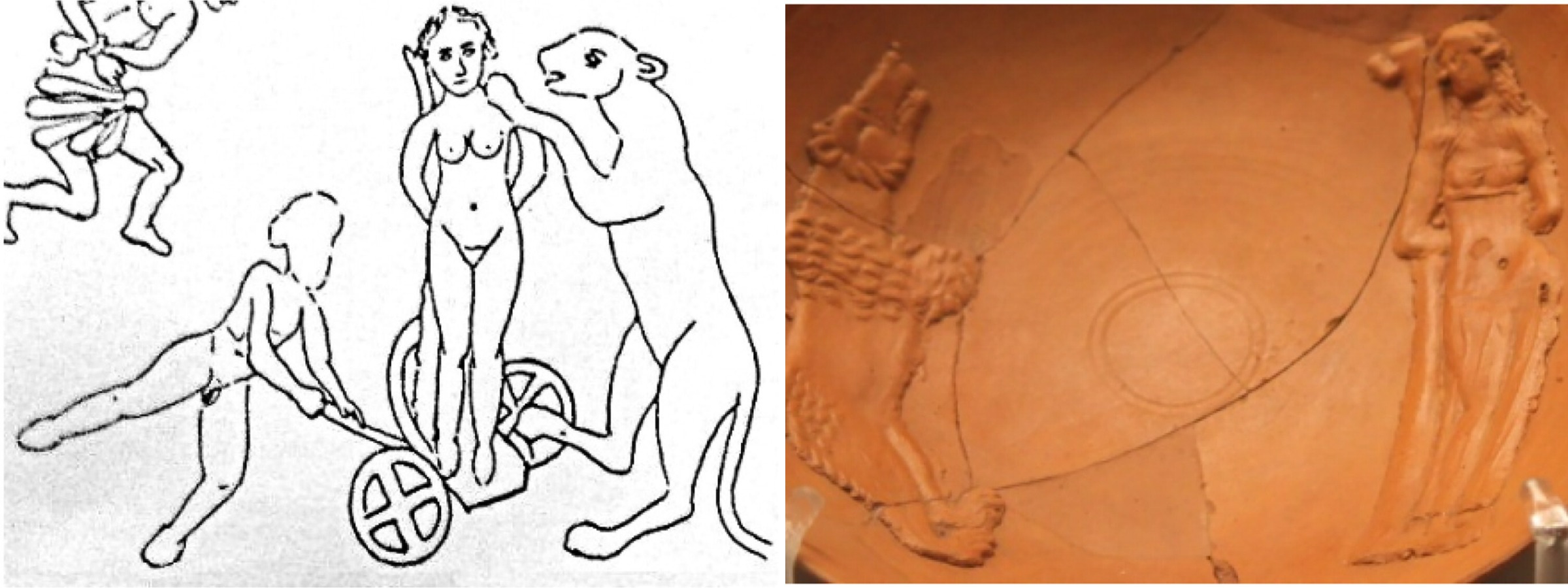
1. A woman thrown to the beasts. Terra sigillata found in Gaul, approximately 2nd century. 2. A woman thrown to a bear, dish found in Rome, 4th century. Image source: tandfonline.com
According to the researcher, the woman performed the role of a succursor — an arena assistant who directed beasts toward other hunters and managed the “choreography” of the hunt for spectators. Such specialists are known from inscriptions found in Pompeii. It turns out that what we see is not a victim of circumstance, but a professional venatrix — a female beast hunter, the Latin equivalent of the male venator.
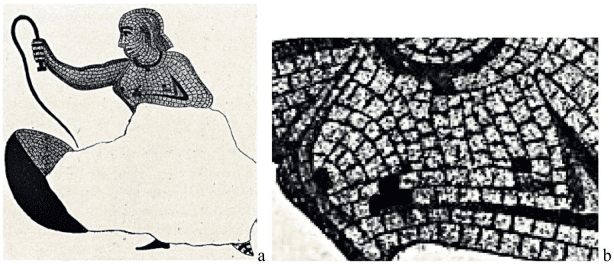
(a) Drawing from Loriquet’s 1862 book: plate IX, No. 11. (b) Detailed image of the breast. Image source: zmescience.com
When Female Gladiators Were Banned and Why Huntresses Remained
Female gladiators appeared in the Roman arena between 40 BCE and 19 CE. And these were serious fighters, not a warm-up act before the main show. Historian Philip Matyszak of Cambridge University notes that some women’s bouts took place at midday — the time slot reserved for the main gladiatorial duels, not for comedies or executions.
Nevertheless, women in the arena remained an extremely controversial phenomenon. In 200 CE, Emperor Septimius Severus officially banned female gladiatorial combat. But the ban did not extend to hunts with wild beasts. Romans revered Diana — the goddess of the hunt. Since the divine patroness hunted beasts, society viewed venatrices far more leniently than female gladiators.
The mosaic from Reims dates to the 3rd century — that is, the period after the ban. This means that women continued to participate in arena beast hunts even after female gladiatorial combat was outlawed.