Twirling a pen, spinning a fidget spinner, turning a ring or running prayer beads through the fingers can look like pointless restlessness. In fact, these small movements serve several purposes. They may help keep alertness and attention from sagging. They give the fingers a simple, predictable sensory signal. Under stress, they may also create a small pocket of control. The benefit is not guaranteed, though. Evidence that fidget toys improve focus is mixed, and a flashy gadget can become a distraction of its own.
What you need to know
- Research links small movements with maintaining alertness and attention. People with ADHD often feel a stronger urge to move precisely when they need to concentrate.
- In a study of adults with ADHD, a stress ball gave no noticeable overall advantage over working without one. This suggests that natural movement, rather than a specific toy, may be what helps.
- In an experiment in which researchers induced anxiety, participants’ hand movements became more repetitive and more rigidly ordered.
- Results for fidget toys are mixed. In some studies they helped some participants stay on task longer, while in others the spinner itself became a distraction.
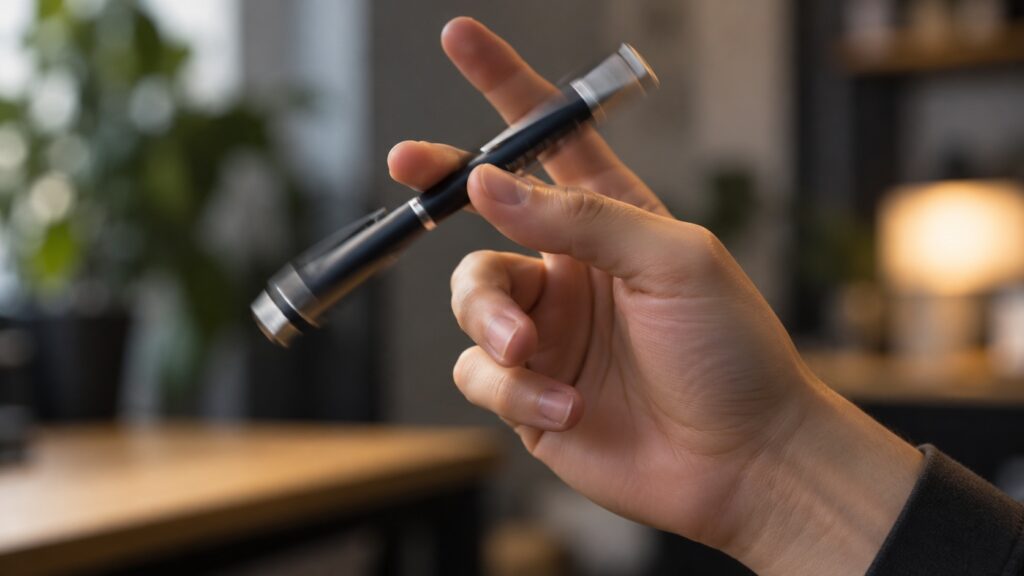
A hand twirling a ballpoint pen
Small movements keep attention from drifting
The main reason is that the brain needs a certain level of alertness. When too little is happening around a person, attention starts to dip. Sitting perfectly still while following a single stream of information for a long time is not always comfortable for the brain.
A long meeting or a drawn-out phone call is a good example. You cannot fully switch off, yet the brain is not getting enough stimulation. In moments like these, a hand reaches for a pen or a foot starts to bounce. In effect, the person adds a small extra stimulus.
Research links small movements with maintaining alertness and attention. This is especially visible in people with attention deficit hyperactivity disorder (ADHD), who often want to move more precisely when they need to focus. There is an important caveat, however. In a study of adults with ADHD, a stress ball gave no noticeable overall advantage compared with working without one. It appears that any benefit may come from natural movement rather than from a particular trendy toy.
The fingers receive a simple, clear signal
When we fiddle with something, the skin constantly takes in information: the object’s weight, shape, texture, resistance and vibration. These sensations repeat again and again. For the brain, this kind of signal is convenient because it is simple, safe and predictable.
That is why objects that feel distinct under the fingers are especially pleasant to hold:
- smooth pebbles;
- prayer beads with identical beads;
- metal rings;
- mechanical buttons and switches;
- pens with a crisp click.
Many fidget toys are designed so that every action has a clear ending. You press and hear a click, or you twist and a part snaps into place. The brain receives a stream of tiny “do it and feel the result immediately” events.
Anxiety makes movements more repetitive
When people are nervous, their movements tend to become more repetitive on their own. In one experiment, scientists induced anxiety in participants and then studied their hand movements. Under stress, the actions became more uniform and followed a stricter order.
The study’s authors suggested that this may be how the brain creates a small island of predictability when a situation is hard to control. This is the researchers’ hypothesis, not a definitively proven mechanism. Still, it fits some familiar behaviour well.
Take prayer beads. The problem a person is worried about cannot be solved right away. Moving the beads, however, is a small action that stays fully under their control: one bead, then the next, then another. This may be why similar habits appear in very different cultures, from prayer beads to a coin or pebble rolled around in a pocket.
Spinners impress with effect, prayer beads with rhythm
The fidget spinner became an almost ideal toy because it combines several pleasing things at once. A light flick of the finger produces motion, vibration, sound and a visual effect. The result also lasts much longer than the action itself: one brief touch sets off several seconds of spinning. The brain likes this ratio of effort to payoff.
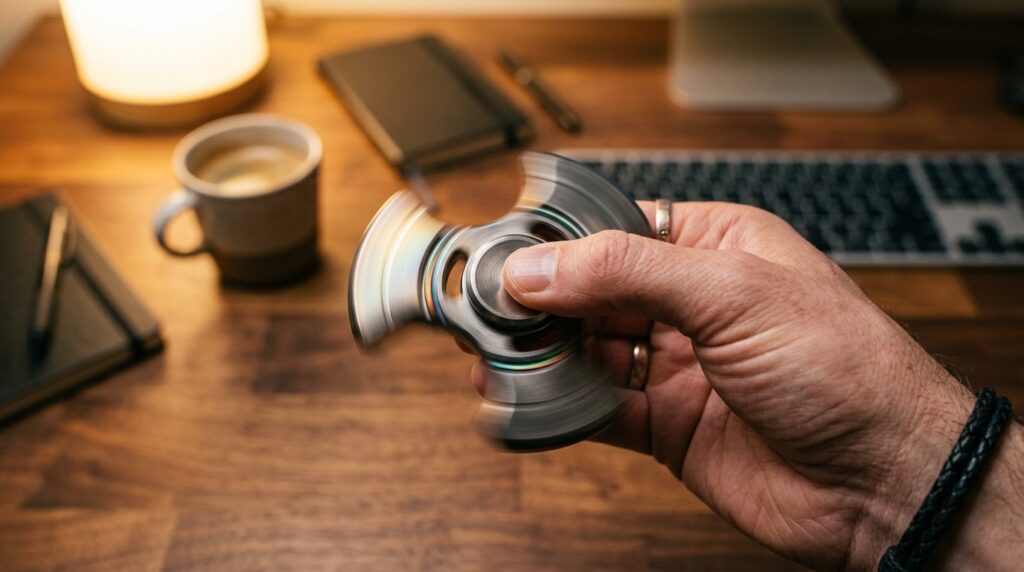
A hand spinning a metal fidget spinner above a desk
Good buttons and switches work the same way: a small movement followed by a distinct response. This is why some people open and close a lid dozens of times in a row, or scroll a mouse wheel for no apparent reason. More precisely, there is a reason: the sensation of the action itself.
Prayer beads offer less spectacle but a stronger rhythm and more tactile feedback. Each bead gives an almost identical signal, and gradually a steady cycle of movement takes shape. It resembles walking, where you do not have to think about each step. That is why beads combine easily with thinking, conversation, prayer or waiting. When an object has been in use for many years, habit adds to the sensation. Picking up the familiar item triggers a familiar way of calming down.

An elderly man on a bench running wooden prayer beads through his fingers in an autumn park
Does a fidget spinner help you concentrate?
Not necessarily. Marketing for fidget toys has clearly run ahead of the science. In some studies, these toys helped some participants stay on task longer. In others, the spinner itself became a distraction.
These findings do not actually contradict each other. A movement that is almost unnoticeable and automatic, such as turning a ring on a finger, does not interfere with the main task. A bright, noisy toy is different. If you want to watch it and invent tricks with it, it turns into a second form of entertainment. For that reason, an ordinary pen or a string of beads is sometimes better suited to work than a spinner.