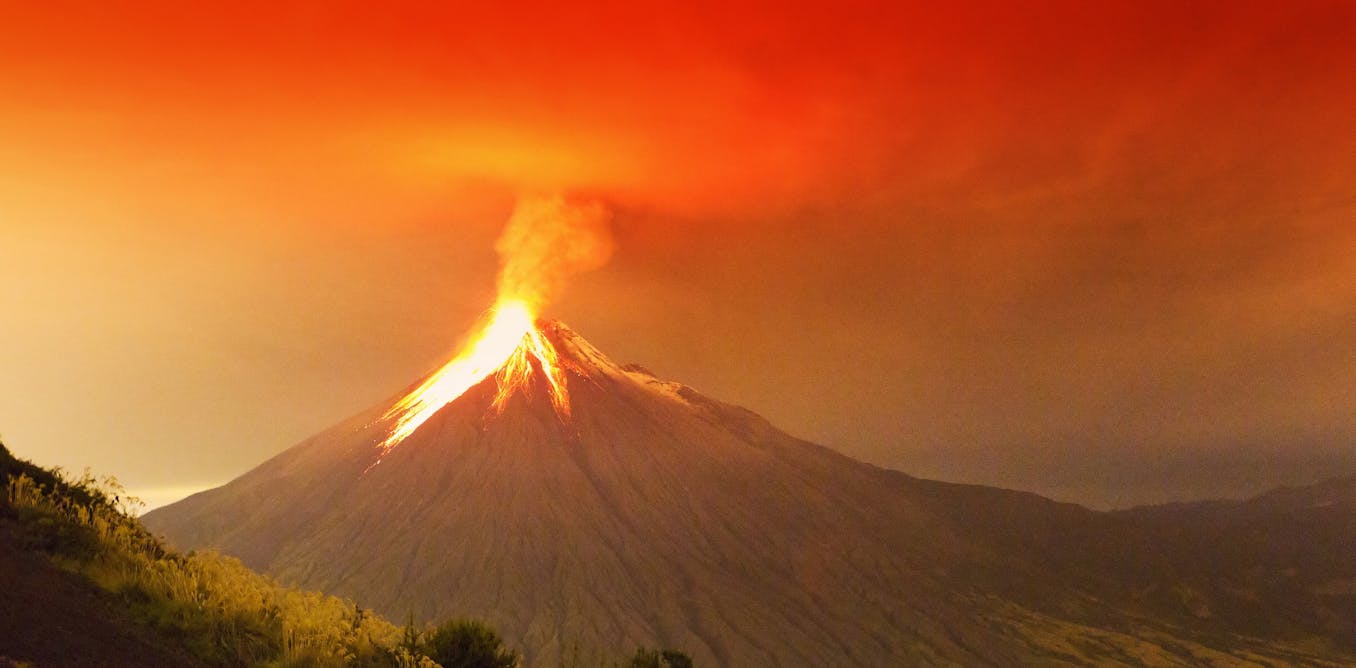
The study of volcanoes is called volcanology
Deep beneath the Earth’s surface, rocks are constantly melting, yet volcanoes don’t erupt continuously. Most of them remain silent for years, decades, and sometimes even centuries before suddenly awakening. To understand why this happens, we need to look at how a volcano’s “engine” works and what determines the moment of eruption.
Where Magma Comes From and Why It Rises
According to The Conversation, it all begins deep underground — from several dozen to hundreds of kilometers down — where temperatures are so high that some rocks slowly melt. This is how magma forms: a thick, scorching mass that is lighter than the surrounding solid rocks and therefore rises upward, accumulating in so-called magma chambers.
A magma chamber is a large reservoir of molten rock beneath the Earth’s surface. The magma inside it is less dense than the surrounding rocks, and buoyant force pushes it upward. If the magma finds a path to the surface, an eruption occurs.
But the path upward isn’t always open. Magma rises through cracks in the Earth’s crust because it is lighter than the surrounding rocks. When it cannot find a way to the surface, it accumulates in the chamber. These chambers gradually fill, sometimes through several successive batches of new magma.
Why Volcanoes Erupt Periodically Rather Than Continuously
The key word is pressure. A volcano doesn’t erupt simply because magma “exists” — it erupts when the pressure inside the chamber becomes great enough to break through the rocks above it and force an exit.
It is generally accepted that an eruption is triggered by excess pressure in the magma chamber: it builds up due to magma crystallization or the arrival of new batches of melt from below. When the pressure reaches a critical point, a channel to the surface opens and the eruption begins. Once the magma partially flows out, the pressure drops and the eruption gradually subsides.
Imagine a bottle of carbonated water. As long as the cap is on, the gas is dissolved in the liquid and the pressure is stable. But if you shake the bottle and suddenly open it, the pressure bursts out along with a jet of foam.
A volcanic eruption works on a similar principle. It occurs due to magma degassing — a process in which dissolved gases escape from the melt. If you open a bottle of soda, there’s a pop and foam appears — the gas escapes. And if you shake or heat the bottle beforehand, the jet will be powerful and impossible to contain.

Soda — a simple model of a volcanic eruption: pressure builds until it finds an outlet
After an eruption, the magma chamber “discharges.” The volcano’s vent is sealed by solidified lava, but heat remains in the chamber — hot gases (fumaroles) or jets of boiling water (geysers) can escape through cracks to the surface. The volcano remains active: at any moment, enough magma can accumulate in the chamber for a new eruption. This is exactly why volcanoes “stay silent” between eruptions — they need time for pressure to build back up to a critical level.
What Determines How Often a Volcano Erupts
The frequency of eruptions varies greatly among different volcanoes. Klyuchevskaya Sopka in Kamchatka, for example, erupts roughly once every six years, while major eruptions with serious consequences occur about once every quarter century. Vesuvius has erupted multiple times per century throughout its history, periodically devastating nearby cities.
There are also opposite examples — volcanoes that remained silent for centuries and then suddenly awakened. There are known cases of volcanoes erupting after 300, 500, and even 800 years of silence. For instance, Krasheninnikov volcano in Kamchatka awoke after more than 500 years of dormancy, meaning it had not erupted once during the entire period of recorded observations.
In the classical model, the magmatic reservoir feeds eruptions with a certain regularity, through crystallization or magma supply from a deeper source. The volume of the chamber directly affects the frequency and power of eruptions.
When a volcano forms and periodically erupts, it is considered active. It can remain so for tens of thousands of years. Its “lifespan” depends on the size of the magma source and geological activity in the region. If there are no eruptions but the magma source still exists, the volcano is considered dormant. When no magma remains at all, it is considered extinct.
Volcanoes That Erupt Almost Continuously
Yes, and this is one of the most fascinating things in volcanology. It is believed that about 46 volcanoes on Earth are in a “continuous eruption status” — among them Ulawun in Papua New Guinea, Shishaldin in the USA, and Klyuchevskoy in Russia.
The most famous of the “sleepless” volcanoes is Stromboli in Italy. Its current eruption began in 1934 and continues to this day (as of March 2026). The volcano is constantly active with small eruptions visible at night from great distances, earning the island the nickname “Lighthouse of the Mediterranean.”
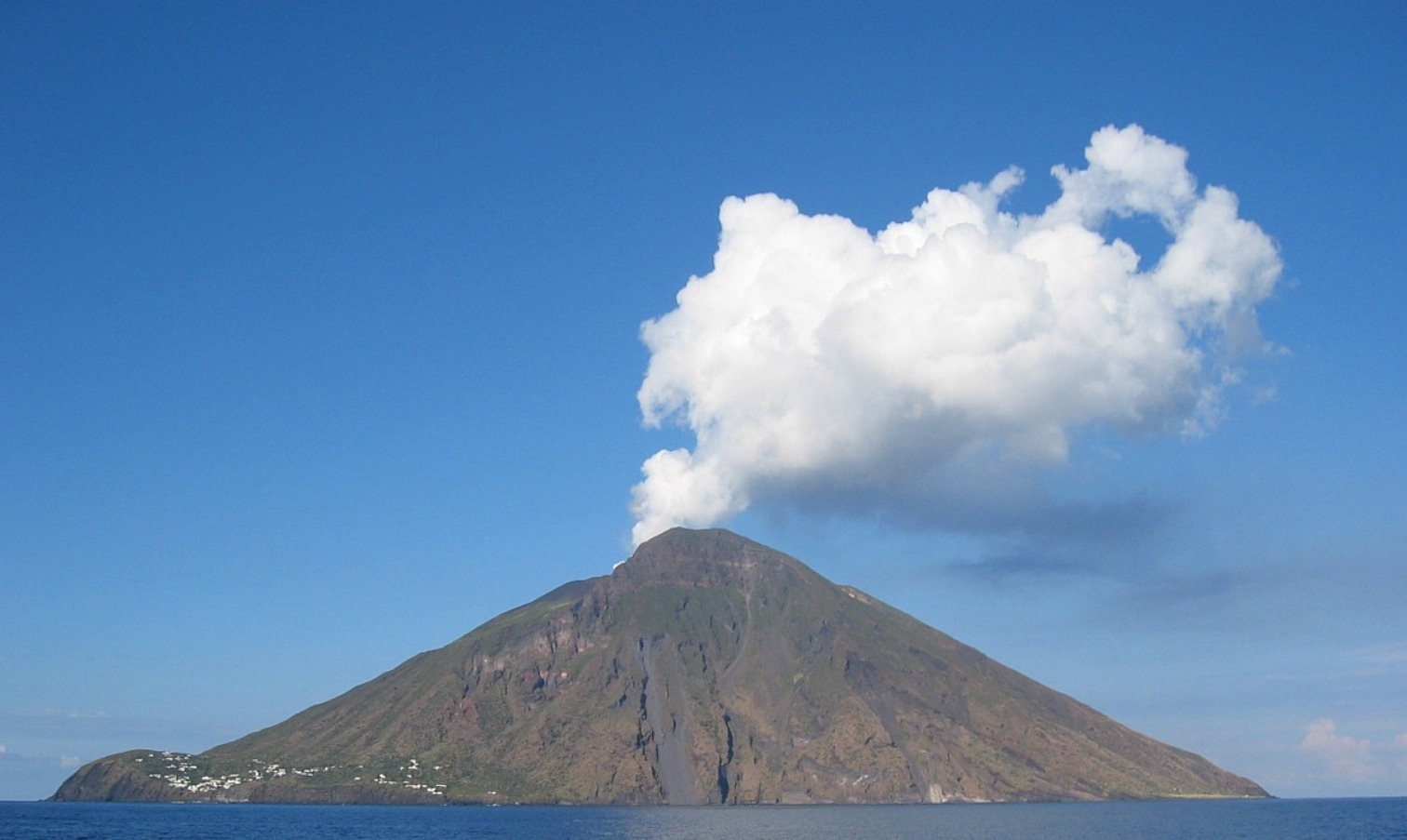
Stromboli: a volcano that hasn’t gone silent for about 90 years. Image source: wikimedia.org
Stromboli is a basaltic volcano, one of the most common types on Earth. Such volcanoes usually erupt effusively: gas escapes easily from the magma, which flows out calmly. But Stromboli is different — it gave its name to a special eruption style in which gas bubbles burst at shallow depth in the magma and eject it in a fountain. Its magma is fluid enough for gases to escape regularly, but not so freely that they simply seep out. The result is rhythmic mini-explosions every few minutes.
But such volcanoes are in the minority. Most behave differently: they build up pressure, erupt, and then go quiet again for years.
How Explosive Eruptions Differ From Calm Ones
Not all eruptions are the same. The main factor that determines their character is the viscosity of the magma and its gas content.
If the magma is fluid and runny, gases escape easily. Such magma flows calmly out of the volcano — like in Hawaii. If the magma is thick and viscous, gases cannot escape. Pressure builds until the gases burst out in an explosion.
For a long time, it was believed that eruption style depended solely on the amount of gas and pressure, like a champagne bottle. However, this explanation turned out to be incomplete: some volcanoes whose magma is rich in gases “should” explode, but instead the lava flows out calmly. Experiments have shown that friction of the magma against the walls of the vent alone is enough to trigger bubble formation — even without a pressure drop.
It is precisely because of this difference that some volcanoes erupt quietly and frequently, while others erupt rarely but catastrophically. Viscous magmas more often create a “plug” in the vent, and the volcano needs more time to build up critical pressure again. Fluid magmas, on the other hand, allow gases to escape regularly — which is why such volcanoes can be active almost continuously.
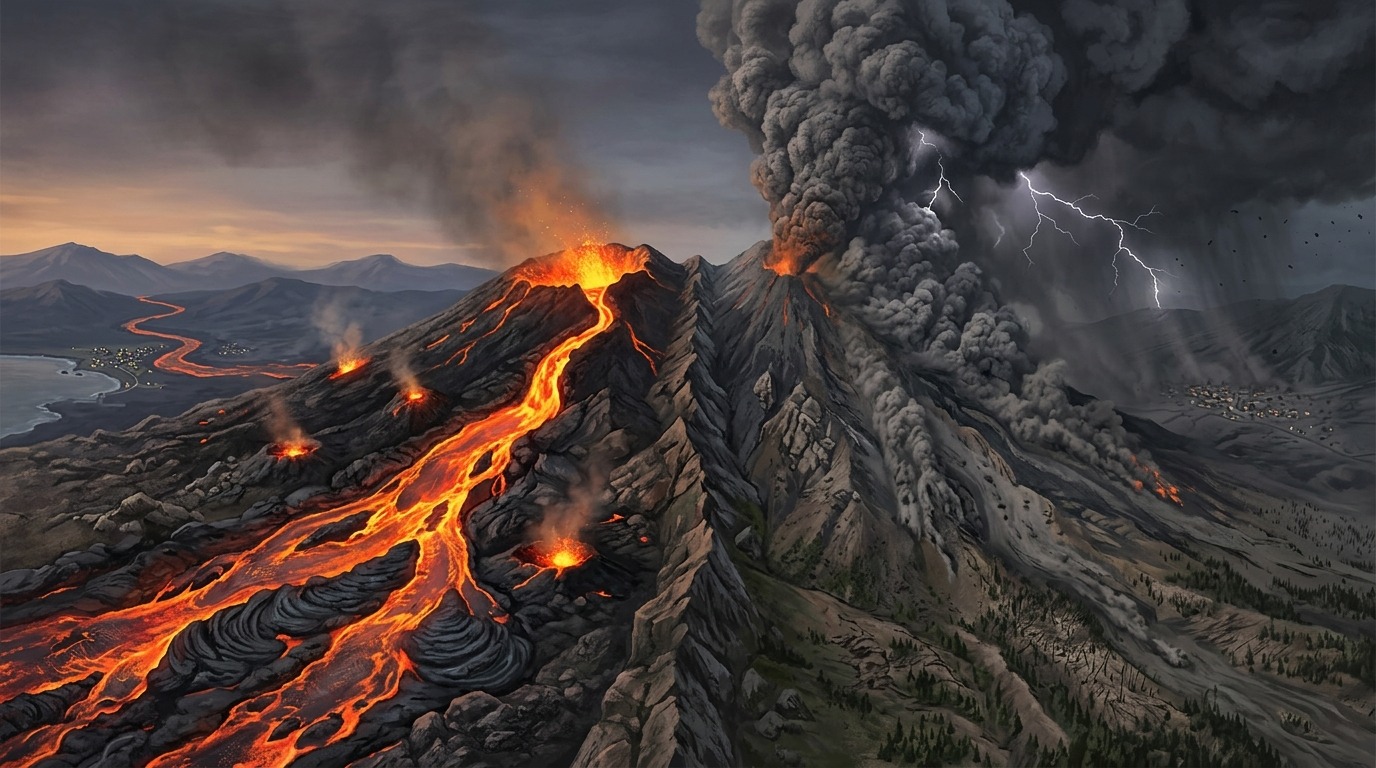
Two types of eruptions: calm lava flow and a powerful explosion with an ash cloud