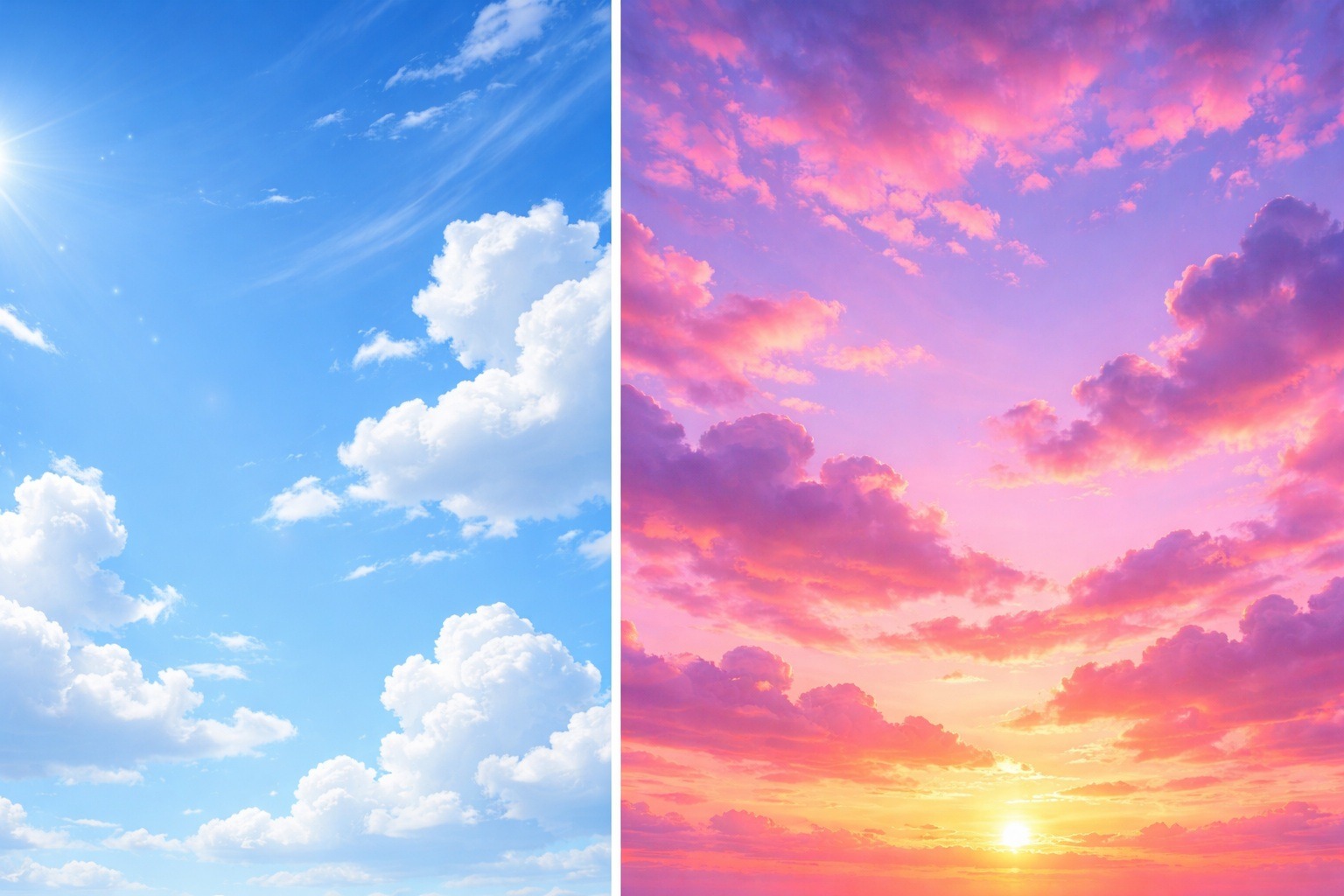
The blue sky isn’t paint or an ocean reflection — it’s trillions of molecules scattering blue light in every direction
Each of us has asked this question at least once as a child: why is the sky blue? The answer seems simple, but behind it lies the amazing physics of light scattering, which also explains fiery sunsets, the grayness of overcast days, and even why smog makes the sky whitish. Let’s take a deep dive into this question.
What Color Is Sunlight
Sunlight appears white to us, but that’s an illusion. If you pass it through a prism, it splits into a full spectrum of colors. Each one is a light wave with a specific wavelength. Short waves are blue and violet, long waves are red and orange. Green and yellow sit in between.
While this entire “set” travels from the Sun through the void of space, nothing interesting happens — the waves simply travel together. But as soon as they reach Earth’s atmosphere, the real show begins. The thing is, the air is full of tiny particles: gas molecules (mainly oxygen and nitrogen), water droplets, dust particles, and ice crystals. And it’s precisely the collisions with these particles that determine what color we see when we look up at the sky.
The size of visible light waves, by the way, is staggering: less than one millionth of a meter. That’s so small that the waves are able to “notice” even individual gas molecules and interact with them.
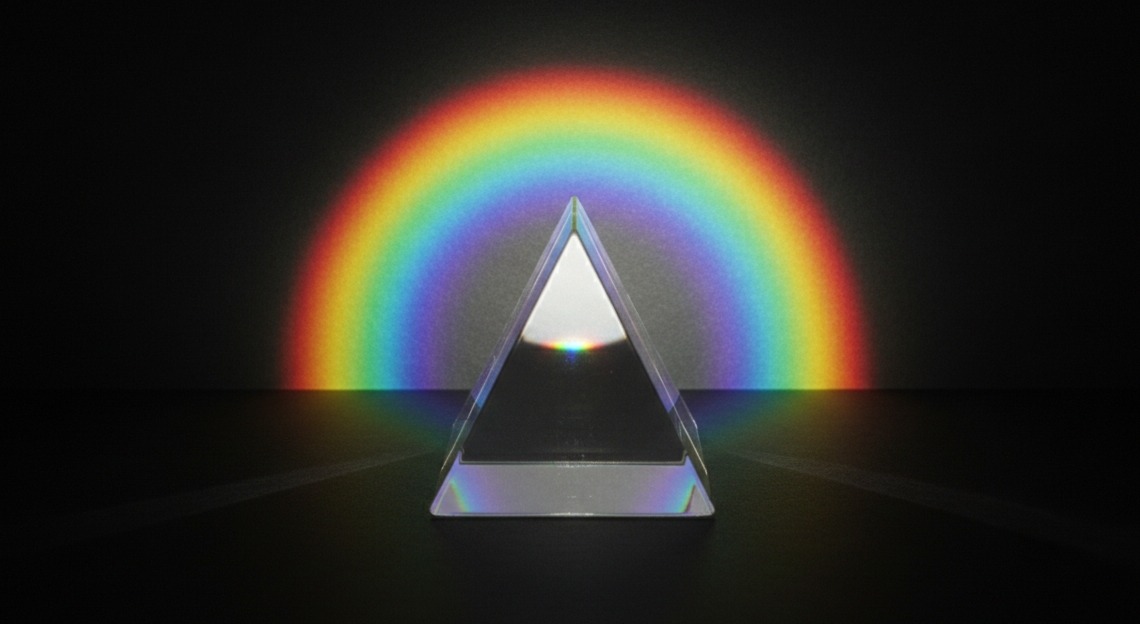
A prism clearly shows: white light is simply all the colors of the rainbow traveling together
Why the Sky Is Blue and Not Violet
When a light wave collides with a particle, it bounces off in a random direction — physicists say the light is scattered. But here’s the key point: the strength of scattering depends heavily on the ratio of wavelength to particle size. Small gas molecules scatter short-wavelength blue light much more strongly than long-wavelength red light.
This is exactly why, when you look at the sky on a clear afternoon, scattered blue light reaches your eyes from every direction. It literally “splashes” off air molecules in all directions, creating the effect of a blue dome overhead.
You might think that violet light has an even shorter wavelength and should scatter even more strongly. But our eyes are much more sensitive to blue than to violet, and some of the violet light is absorbed by the upper layers of the atmosphere. The result — the sky is specifically blue, not violet.
Why Sunsets and Sunrises Are Red
According to Optics 4 Kids, at sunset or sunrise the Sun hangs low above the horizon, and its rays have to travel through the atmosphere over a much longer path than at noon. During this journey, blue light has time to scatter almost completely — it “flies off” in all directions long before the rays reach your eyes.
Red and orange waves, on the other hand, scatter the least, so they successfully reach the observer. Simply put, a sunset is what remains of white light when you “subtract” the blue component. This is why the sky on the horizon blazes with shades ranging from golden to deep red.
Fine particles of dust and pollutants in the air can amplify this effect and make sunsets even more vivid. But the main reason for red sunsets is scattering by gas molecules, not dust. Dust is just a bonus to the spectacle.
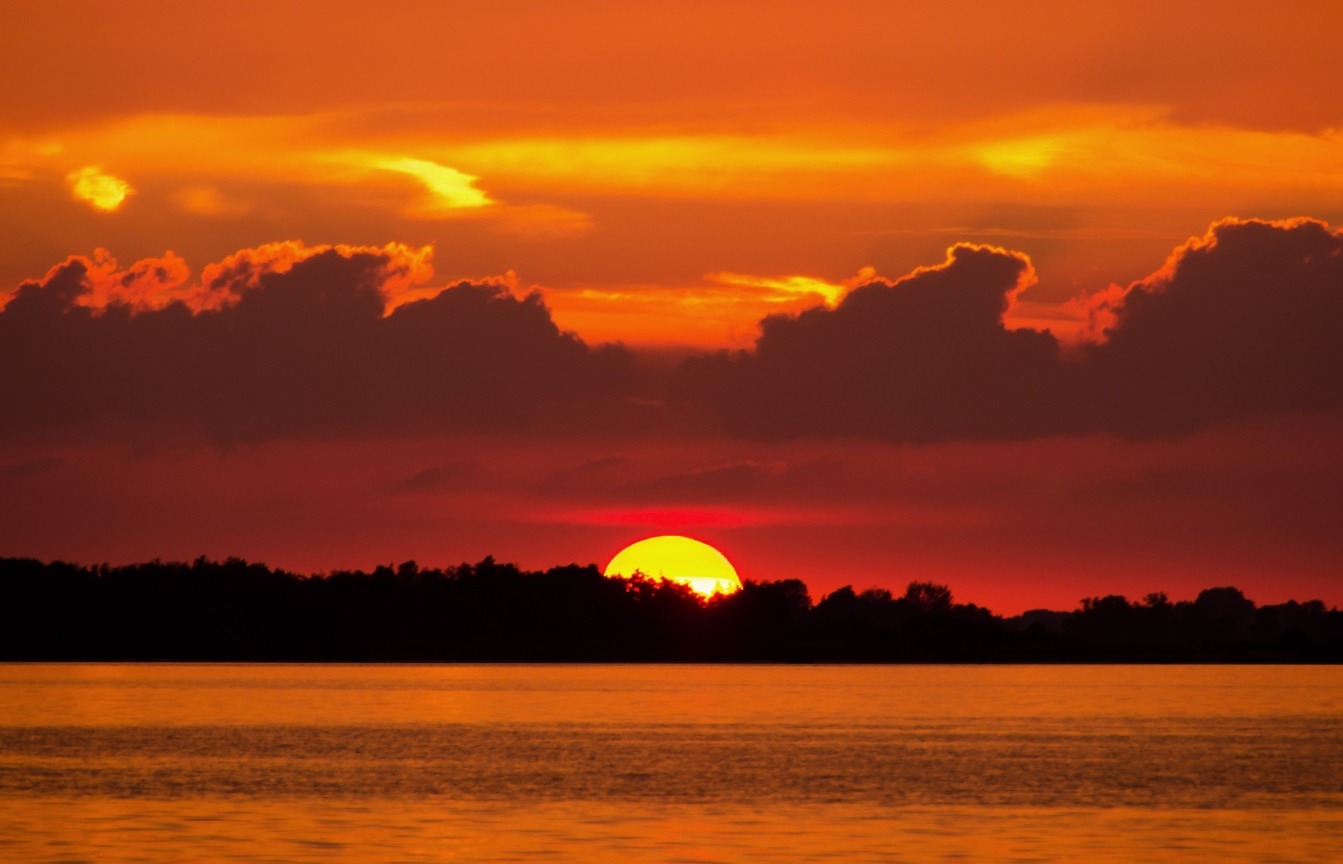
A sunset is the result of the blue portion disappearing from white light
Why Clouds Are White and Polluted Skies Are Gray
If small molecules primarily scatter blue light, things work differently with larger particles. Water droplets in clouds range in size from 10 to 100 millionths of a meter — that’s many times larger than the wavelength of light. Such droplets scatter all colors roughly equally, without preference. That’s why clouds appear white or gray — they simply “pass along” the color of the light falling on them.
This also explains why clouds at sunset turn pink, orange, and scarlet. They act like a screen onto which nature projects its colors. This is precisely why the most beautiful sunsets are those with clouds: without them, the colors simply have nothing to “reflect” off of.
Large pollution and dust particles behave similarly to cloud droplets — they scatter light of all colors almost equally. The result isn’t very pleasant: the sky over a polluted city becomes not blue but grayish-white. So if the sky over your city doesn’t delight you with its blueness, it might not be clouds — it could be the air quality.