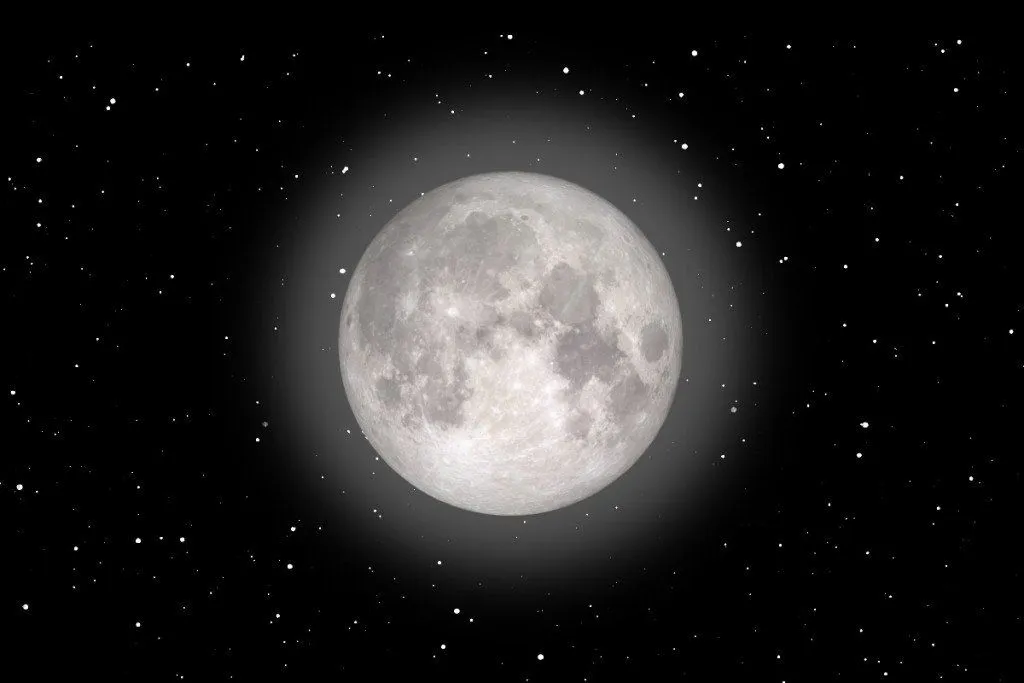
The Moon’s surface: above it only a barely noticeable exosphere, and beyond it — open space
If you ask whether the Moon has an atmosphere, most people would give a confident “no.” In reality, a thin layer of gases above the lunar surface does exist — it’s just so rarefied that on Earth we would call it a deep vacuum. To understand why our planet is surrounded by a dense blanket of air while the Moon has only a ghostly gas trail, we need to look at two things: gravity and the magnetic field.
Does the Moon Have an Atmosphere
Technically — yes, but with enormous caveats. What surrounds the Moon, scientists call an exosphere — a layer of atoms and molecules so thin that they virtually never collide with each other. According to Science ABC, the pressure at the lunar surface is approximately 3×10⁻¹⁵ atmospheres — a trillion times less than on Earth. The entire mass of this gas envelope doesn’t even reach 10 tons — roughly the weight of a single city bus.
For comparison, at sea level one cubic centimeter of Earth’s air contains about 10¹⁹ molecules. At the Moon’s surface in the same volume — fewer than a million. This is comparable to the density of Earth’s atmosphere at the altitude of the ISS orbit, essentially at the edge of space. Laboratory vacuum created on Earth for scientific purposes contains more particles than the lunar exosphere.
What Is the Moon’s Atmosphere Made Of
Although the Moon has extremely few gases, they have been detected and their composition determined. The Moon’s exosphere consists primarily of argon, helium, and neon, and also contains trace amounts of sodium, potassium, rubidium, and several other elements. Detectors left on the surface by Apollo program astronauts recorded argon-40, helium-4, oxygen, methane, nitrogen, carbon dioxide, and carbon monoxide. Earth-based spectrometers added sodium and potassium to the list, while the Lunar Prospector orbiter detected radioactive isotopes of radon and polonium.
A curious detail: sodium and potassium, which are present in the lunar exosphere, are not found in the atmospheres of Earth, Mars, or Venus — this makes the composition of the Moon’s gas envelope truly unusual.
How the Moon’s Exosphere Formed
If the Moon’s gases constantly escape into space, where do they come from? The main source is micrometeorite impacts. Tiny cosmic dust particles, ranging from molecular sizes to a few millimeters, continuously bombard the surface. Upon collision, they vaporize part of the lunar soil, launching atoms into the space above the surface. This is called impact vaporization.
The second process is ion sputtering: charged particles of the solar wind strike atoms in the lunar soil and “flick” them upward. A 2024 study finally helped determine which of the two mechanisms is more important. Scientists analyzed the isotopic composition of potassium and rubidium in soil samples brought back by Apollo missions and concluded that about 70% of atoms in the exosphere appear thanks to meteorite impacts, and only 30% are due to the solar wind.
There is also a third, less prominent source — outgassing from the Moon’s interior. Radioactive decay of elements inside the Moon releases gases that reach the surface. For example, argon-40 comes from the interior through the decay of potassium-40.
Why Earth Retains Its Atmosphere but the Moon Does Not
Two key factors are at work here, and both are not in the Moon’s favor.
The first is gravity. The Moon’s mass is only 1.2% of Earth’s mass, and the gravitational pull on its surface is about one-sixth of Earth’s. For a gas molecule to permanently leave a celestial body, it needs to accelerate to the so-called escape velocity. For Earth, this is about 11.2 km/s; for the Moon — only 2.4 km/s. Many molecules, heated by sunlight or knocked out by the solar wind, easily reach this speed and simply fly off into space. On Earth, the same molecule would be “caught” back by gravity.
The second factor is the magnetic field. Earth possesses a powerful magnetosphere: our planet’s liquid iron core works like a giant dynamo, generating a magnetic field that extends tens of thousands of kilometers into space. This invisible shield deflects charged particles of the solar wind, preventing them from “blowing away” the atmosphere from the planet. The Moon has virtually no magnetic field — its surface is exposed to the direct impact of solar plasma. Solar wind protons slam directly into the lunar soil, knocking atoms outward, and there is nothing to hold them back.
A telling example is Mars. This planet lost its magnetic field billions of years ago, and the solar wind gradually “blew away” most of its atmosphere. Venus, on the other hand, which also lacks a magnetic field, retains an extremely dense atmosphere through gravity alone — it is nearly as massive as Earth. This confirms that it is precisely the combination of mass and a magnetic shield that determines the fate of a gas envelope.
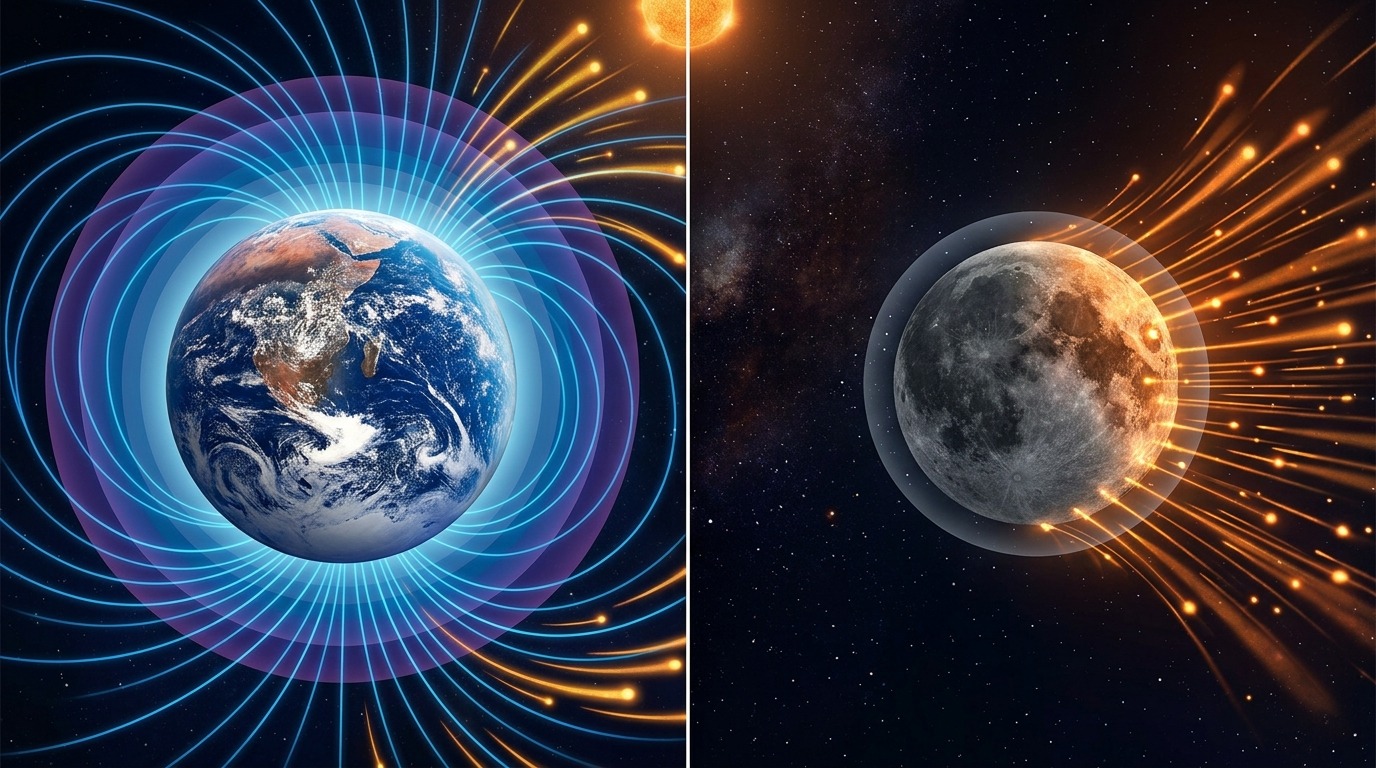
Earth is protected by both gravity and a magnetic shield. The Moon lacks both advantages
Did the Moon Have a Dense Atmosphere in the Past
Surprisingly, scientists believe that about 3–4 billion years ago, the Moon possessed a much denser atmosphere. In 2017, NASA specialists announced that, based on studies of lunar magma samples delivered by Apollo missions, the Moon had a relatively thick atmosphere for approximately 70 million years. This atmosphere, formed by gases from powerful volcanic eruptions, was twice as dense as the current Martian atmosphere.
But the lunar volcanoes gradually went quiet. Fresh supplies of gases stopped arriving in sufficient quantities, and those that remained gradually dissipated into space. Without strong gravity and a magnetic field, retaining this envelope was impossible.
How the Atmosphere on the Moon Affects Lunar Missions
The absence of a dense atmosphere is not just a scientific fact but a practical problem for lunar exploration. Without a gas envelope, the surface is unprotected from harsh cosmic radiation, which is deadly for living organisms. The temperature on the sunlit side rises to +127 degrees, while on the shadow side it drops to −173 degrees. Micrometeorites, which burn up in Earth’s atmosphere before reaching the surface, strike the lunar soil unimpeded on the Moon.
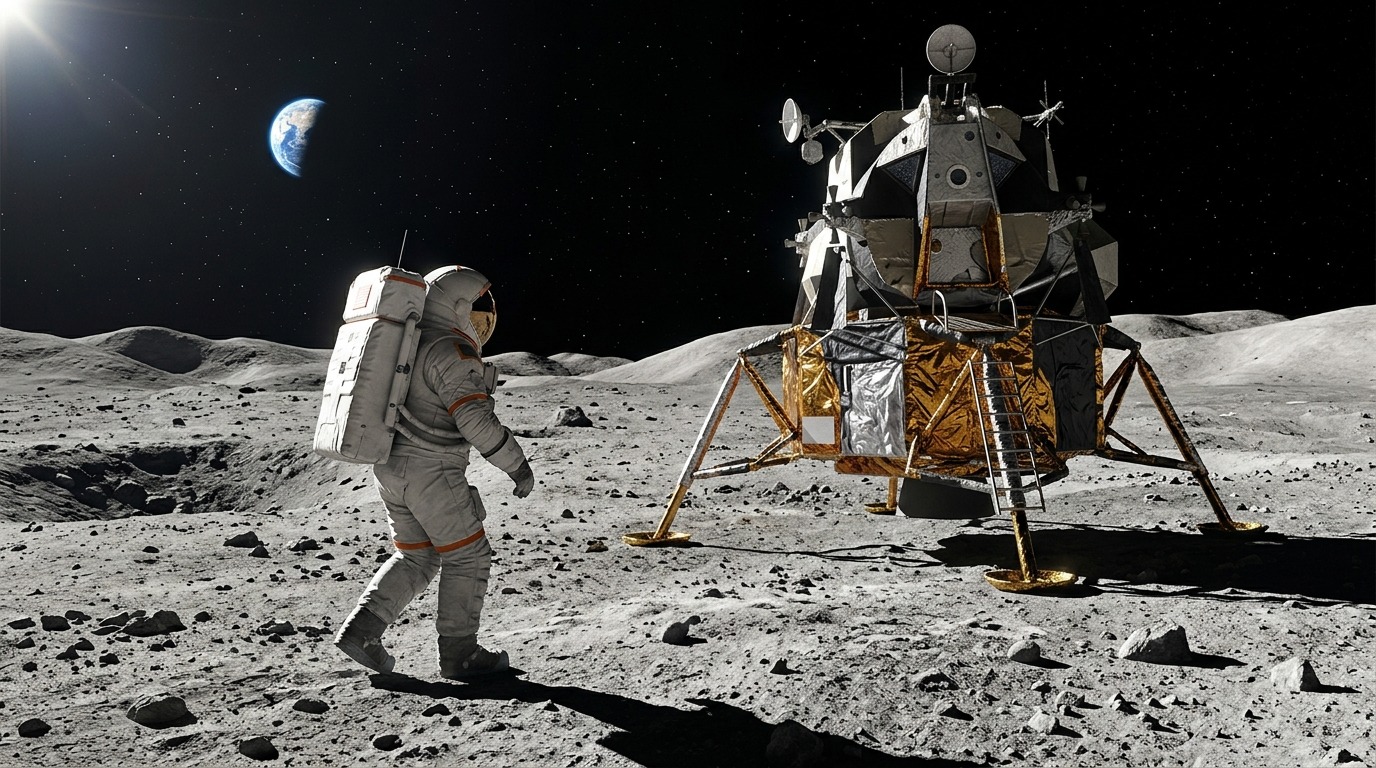
Future astronauts will have to work on the Moon without atmospheric protection
Interestingly, lunar missions themselves are already affecting the exosphere. Exhaust from a single landing module can temporarily increase the amount of gases around the landing site. Scientists are already modeling how the Artemis program and other future expeditions will affect the lunar atmosphere — because if we want to study its natural composition, we need to account for the traces of our own presence.
The Moon is a vivid example of how mass, magnetic field, and geological activity determine whether a world will have air. Earth won this lottery: heavy enough to retain gases, active enough to generate a magnetic shield, and volcanically productive enough to replenish the atmosphere for billions of years. The Moon is only 384 thousand kilometers away from us, but conditions there are completely different. And now you know why.