
Scientists explained why adhesive tape makes such an unpleasant sound
You’ve probably heard this sound hundreds of times — the sharp, piercing screech that adhesive tape makes when you unroll it. Some people wince, some just endure it, but few ever wonder where it comes from. It turns out that behind this irritating screech lies the physics of extreme phenomena — supersonic cracks, micro-lightning, and electric fields of up to a billion volts per meter.
What Happens When You Peel Off Tape
At first glance, it’s simple: you pull the tape — it comes off. But if you slow the process down and look at it on a micrometer scale, the picture turns out to be far more dramatic. The thing is, the tape doesn’t come away from the surface smoothly. It moves in jerks — scientists call this the “stick-slip” mechanism. The tape alternately sticks and suddenly breaks free — dozens of times per second.
It’s precisely during the “slip” moments that tiny cracks form in the adhesive layer. They run across the tape — perpendicular to the direction in which you’re pulling it. And as it turns out, they travel faster than the speed of sound in air. Simply put, these are supersonic micro-fractures happening right in your hands.
The study describing this mechanism was published in the journal Physical Review E. It was conducted by a team of physicists led by Sigurdur Thoroddsen from King Abdullah University of Science and Technology (KAUST) in Saudi Arabia.
Why Tape Screeches Rather Than Rustles
Thoroddsen’s team hypothesized that the screech originates at the tips of cracks racing through the adhesive layer. To test this, the scientists attached a strip of tape to a thick glass plate and yanked it off sharply. From below, through the glass, a high-speed camera recorded exactly how the cracks formed and traveled.
The first surprise: while the crack runs across the width of the tape, no shock waves form in the air. But when it reaches the edge — a sharp pop occurs. And not just one, but an entire series of them.
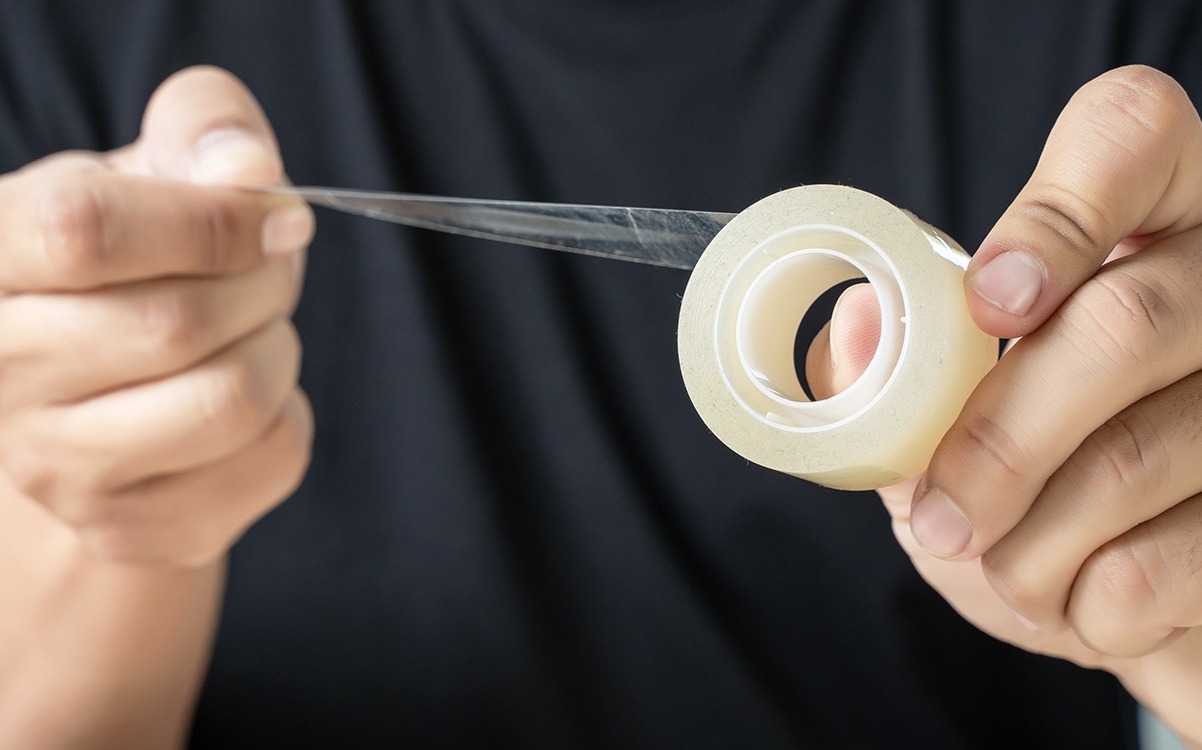
Ordinary tape in the hands of a physicist becomes a generator of supersonic cracks. Image source: science.org
The mechanism turned out to be both elegant and brutal. The crack moves so fast that air doesn’t have time to fill the void left behind. Behind the crack, a zone of reduced pressure forms — a kind of micro-vacuum. When the crack reaches the edge of the tape, these cavities collapse, releasing a sharp sound wave. The faster the crack — the larger the void and the louder the pop.
Anastasia Krushinskaya, a metamaterials specialist from the University of Groningen, noted that the study fits perfectly within the spirit of fundamental science — the drive to understand the nature of events that happen literally right under our hands.
Micro-Lightning from a Roll of Tape
But the story doesn’t end with the screech. In parallel, another group of scientists discovered that peeling tape is also an electrical show. The study, published in 2025 in the journal Proceedings of the National Academy of Sciences, was conducted by Xuefeng Gao from Nankai University (Tianjin, China) and the legendary Richard Zare from Stanford University.
When the tape jerks away from the roll, a positive charge accumulates on the sticky side, while a negative charge builds on the reverse side. The electric field in the gap between the separating surfaces reaches 10⁹ V/m — that’s a billion volts per meter. For comparison, achieving such field intensity is extremely difficult even in a well-equipped laboratory. And here we have an ordinary roll that costs next to nothing.
This field is so powerful that it ionizes the air in the gap. Essentially, tiny lightning bolts jump between the separating layers of tape — the researchers called them “microlightning.” These are what cause the characteristic bluish glow that you can see if you unroll tape in the dark. This phenomenon is called triboluminescence — the emission of light from mechanical action.
From Tape to X-Rays and Green Chemistry
Scientists have actually known about the glow of adhesive tape since 1939. And in 2008, physicist Seth Putterman from the University of California, Los Angeles, demonstrated something truly astonishing: if you unroll tape in a vacuum, it generates X-ray radiation with energy up to 100 keV. This is no joke — ordinary office tape is capable of emitting X-rays.
But Gao and Zare’s team went further. They showed that microlightning from peeling tape can trigger real chemical reactions. When the tape was pulled at speeds above 0.3 m/s, the electric field in the gap was sufficient to ionize water and initiate the Menshutkin reaction — a classic organic chemistry reaction used in pharmaceutical manufacturing.

A line of blue light at the point where adhesive tape separates from the roll. Image source: fiatphysica.com
Richard Zare suggests that similar microlightning may also occur in nature — for example, when methane bubbles rise through water in swamps. This could explain the mysterious swamp lights that people have observed for centuries. Moreover, such electrical discharges at interfaces could have played a role in prebiotic chemistry — the formation of the first building blocks of life on ancient Earth.
Why Study the Sound of Tape at All
It might seem like all of this is pure academic amusement. But there’s a practical side too. For people who work in warehouses and delivery services, the sound of tape is not a trivial matter but a constant source of discomfort. Understanding the mechanism opens the way to creating “quiet” adhesive tape — with a modified adhesive layer that tears less abruptly.
And the discovery of microlightning hints at something bigger. If simply peeling tape creates electric fields of a billion volts per meter and triggers chemical reactions, then tribocharging could become the basis for energy-efficient “green” chemistry — without expensive equipment and extreme conditions.
So next time a roll of tape lets out its signature screech, know this: you’ve just witnessed supersonic cracks, microlightning, and electric fields that not every laboratory can reproduce. All of this — in one small, cheap roll of tape.