
The human brain has a mechanism that selects which memories to preserve
The brain processes a huge amount of impressions every day, but remembers only a small fraction of them. Scientists long believed that the transition from short-term to long-term memory worked like a simple switch: click — and done. However, new research reveals a completely different picture: memory is governed by a chain that itself decides whether a memory is worthy of preservation or not.
How Long-Term Memory Works
Previously, the classical model of memory was beautiful in its simplicity. The hippocampus, a small structure deep within the brain, forms short-term memories. The cerebral cortex stores long-term ones. If a memory is “tagged” as important, it moves from the hippocampus to the cortex and stays there for a long time — possibly forever.
The problem is that this model failed to explain one obvious thing: why some long-term memories last for weeks while others persist for decades. If the switch is the same, why does the result differ so greatly? As the lead researcher of the new study, Priya Rajasethupathy, noted, old models envisioned memory molecules with an on/off switch, but reality turned out to be more complex.
Back in 2023, the same group of scientists discovered that between the hippocampus and the cortex there is an important intermediate link — the thalamus. It doesn’t simply transmit a signal but helps select which memories are worth preserving long-term. The 2025 study explained exactly how it does this.
Memory Experiment with Mice
The research team conducted an experiment on mice using a virtual reality system. The mice were trained to memorize different contexts, with some repeated frequently and others rarely. Repetition served as an analog for “importance”: the more often an experience was repeated, the more strongly the brain perceived it as significant.
After 15–30 days of training, the mice remembered only those situations that were repeated frequently. The rest were forgotten. The scientists tracked what was happening in the brain and discovered not a single switch, but an entire chain of genetic programs that are triggered sequentially, like a series of timers.
Imagine a relay race. The first runner starts quickly but runs a short distance. The second takes the baton and runs farther. The third finishes the longest distance. If even one runner fails to start, the memory “drops out of the race” and is forgotten.
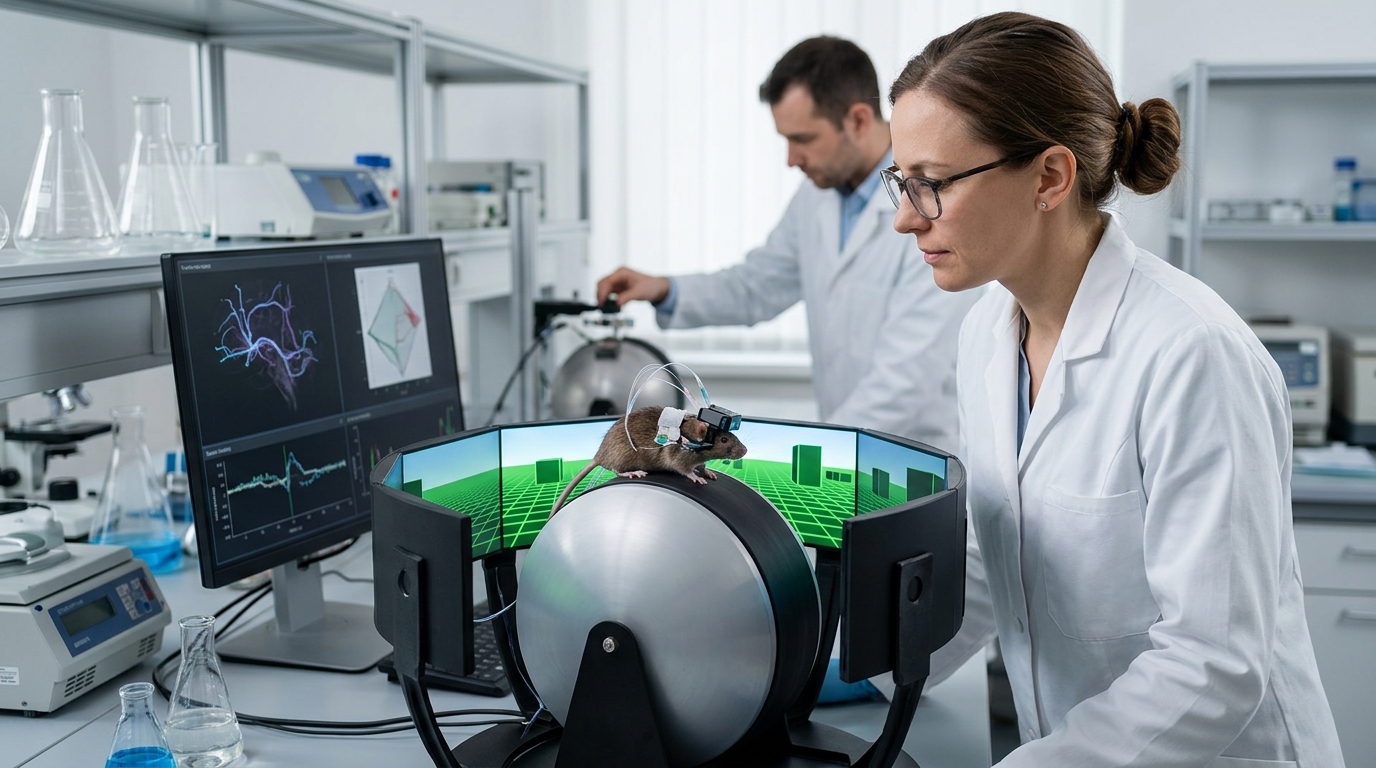
Laboratory experiment with mice in a virtual reality system
What Affects Memory Preservation
Using CRISPR technology, the scientists precisely disabled genes in different brain regions. This allowed them not only to observe correlations but to prove causal relationships: specific molecules truly control how long a memory will survive.
Three key regulators were found:
- Camta1 — works in the thalamus and supports the memory during the first days after its formation. This is the first “timer” that holds the memory at an early stage.
- Tcf4 — also works in the thalamus but activates later. It strengthens the physical connections between neurons, creating a structural “scaffold” for the memory.
- Ash1l — acts in the anterior cingulate cortex (part of the cerebral cortex). This enzyme modifies chromatin structure, the packaging of DNA, and thereby “locks in” the memory for weeks and months ahead.
A critically important point: none of these molecules participate in the actual formation of the memory. They are needed only for its preservation. When the scientists disabled Camta1 or Tcf4, the connections between the thalamus and cortex weakened, and memory was lost. This means the brain can perfectly “record” an event, but without the timers working, it quickly erases it.
Why Human Memory Works This Way
At first glance, the cascade system seems redundant. Why three stages when you could get by with one? But that’s precisely where its elegance lies: this multi-stage architecture allows the brain to constantly reconsider whether a memory is still worth keeping.
If an event turns out to be random and doesn’t repeat, the first timer simply “expires,” and the memory quietly fades. If the event repeats or proves to be important, the next timer is triggered, followed by the third. In Rajasethupathy’s words, “if you don’t advance the memory onto these timers, you are set up to forget it quickly.”
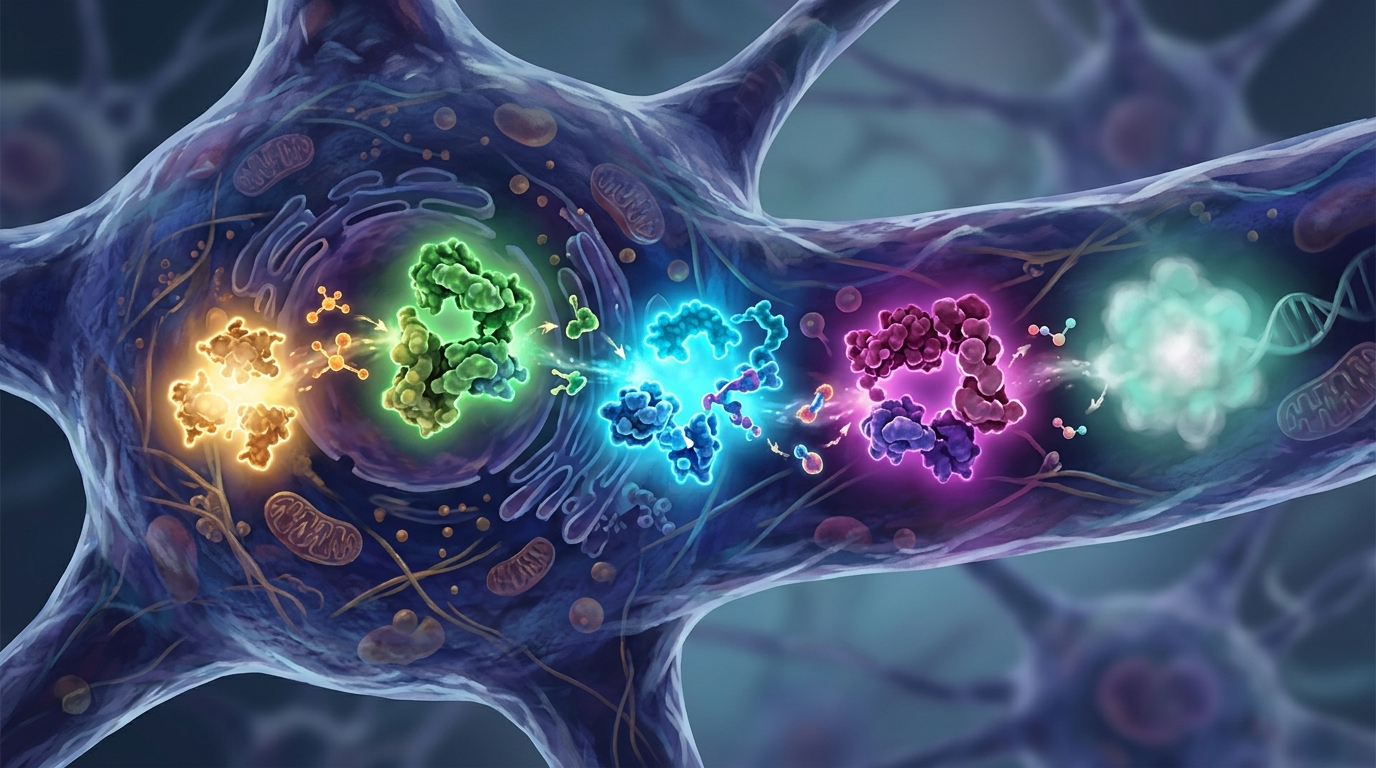
Conceptual illustration of a cascade of molecular timers inside a neuron
This system makes memory not a static archive but a living, constantly updating process. The brain doesn’t simply record information — it continuously decides what still deserves storage and what it’s time to let go.
How the Immune System Is Connected to Long-Term Memories
One of the most unexpected details of the study involves the molecule Ash1l. It belongs to a family of proteins, histone methyltransferases, that work not only in the brain. These same proteins help the immune system “remember” past infections, and help developing cells maintain their identity (a neuron must remain a neuron, and a muscle cell must remain a muscle cell).
This means the brain may not have invented its memory storage system from scratch, but rather repurposed ancient biological tools of cellular memory for cognitive tasks. Nature, as is often the case, doesn’t create something new — it rebuilds the old.
How This Discovery Could Help Treat Alzheimer’s
In Alzheimer’s disease, brain areas responsible for memory storage and consolidation are damaged. If scientists precisely understand which stations a memory passes through on its way to long-term storage, a fundamentally new idea emerges: rerouting the memory pathway to bypass damaged areas.
Rajasethupathy puts it this way: if we know the second and third stations important for consolidation, and neurons are dying at the first one, it may be possible to bypass the damaged area and allow healthy parts of the brain to take over the work. This is still a hypothesis, but the logic itself — not fixing what’s broken but finding a detour — looks promising.
The next step for the researchers is to figure out what exactly triggers each of the timers and how the brain evaluates the “importance” of a memory. The team believes that the thalamus plays a key role in this process, serving as a central dispatcher.