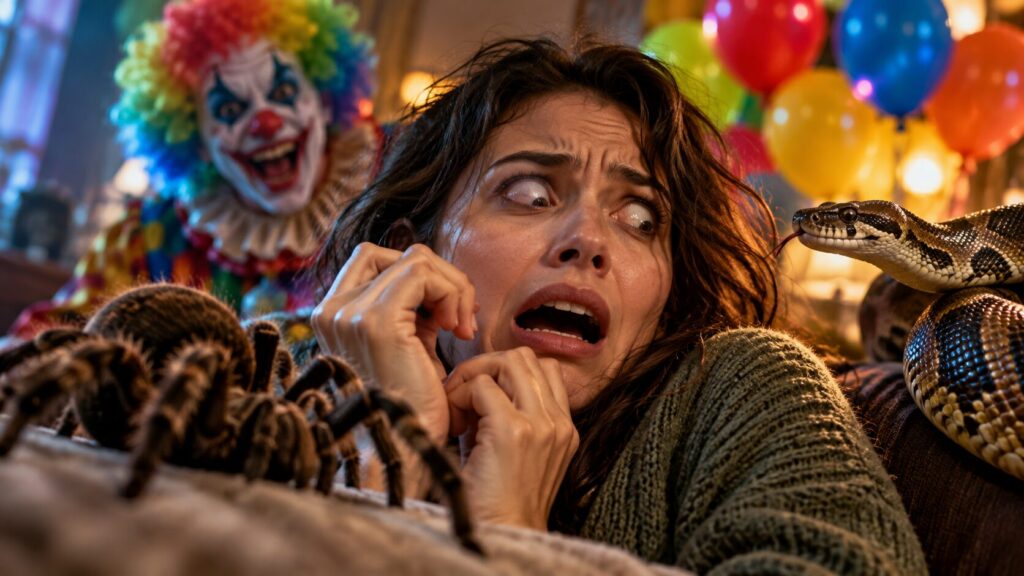
A frightened woman next to a spider, a snake and a clown
People can develop a fear of almost anything, from beards to flowers to clowns. Yet most phobias fall into a fairly short list: snakes, spiders, heights, deep water and needles. The likely reason is evolutionary: these are the kinds of things that threatened our ancestors, and research suggests humans are primed to learn such fears quickly. Rarer, stranger phobias usually have a different origin, growing out of personal experience, observation or what people hear and see around them. This explainer covers where both kinds of fear come from, why some people are more susceptible than others, and what keeps a phobia going.
What you need to know
- Research indicates that certain nerve cells respond faster to images of snakes than to other animals, and that infants react more strongly to snakes and spiders than to fish.
- Young monkeys learn to fear snakes by watching frightened adults, but do not pick up a fear of flowers the same way.
- Unusual phobias, such as fear of balloons or knees, typically arise from direct experience, observing others, or messages from parents and media.
- There is no specific gene for fearing spiders or snakes; genes appear to raise general vulnerability, while experience shapes what a person fears.
Fear helps us survive; a phobia gets in the way of living
Fear in itself is useful. It helps people notice danger in time and keep their distance. If you walk carefully around the edge of a cliff, your brain is doing its job.
A phobia works differently. It is an irrational fear that is out of proportion to the actual threat. In severe cases it disrupts everyday life: a person may change their routes, turn down trips and walks, and panic at the sight of a tiny spider.
Even rare phobias have their own names: fear of beards is called pogonophobia, and fear of flowers is anthophobia. Still, people most often fear the things that killed our ancestors for centuries: venomous animals, falls from height, deep water and sharp objects.
The brain appears primed to notice snakes and spiders
We seem to be ready for some fears from birth. Certain nerve cells respond to images of snakes faster than to photos of other animals, as if vision were tuned to pick out a snake from its surroundings first.
Even infants become more aroused when they see snakes or spiders than when they see fish. And young monkeys learn to fear snakes by watching frightened adults. They do not acquire a fear of flowers in the same way, however, even when adults nearby act scared.
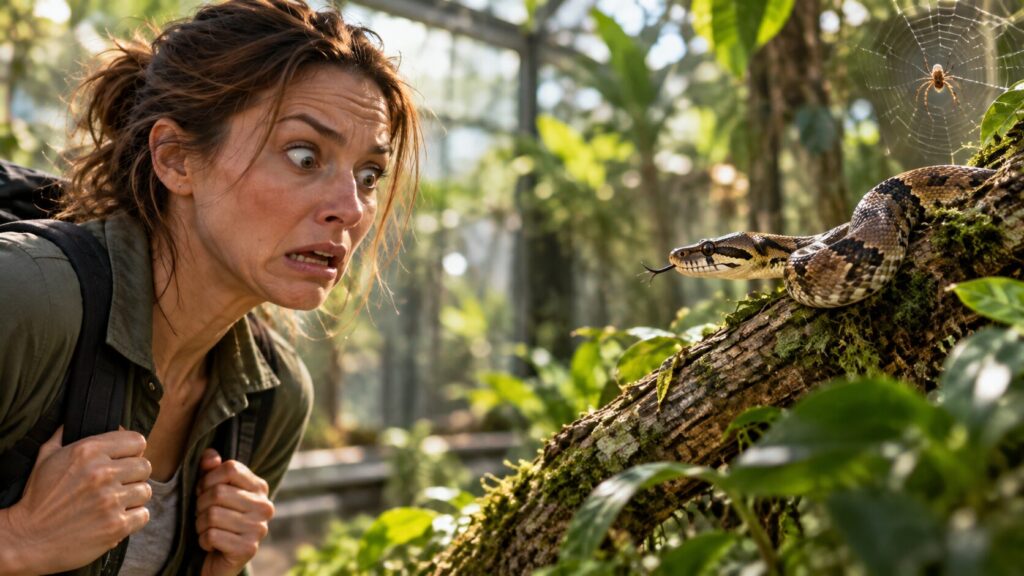
A woman frightened by a snake and a spider
Psychologists call these prepared fears. The idea is that evolution has made some fears noticeably “easier” to acquire: we learn them faster and more readily than others. Ancestors who kept away from snakes and spiders were more likely to survive.
Fear of clowns and needles may also have ancient roots
There were no clowns or syringes in prehistoric times, but these fears may still trace back to the distant past. Fear of clowns, or coulrophobia, is considered part of a broader childhood fear of costumed characters.
Children are probably naturally wary of strangers and odd-looking people who might do them harm. From a survival standpoint, that is a perfectly sensible caution.
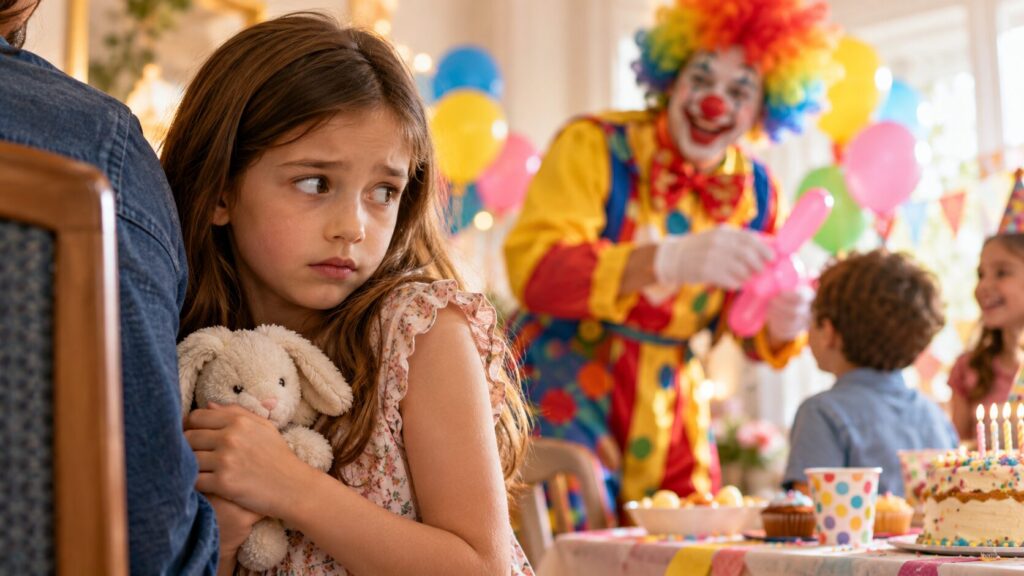
A girl hides from a clown at a children’s party
The same goes for needles. Our ancestors knew nothing of injections, but having the skin pierced by a sharp object was certainly dangerous. That is why fear of needles, trypanophobia, is also classed as a prepared fear. The fear of contamination seen in obsessive-compulsive disorder, a condition involving intrusive thoughts and repetitive behaviours, falls into the same category.
Unusual phobias grow out of life experience
Evolution cannot explain a fear of knees (genuphobia), balloons (globophobia) or peanut butter sticking to the roof of the mouth (arachibutyrophobia). Such fears are possible, but they are much harder to acquire. They usually appear after significant life events, and there are three main routes:
- Direct experience. This is genuine trauma: after a car crash, a person becomes afraid of driving; after a dog bite, they become afraid of dogs.
- Watching others. Sometimes it is enough to see someone panic around a particular object for that terror to pass to an impressionable observer.
- Words and messages. This includes what parents say, what is shown on television and what is posted on social media. Media outlets often hold attention precisely through fear.
Given the abundance of horror films, disaster movies and frightening news, it is hardly surprising that so many people have phobias.
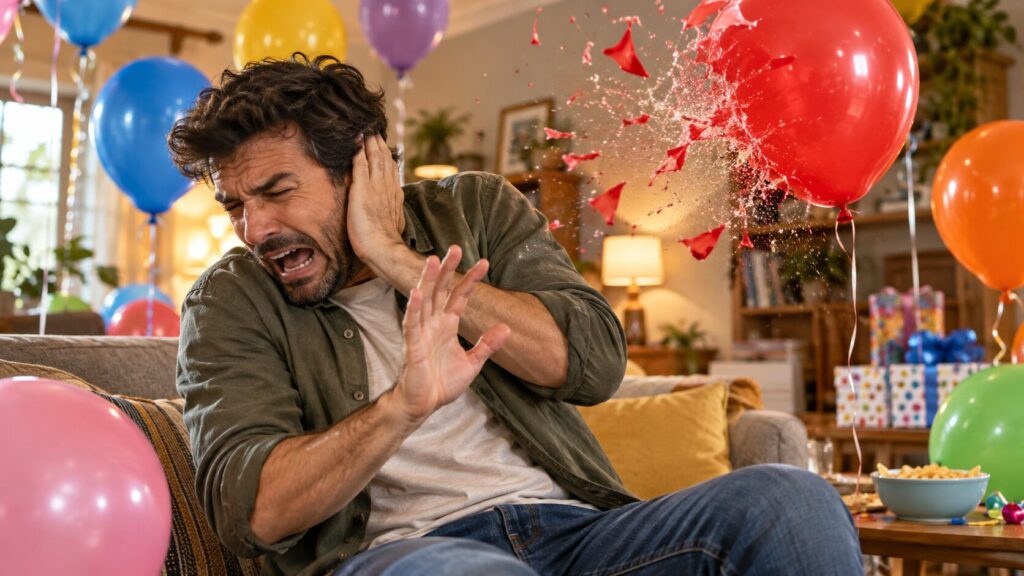
A man startled by a bursting balloon
Why some people are more fearful than others
These signals do not affect everyone equally. Stress levels, past experience and even genes all play a role. Some people are naturally more anxious and reactive; others are more resilient.
But there is no single “spider fear gene” or “snake fear gene”. Genes instead appear to make a person more vulnerable to fears in general, while experience determines what exactly they come to fear.
Avoidance keeps a phobia going, and facing the fear can treat it
Many people do not remember how their phobia started. Most often there was no vivid trauma; instead, the cause was some unremarkable event in early childhood that has long been forgotten.

A girl watches a snake in a terrarium
The good news is that knowing the original cause is not necessary for treatment. What matters more is understanding what sustains the fear now, which is usually avoidance. If someone rearranges their life to avoid heights, or flees a small spider in a panic, the brain is reassured each time that the danger is real and that escape brings relief.
That is why exposure therapy is considered one of the most effective ways to deal with a phobia. Under controlled conditions, a person confronts their fear and stays in the situation until they are convinced that nothing bad is happening and that being afraid is not necessary. The method works so well that a phobia often goes away within a single session.
Phobias are a bit like monsters under the bed: they persist as long as we keep believing in them. Even the fear of fear itself has a name: phobophobia.