If you’ve been eyeing a new smartphone and can’t quite make up your mind, I have some unpleasant news — it’s not going to get cheaper than it is today. Multiple sources in the supply chain report: the first wave of smartphone price increases is expected as early as March-April 2026, and some brands have already announced which models will go up in price. That wave has already passed and we know which Chinese smartphones have become more expensive. But there will be more waves of price increases, and ultimately we’re looking at a rise of around 30%. This isn’t a clickbait headline — it’s the reality of the market. Let me explain why smartphones are getting more expensive and why you shouldn’t expect prices to drop.

You have to pay more and more for smartphones.
Why Smartphones Are Getting More Expensive
The main reason is a shortage of RAM. It sounds a bit unexpected in 2026, when it would seem that more and more chips are being produced. But that’s exactly where the trap lies. Samsung, SK Hynix, and Micron — the three major memory manufacturers in the world — have massively redirected their capacity toward producing server chips for AI infrastructure. Data centers pay more, orders are enormous, and margins are more attractive. The problem is that the PC, tablet, and smartphone market ended up at the very back of the line.
The result is predictable: the price of mobile memory has crept upward, and phone manufacturers are forced to pass this increase on to consumers. However, they can’t pass it on in full because competition still exists, and some brands offset part of the increase at the expense of their profits. That’s why 30% isn’t a one-time jump but a gradual increase that will accumulate in waves throughout the year.
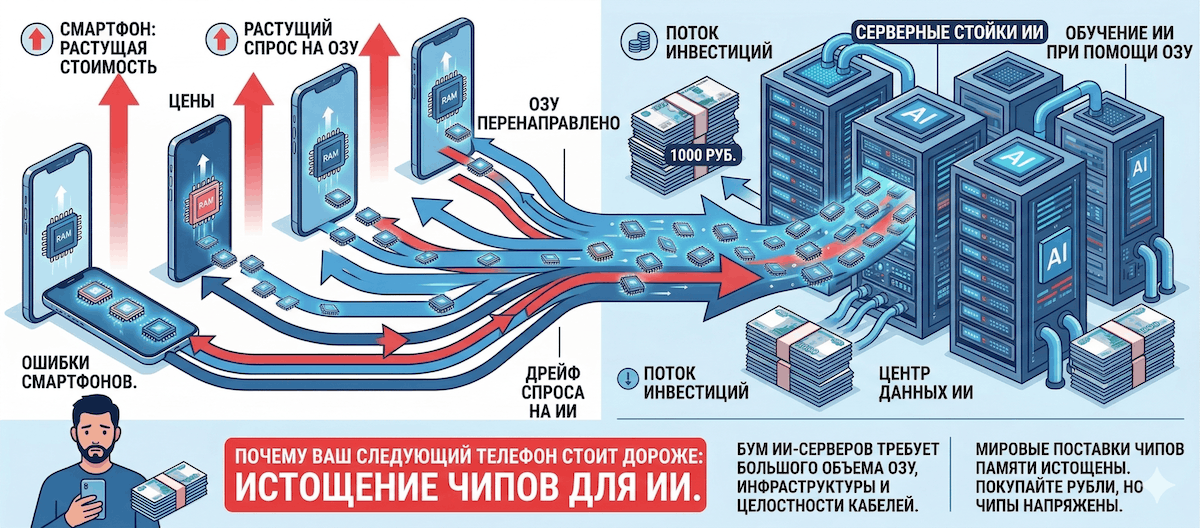
You can thank neural networks for all of this.
Which Smartphones Will Get More Expensive Than Others
Market analysts are painting a rather grim picture. According to some forecasts, total smartphone shipments could decrease by 31% in 2026. Some brands will be hit even harder: for Xiaomi, figures suggest a 55% drop in shipments. This doesn’t mean the company will shut down — production is simply adjusting to actual demand, which falls as prices rise.
Buyers in the 15,000–30,000 ruble price range will feel the changes most acutely. This is the mid-range segment where the main competition between Chinese brands is currently concentrated. If a year ago you could get a decent device with a good camera and fast charging for 20,000 rubles, by autumn the same set of features will require 25,000–26,000 rubles.
The flagship segment won’t be spared either, but price increases will be less noticeable there because all components are already expensive. The difference between 90,000 and 95,000 rubles is psychologically less painful than between 18,000 and 24,000.
Which Smartphone to Buy So It Lasts a Long Time
If you were ready to buy, it’s better not to wait. First and foremost, look at models released in late 2025 or early 2026. They can still be found at old prices, but they already offer up-to-date processors and cameras. This is especially true for devices with the Snapdragon 7s Gen 3 and Dimensity 8300 — these are good mid-range chips that can still be purchased relatively cheaply. They will perform well for quite a long time.
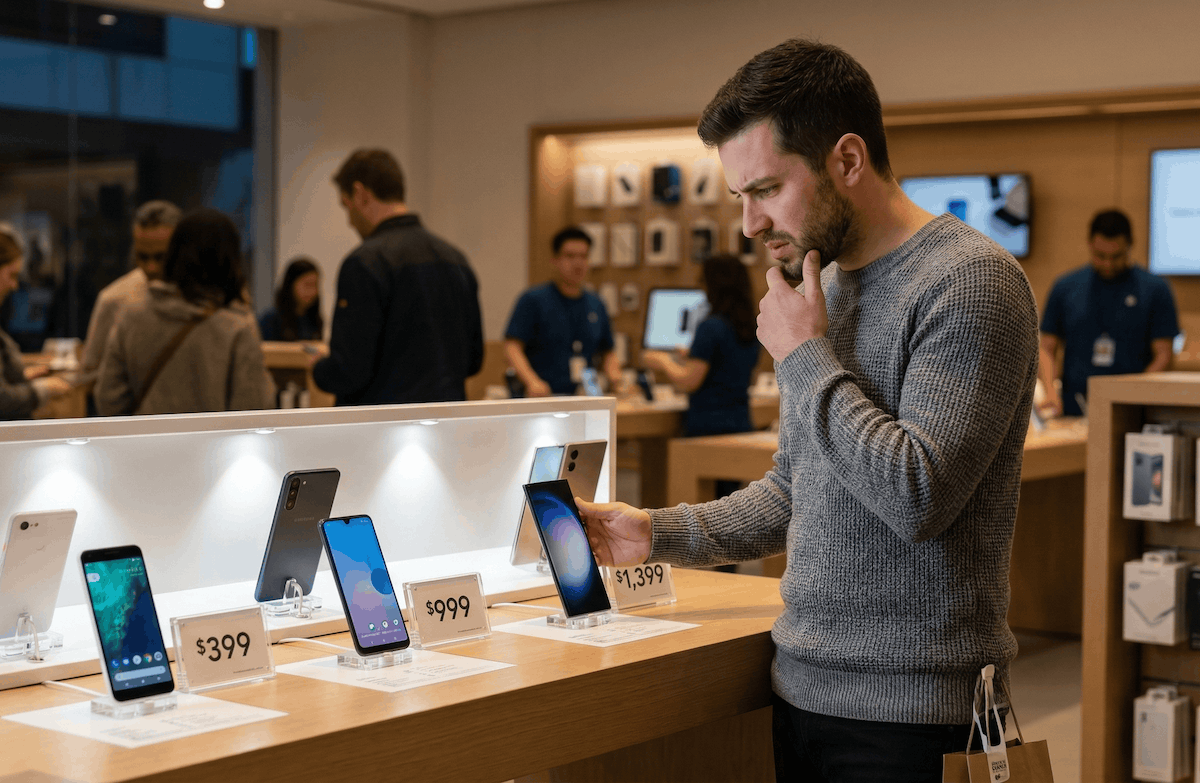
Buying a smartphone is becoming increasingly difficult. But it won’t be cheaper than it is today.
Smartphones like these will easily last 3-4 years, and by then the situation may have calmed down and smartphones may once again be sold at good prices. They’ll still be higher than now, but that would have happened anyway. However, they’ll come with new specs and you won’t have to pay more for weaker hardware.
Personally, in moments like these I always advise one thing: don’t chase the latest and greatest. A smartphone that came out six months ago still takes great photos, runs fast, and doesn’t need charging every half day. And it’s priced based on old stock at distributor warehouses. While those stocks last — now is the time.