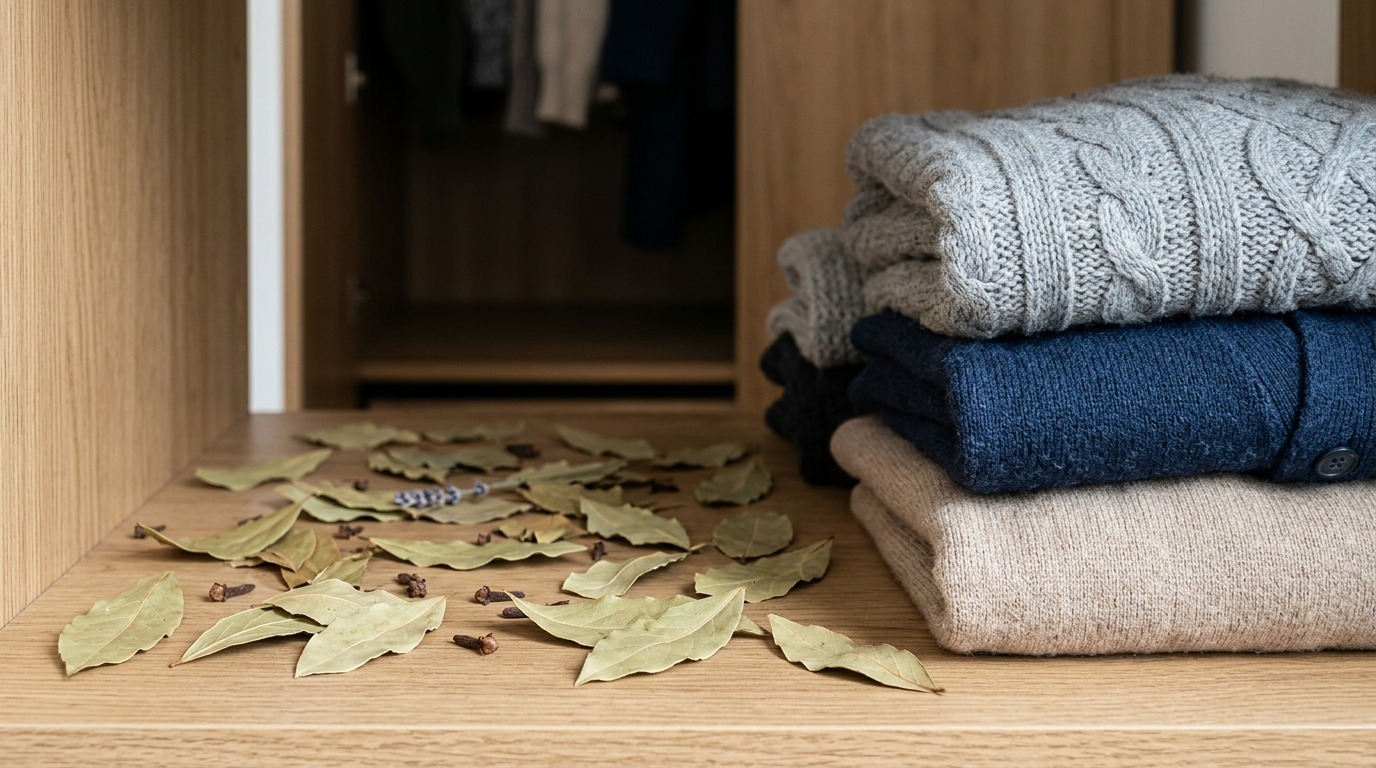
Bay leaves on a wardrobe shelf next to woolen clothes
Bay leaf is one of the most accessible kitchen spices that, as it turns out, can protect your wardrobe from moths just as well as expensive chemical products. The secret lies in the essential oils contained in bay leaves: their sharp, spicy scent repels insects. At the same time, the aroma is pleasant and safe for humans, and a packet of bay leaves costs dozens of times less than any repellent.
The Scent of Bay Leaf Repels Insects
To understand why bay leaf helps, you need to learn about the pest itself. The holes in your favorite sweater are not made by the butterfly you see flying around the apartment. Adult moths essentially don’t eat at all — some species even have underdeveloped mouths. Their only purpose is to lay eggs. It’s the larvae that hatch from those eggs that feed on keratin — a protein found in wool, cashmere, silk, and fur.
Moths navigate by smell. They search for wool and fur by detecting the scent of keratin, as well as traces of sweat, skin particles, and oils on clothing. This is exactly why dirty clothes attract moths more than clean ones.
Bay leaf contains essential oil whose main component is cineole (eucalyptol). In bay leaves, its concentration reaches 30–70%. Besides cineole, the oil contains linalool, pinenes, and limonene. All of these substances have a strong aroma that overpowers the scent of keratin and disorients moths: the insect simply cannot find food and leaves the wardrobe. According to Roskachestvo experts, among folk remedies, bay leaf proved to be even more effective than lavender.
How to Protect Clothes from Moths
Bay leaf is far from the only natural moth remedy. Moths cannot tolerate many spicy and coniferous aromas. Here’s what else you can place in your wardrobe to repel insects:
- Lavender — a classic tested by generations of homemakers. Dried flowers or essential oil can be used;
- Cedar wood — cubes, balls, or even cedar hangers. The wood’s aroma lasts for years;
- Rosemary, thyme, cloves — these can be placed in fabric sachet bags;
- Citrus peels — fresh or dried, their scent is unpleasant to moths;
- Essential oils (fir, eucalyptus, mint) — a couple of drops on a cotton pad creates an invisible barrier in your wardrobe.
It’s important to understand one thing: all natural remedies work as repellents — they scare away adult butterflies but do not kill eggs and larvae. If moths have already infested and laid eggs, bay leaf alone won’t suffice. A thorough cleaning will be needed: washing at temperatures above 60 degrees (or freezing for several hours), treating shelves with soapy water, and possibly using special insecticidal sprays. Roskachestvo experts recommend supplementing chemical products with natural remedies — this way the protection will be comprehensive.

Herb sachets in a wardrobe — a simple way to protect clothes
How to Properly Use Bay Leaf in Your Wardrobe
Simply tossing a couple of leaves on a shelf is possible, of course, but the effect will be weak. For bay leaf to truly work, follow these simple rules:
- Take 3–5 dry leaves and gently crush them with your hands to release the essential oils — this will make the aroma significantly stronger;
- Place the leaves in cheesecloth or a small fabric bag;
- Distribute the bags across shelves, between stacks of clothing, and in the pockets of outerwear;
- Replace the contents every 4–6 weeks — over time, essential oils evaporate and the leaf loses its protective properties.
Before storing clothes away, be sure to wash or clean them. Moths are attracted to the smell of sweat and organic contaminants, so dirty clothes are the first target. Store woolen, silk, and other delicate items in separate garment bags or airtight bags — this creates an additional physical barrier.
Storing Clothes in Vacuum Bags as Moth Protection
Another popular way to protect seasonal clothing is vacuum bags. The principle is simple: you place items inside, vacuum out the air, and the clothing turns into a flat, compact bundle. Along with the air, moth access is also removed — insects cannot survive in a vacuum.
The advantages of vacuum storage are obvious:
- Space savings — the volume of clothes is reduced by 2–3 times;
- Protection from dust, moisture, and insects;
- Convenience for moving and traveling.
But there are limitations. Items made of natural fur and leather should not be stored in vacuum bags — they will deform and lose their structure. Down jackets should not be fully vacuumed — only about two-thirds of the air should be removed so the filling doesn’t clump. Additionally, manufacturers warn that without airing, clothes should not be kept in vacuum bags for longer than six months — otherwise a musty smell and permanent creases may develop.
If you place cotton or synthetic items in vacuum bags, there are usually no problems. For delicate fabrics, it’s better to choose fabric garment bags with zippers and place a sachet of bay leaf inside — this way you combine physical and aromatic protection.
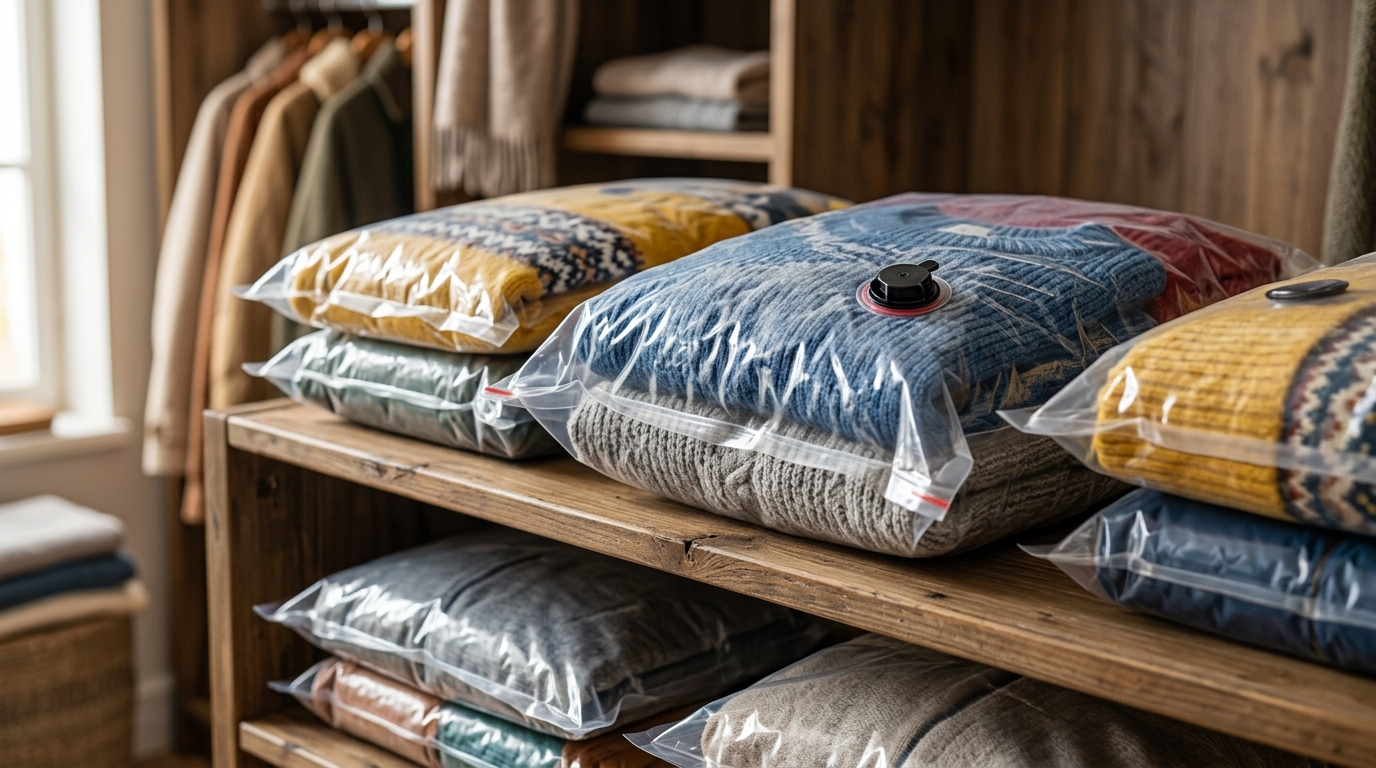
Vacuum bags save wardrobe space but are not suitable for all fabrics
How to Store Clothes to Prevent Moths
Sometimes moths appear not because you did something wrong, but simply because they flew in through a window, ventilation, or “arrived” on new clothes from a store. That’s why prevention is important all the time, not just before seasonal storage.
Here is a set of simple habits that make your wardrobe unattractive to moths:
- Only put clean items on shelves — traces of sweat and oils attract insects;
- Periodically shake out your clothes — moth eggs and larvae are not attached to fabric and fall off easily;
- Air out wardrobes and wipe shelves with a damp cloth at least once per season;
- Place natural repellents — bay leaf, lavender, cedar — and replace them monthly;
- Store woolen and silk items in garment bags or airtight bags.
If you notice even one moth butterfly, immediately check all woolen and fur items. A single female moth can lay between 30 and 200 eggs during her short life. Finding larvae is difficult because they hide in clothing folds and dark corners of the wardrobe.
Bay leaf is not a magic wand and not a replacement for thorough cleaning. But as a constant, safe, and nearly free preventive measure, it works excellently. Place a couple of bags with crushed leaves in your wardrobe, replace them once a month — and the chances of finding holes in your favorite cashmere sweater will be noticeably lower. And if you add cleanliness, proper storage, and regular airing to this — moths will have to find themselves another home.