
Musical age: at what point do we stop discovering new things.
At 20, a new song could turn your whole day around. At 35, you more often hit play on a tried-and-true playlist of familiar, beloved songs. Data from streaming services shows: peak musical curiosity falls between ages 15 and 25, and after 30 most people barely seek out new releases. And it’s definitely not a case of “music was better back then.” But why does this happen, and can it be changed?
What research shows: at what age do people stop listening to new music
Analysis of user data has shown that by ages 30–33, many people have developed a stable set of artists, and their playlists essentially freeze. Reports from Spotify (2015) and Deezer (2018) point to roughly the same threshold — around age 30.
The reason isn’t just habit. In youth, music is closely intertwined with identity formation: first love, friendship, rebellion. Tracks from this period become imprinted in memory and serve as emotional anchors. With age, the brain increasingly chooses predictability over novelty.
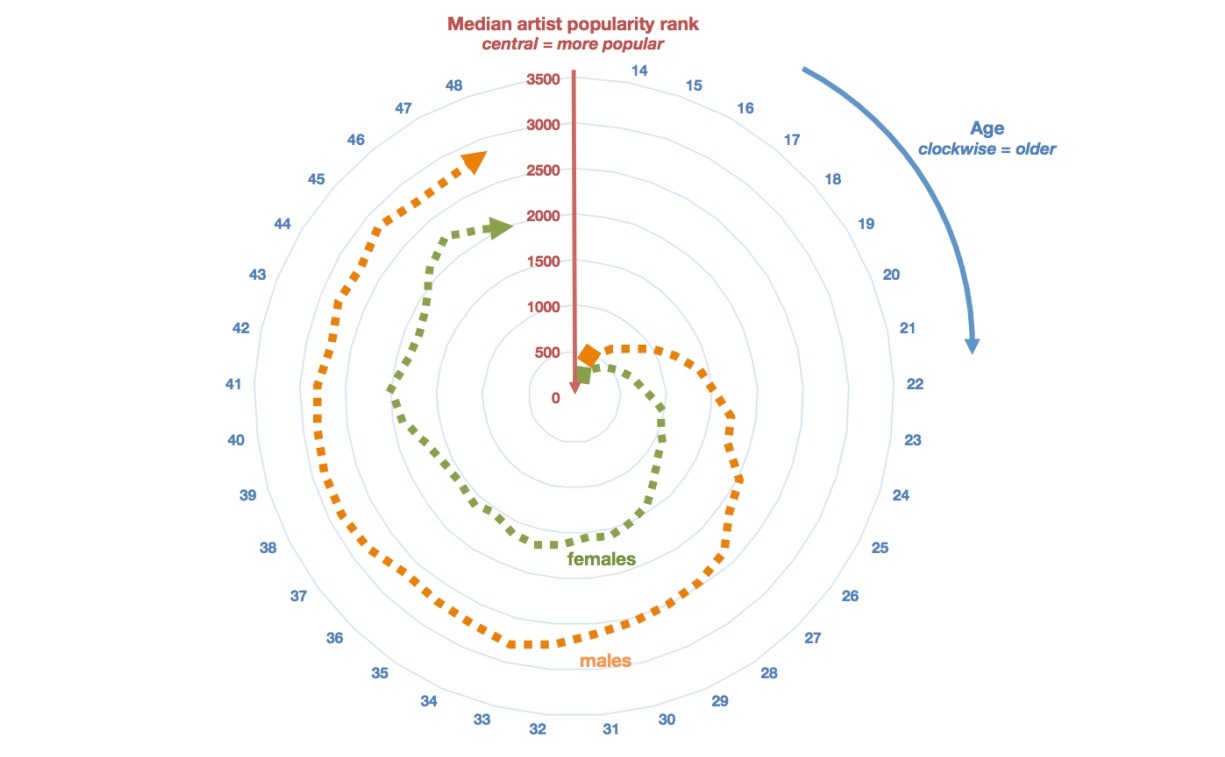
Although both genders stop listening to popular music as they age, on average this effect appears earlier and to a greater extent in men than in women. Image source: skynetandebert.com
Why the brain responds worse to new music after 30
The teenage brain reacts more intensely to novelty: the dopamine reward system is more active, and emotions are more vivid. Over time, the response to novelty decreases — this is a normal neurobiological process. A familiar song triggers a ready-made cascade of memories, while a new one requires effort.
Add in everyday life: work, children, early mornings. There’s simply no time to experiment and seek out new things. Plus, recommendation algorithms often work on the principle of “similar to what you’ve already listened to.” This creates a “filter bubble” that imperceptibly reinforces old tastes.
How to start listening to new music again after 30
Musical paralysis is not a life sentence. Neuroplasticity is preserved throughout life. Simple techniques work:
- The 30-second rule: don’t skip a track right away — give your brain time to find a pattern.
- Active listening: 15 minutes a week without background noise or multitasking.
- Other people’s recommendations: friends and concerts expand your horizons better than algorithms.
- Consciously stepping out of your comfort zone: one new genre per month.
Interests change — that’s normal. But if you notice that the question “What are you listening to?” has disappeared from your conversations, it might be worth bringing it back. Sometimes all it takes is one unexpected track to remind your brain that it’s still possible to be surprised.