
You can deal with nausea in a car, and it’s not as hard as it seems
Have you ever experienced riding along winding roads while the driver aggressively takes turns, and you feel like you’re being turned inside out? First, you just feel dizzy and overwhelmed by fatigue, and by the end of the trip, your only wish is for this nightmare to stop and for the nausea to go away. Meanwhile, the driver behind the wheel feels absolutely fine and doesn’t understand the problem at all. Why does this happen, and why is it specifically passengers who get carsick?
Why You Get Carsick in Cars and Buses
In fact, motion sickness (or kinetosis) is not a disease but a protective reaction of the body. Imagine the brain as a headquarters that constantly receives reports from scouts. In our case, the scouts are the eyes and the vestibular system, which is located in the inner ear and is responsible for balance.
The problem arises when these two sources of information start blatantly contradicting each other. For example, you’re sitting in the back seat reading a book.
The eyes report to the brain:
All clear, commander! The page is stationary, we’re sitting still.
But the vestibular system screams:
No way! We’re flying into a turn, centrifugal force is acting on us! We’re moving!
The brain receives two opposite signals and doesn’t understand what’s happening. It decides these are hallucinations caused by… poison! After all, poisoning is the most common cause of sensory malfunction. An ancient defense mechanism kicks in:
If the eyes see one thing and the body feels another, it means we’ve been poisoned — we need to throw everything up immediately.
That’s how nausea occurs.
Why Drivers Don’t Get Carsick on the Road
The driver doesn’t feel nauseous while driving because they are not a passive passenger. They turn the steering wheel themselves, press the gas and brake. Their brain knows in advance that a turn is coming. When the driver turns the wheel, their brain has already sent a command to the muscles and is prepared for the body to lean.
There is no signal conflict for the driver. Their brain says:
I did this myself, everything is under control.
That’s why, even if the passengers in the back seat are feeling sick, the driver feels perfectly fine. They control the situation, which means their brain is calm.
What to Do to Avoid Getting Carsick
The simplest and most effective advice, given by Dr. Herman Kingma on the Universal Sci website, is to trick your brain. You need to redirect its attention from the fact that you’re moving to something else.
You might think reading a book would help, but that’s actually the worst thing you can do. In this case, the conflict between the eyes and the vestibular system only intensifies.
Here’s what actually works:
- Look at the road through the windshield. Your eyes will see the same thing your body feels, and the conflict will disappear.
- Play video games. Yes, this is advice from a scientist! When you’re engrossed in a game on your phone or tablet, the brain immerses itself in the virtual world and stops paying attention to the body’s signals about movement.
- Sit in the front. There’s less shaking in the front seat, and you can see the road better.
Why Seasickness Is Worse Than Carsickness
Seasickness is a whole different level of misery. In a car, the shaking mainly happens in turns, but on a ship, things are much more complicated. Your body is subjected to two types of motion simultaneously: linear (up and down on the waves) and rotational (tilting). The vestibular system goes crazy from this cacophony of movements and loses its orientation in space.
Our body has an especially hard time when the rocking repeats at a frequency of approximately once every 5 seconds. The brain quickly realizes it’s losing control and sounds the alarm: the distress signal reaches the vomiting center, and you start feeling queasy.
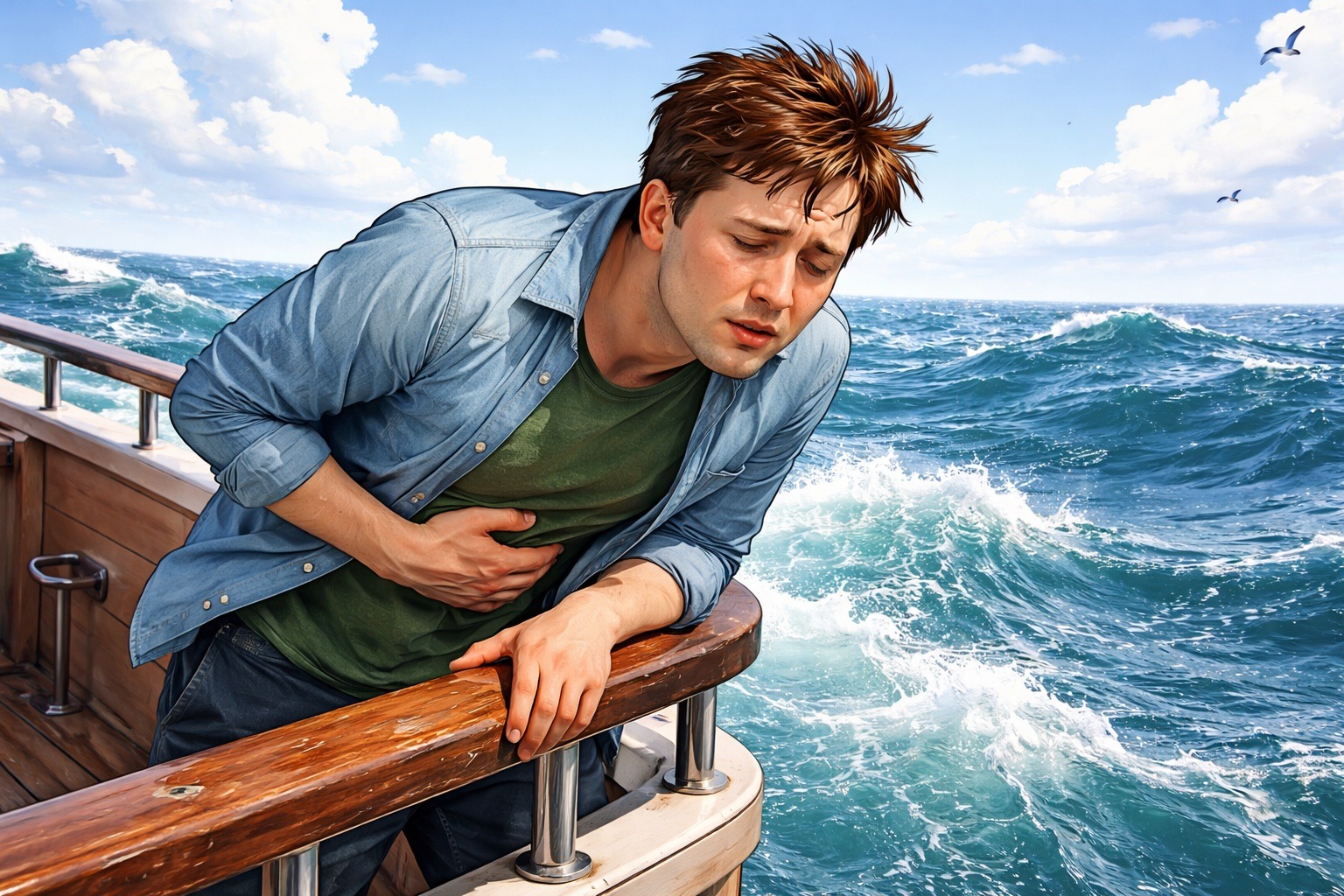
Sailors suffer from seasickness only at the beginning, then they get used to it
How to Fight Seasickness
If sea trips are a regular thing for you, there’s good news: the body can adapt. The brain learns to recognize the rhythmic rocking and creates a new movement pattern. The more often you go out to sea, the faster this will happen. The bad news: about 10% of people will never be able to adapt, no matter how much they sail.
Here are some practical tips for those planning a cruise or a sea trip:
- Get enough sleep before the trip. Fatigue makes us more vulnerable to motion sickness.
- Look at the horizon. This helps the brain restore its sense of vertical orientation and understand which way is up and which is down.
- Go out for fresh air. This helps distract you and slightly calms the body.
- Relax and breathe. Deep breathing helps reduce anxiety, which only makes nausea worse.
Sleeping pills? Dr. Kingma says that sleeping pills can help you get through a voyage, as they reduce the brain’s “preoccupation” with spatial orientation. But this is a last resort and should not be used without consulting a doctor.
The main thing to remember: motion sickness is not a life sentence. Now that you understand the mechanism, you can help your body not to panic and enjoy the ride, whether it’s a car trip or a sea cruise.