
Brain scans of people with multiple sclerosis reveal characteristic white matter damage, but this study focuses on the less studied gray matter.
For decades, multiple sclerosis has been studied through the lens of the brain’s white matter — the myelin sheaths of nerve fibers, whose destruction was long considered the primary scenario of the disease. But two new studies published in Nature have for the first time explained why neurons of a completely different type die in this disease — gray matter cells. The culprit turned out to be uncontrolled DNA damage that overwhelms the neurons’ protective system. Scientists believe that this opens an entirely new front in the fight against multiple sclerosis.
What Is Multiple Sclerosis and Why Is It Difficult to Treat
Multiple sclerosis (MS) is an autoimmune disease in which a person’s immune system attacks their own nervous system. The main target is myelin, the protective sheath of nerve fibers. Imagine the insulation on an electrical wire: if it’s damaged, the signal passes through poorly, and the wire wears out faster. Roughly the same thing happens to nerves in MS.
When myelin is destroyed, it leads to characteristic symptoms: vision problems, numbness, muscle weakness, and coordination disorders. The disease is divided into several types. The most common is relapsing-remitting, in which flare-ups alternate with periods of remission. But in some patients, the disease eventually transitions to a progressive form, where symptoms constantly worsen.
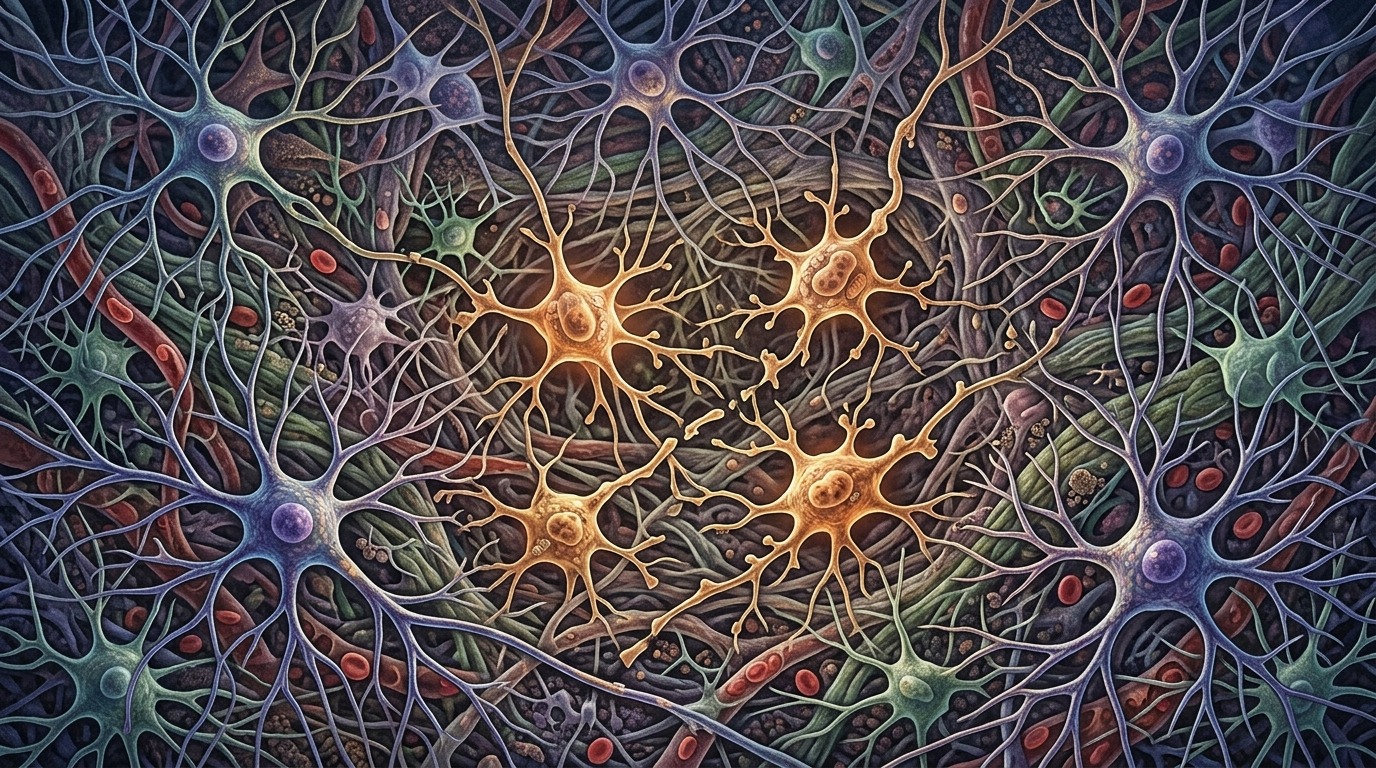
Gray matter neurons of the brain: some cells turn out to be more vulnerable than others
Until now, doctors and researchers have focused primarily on the brain’s white matter — that’s where MRI scans show lesions used for diagnosis and tracking the disease’s progression. But alongside this, a mystery persisted: patients with severe forms of MS also show damage in the gray matter — the brain layer where neuron cell bodies are located. This damage is harder to detect on scans, and until recently, the mechanism behind the death of these cells remained unknown.
Why Gray Matter Suffers in Multiple Sclerosis
Gray matter is the outer layers of the brain where nerve cell bodies are concentrated (unlike white matter, which consists of long axon extensions covered in myelin). Gray matter damage in MS occurs less frequently and is harder to diagnose, but it is precisely this damage that is associated with chronic and disabling forms of the disease.
Scientists have long known that among gray matter neurons, there is a particularly vulnerable group — cells expressing the CUX2 gene. But why these cells suffer first was unclear. The team of Professor Steve Bhatt Bhatt Fancy from the UCSF Institute of Neurosciences decided to investigate this, and the results were unexpected.
“It became clear that in addition to myelin repair, progressive MS requires finding ways to directly protect gray matter neurons,” Fancy explained.
How DNA Damage Leads to Neuron Death in Multiple Sclerosis
In the first of the two studies, the team examined the development of CUX2 neurons in a mouse model. It turned out that these neurons form at a very early stage of brain development — when cells divide at enormous speed. Rapid division is serious stress for a cell, as each DNA copying carries a risk of errors and damage.
To cope with this stress, CUX2 neurons use a kind of molecular “bodyguard” — the ATF4 gene. This gene protects cells from DNA damage during periods of rapid growth. When researchers disabled ATF4 in mice, the consequences were dramatic: the entire front part of the brain failed to form normally.
“The ATF4 gene is at the center of the survival strategy for DNA damage,” Fancy emphasized.
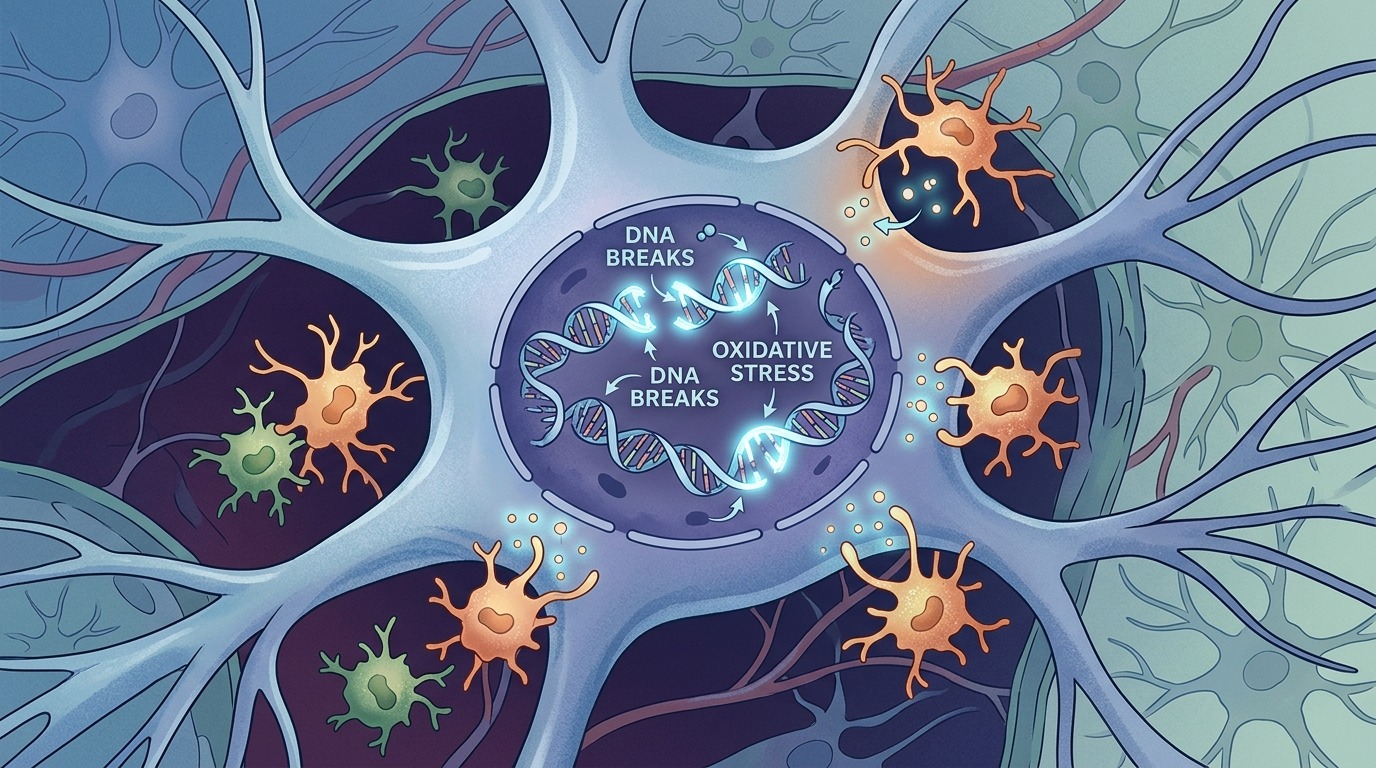
Diagram: inflammation causes DNA damage inside a neuron, which accumulates and leads to cell death
In the second study, scientists showed what happens in multiple sclerosis: inflammation in the brain triggers DNA damage in CUX2 neurons, and the protective ATF4 mechanism can no longer cope. In a mouse model of MS, the team observed how accumulating DNA damage ultimately leads to cell death and the formation of gray matter lesions. Essentially, neurons die not from a direct immune system attack, but because their own DNA repair system becomes overwhelmed.
New Methods of Treating Multiple Sclerosis: What This Discovery Will Change
The discovery fundamentally changes the understanding of how multiple sclerosis progresses. Until now, therapy has focused on two tasks: suppressing autoimmune inflammation and attempting to restore myelin. Now a third direction emerges — protecting gray matter neurons from DNA damage.
“If we can protect CUX2 neurons, it may be possible to contain damage before the disease begins to progress,” said David Rowitch, co-author of the study from the University of Cambridge.
The study authors also note that in the future, it will be worth investigating whether there are genetic factors that make CUX2 neurons even more vulnerable in specific individuals. This could explain why some patients experience a relatively mild course of multiple sclerosis, while others quickly develop severe disability.
Why This Discovery Matters for Treating Multiple Sclerosis and Other Brain Diseases
Multiple sclerosis affects more than 2.8 million people worldwide, and a significant portion of them are young and middle-aged women. Existing medications can slow the disease’s progression but cannot stop it completely, and no drug can yet restore already dead gray matter neurons.
The new research does not offer a ready-made cure — it is fundamental work revealing a previously unknown mechanism. But it is precisely such discoveries that set the direction for developing next-generation drugs. If a therapy can be created that strengthens DNA protective mechanisms in neurons, it could change the prognosis for patients with progressive forms of MS — those for whom treatment options are fewest today.
Furthermore, understanding the role of DNA damage in neuron death may prove useful beyond multiple sclerosis. Mechanisms related to the accumulation of DNA damage and failures in cellular repair systems are also being studied in other neurodegenerative diseases. The work of Fancy’s group is another step toward understanding why the brain loses its cells with age and under the influence of disease, and how this can be prevented.