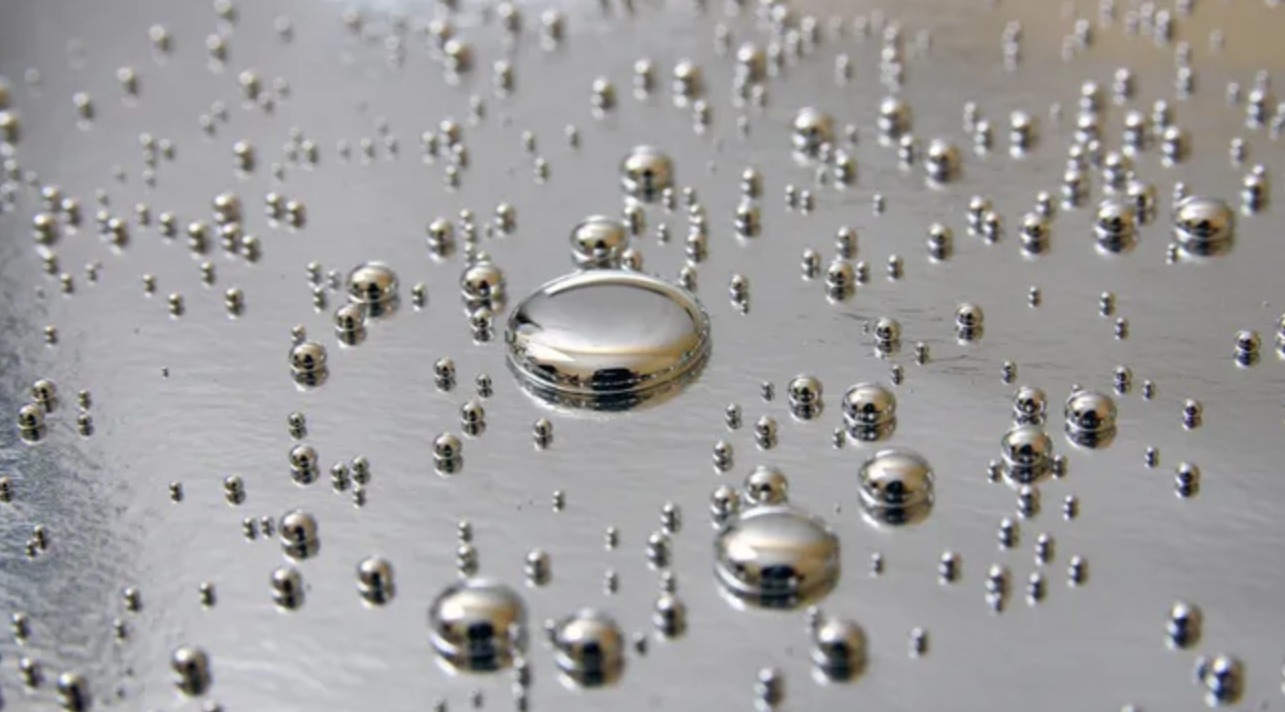
Alchemists called mercury “living silver” and “the mother of all metals.” Image source: livescience.com
All metals are solid. Iron, gold, copper, aluminum — try bending any of them with your bare hands, and you’ll understand how strong their crystal lattice is. But there is one element that breaks this rule so boldly that it puzzled alchemists as far back as antiquity. Mercury, the only metal that remains liquid at room temperature, was only understood when physicists brought in Einstein’s theory of relativity.
Why Mercury Is Liquid at Room Temperature
To understand why mercury is liquid, it’s first worth figuring out why other metals aren’t. According to Live Science, in a typical metal, atoms arrange themselves in an ordered crystal lattice. Their outer electrons are shared, forming what is known as an “electron sea.” It is this metallic bond that holds the atoms together and makes metals solid, shiny, and electrically conductive.
The stronger the bond between atoms, the higher the melting point of the metal. Tungsten, for example, has a melting point of 3,422 degrees, while iron’s is about 1,538 degrees. Mercury, however, melts at a mere −38.83 degrees. For comparison, that’s colder than a winter night in Yakutsk, and mercury is already liquid. At a room temperature of +20 degrees, it has long since turned into that silvery droplet familiar to anyone who has ever broken a thermometer and put themselves and others at risk. After all, we do remember why mercury is poisonous, right?
For a long time, chemists explained this with “weak bonds between mercury atoms,” but why exactly they were weak remained a mystery. After all, mercury’s neighbors in the periodic table, gold and thallium, are quite solid.
Mercury and the General Theory of Relativity
The answer turned out to be hidden not in ordinary chemistry, but in quantum physics. The nucleus of a mercury atom contains 80 protons, creating an extremely powerful electric field. The inner electrons are forced to move at colossal speeds to avoid “falling” into the nucleus. How colossal? The speed of mercury’s electrons reaches approximately 58% of the speed of light.
At such speeds, Einstein’s special theory of relativity comes into play. According to it, an object’s mass increases as it approaches the speed of light. The electrons become “heavier,” and their orbitals contract closer to the nucleus. This effect is called relativistic orbital contraction.
One might think this only concerns the inner electrons. But the trick is that the contraction of the inner shells affects the outer ones in a chain reaction. Mercury’s outer electrons end up so tightly pressed against the nucleus that they are extremely reluctant to participate in forming bonds with neighboring atoms. Simply put, mercury “doesn’t want” to share its electrons, and its metallic bond turns out to be anomalously weak.
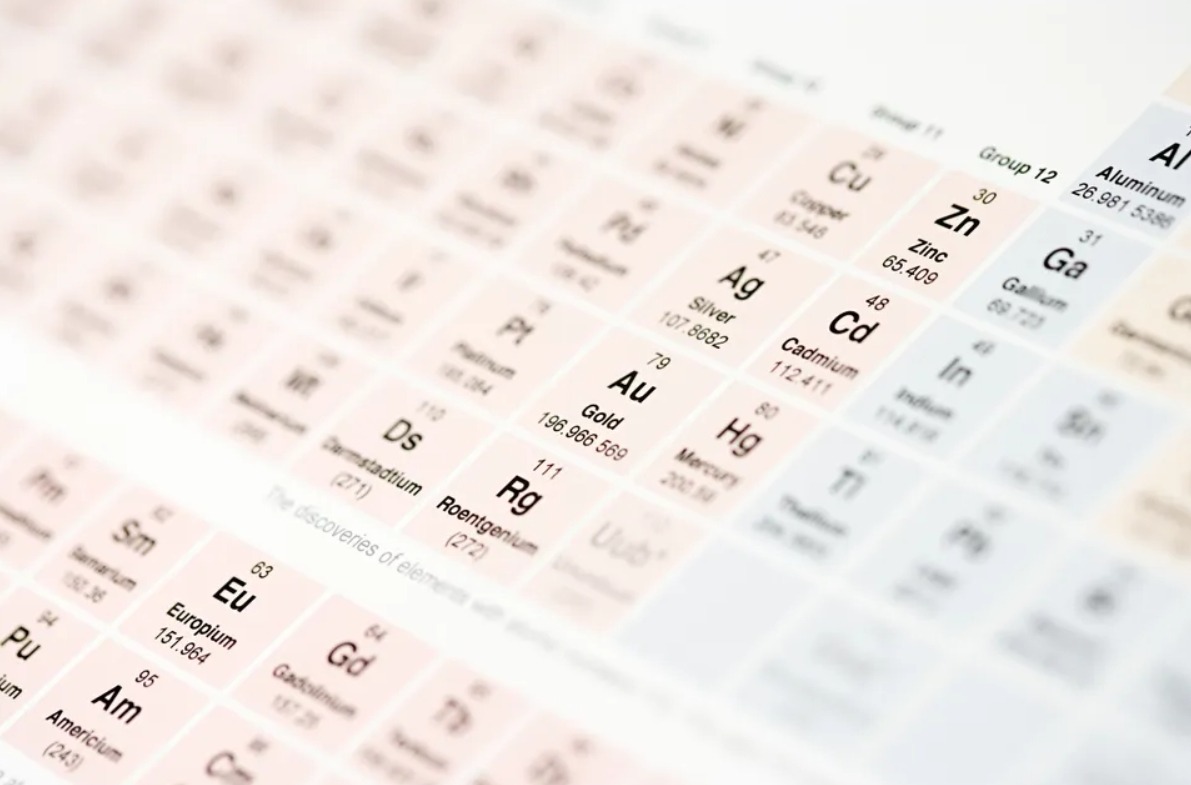
Gold and mercury, neighbors in the periodic table, owe their unusual properties to the same relativistic effect. Image source: Live Science
What Gold and Mercury Have in Common
The most curious thing is that the same relativistic mechanism also explains another mystery: why gold is yellow rather than silvery like most metals. Gold has 79 protons — just one fewer than mercury. Relativistic orbital contraction shifts the light absorption threshold so that gold absorbs the blue part of the spectrum and reflects yellow-orange. Without the theory of relativity, gold would look like silver.
However, gold’s outer electrons still form sufficiently strong bonds for a solid state. But with mercury, with its additional proton and fully filled shell, the effect crosses a critical threshold. The electron pair in the orbital is so stable that it practically does not participate in interatomic interactions. This phenomenon is sometimes called the “inert pair effect.”
In 2013, a group of scientists published calculations in the journal Angewandte Chemie that definitively confirmed: if you “turn off” relativistic effects in a computer model, mercury would become solid with a melting point of about +82 degrees. In other words, without Einstein, mercury would behave like an ordinary metal.
Why Mercury Thermometers Are No Longer Sold
Despite all its physical beauty, mercury is extremely toxic. Its vapors damage the nervous system, kidneys, and lungs. This is precisely why mercury thermometers are gradually becoming a thing of the past: their sale has been banned in the European Union since 2009, and in Russia a ban on the production and distribution of mercury thermometers has been in effect since 2020.
The main danger is that mercury evaporates at room temperature. A broken thermometer is not just broken glass — micro-droplets of mercury roll into cracks, and their vapors can poison the air in a room for weeks. If this happens, don’t try to collect the mercury with a vacuum cleaner — that will only disperse it. Call specialists!
However, in some areas mercury remains irreplaceable for now. It is used in certain types of lamps, in scientific instruments, and even in some vaccines in safe micro-doses, although this practice is also gradually being phased out.