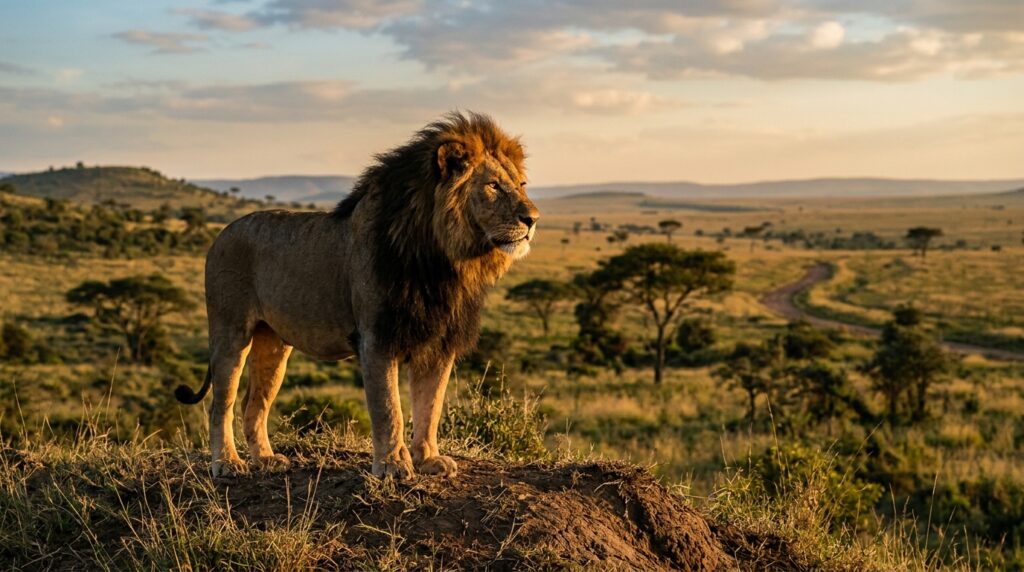
A dark-maned lion on a hill in the African savanna
A lion’s mane appears to work mainly as a signal rather than as armor. Long-term research on wild lions in Tanzania suggests the mane tells rivals and lionesses how old, healthy and strong a male is. Meanwhile, a classic idea dating back to Charles Darwin, that the mane shields the neck in fights, has not been supported by evidence.
That matters because a thick mane is costly. It can make a lion uncomfortable in the heat and makes one of the world’s most dangerous predators easier to spot. For a trait with those drawbacks to persist, it must offer a substantial benefit.
What you need to know
- Zoologists Peyton West and Craig Packer placed life-size lion dummies with manes of different lengths and colors in front of wild lions in Serengeti National Park and the Ngorongoro Crater.
- Males approached dummies with long manes more cautiously, while lionesses showed more interest in dummies with dark manes; long-term field observations found that dark-maned males produce more offspring.
- Dark-maned males suffer more in hot months, with hotter skin, reduced eating and more defective sperm, which is why the mane is described as an honest signal.
- A 2006 study by West, Packer and colleagues found no evidence that the mane provides good protection against injuries.
A badge that identifies an adult male
In most cat species, males and females are hard to tell apart by appearance. Lions are an exception: an adult male can be recognized from a distance by his mane. The likely explanation is their way of life. Unlike other cats, lions live in groups called prides. They regularly encounter unfamiliar lions, defend their territory and compete for females.
In that setting, it helps to know who you are facing before a fight starts. A mane immediately signals that the animal is neither a cub nor a lioness, but an adult male. It also visually enlarges the head, neck and shoulders, making the lion look bigger than he really is.
A long mane can deter rivals without a fight
West and Packer studied lions in Tanzania for many years. In their experiments, they presented the animals with life-size lion dummies, changed the length and color of the dummies’ manes, and observed how real lions responded.
Males approached long-maned dummies more warily. That makes sense, because mane length is linked to a male’s age, health and the number of fights he has already won. Fights between lions can end in serious injury or death, so a weaker male benefits from backing down as soon as he sees a stronger rival, an outcome that is better for both animals.
Lionesses favor dark-maned males
In the same experiments, lionesses were more interested in dummies with dark manes. Years of observations of wild lions supported this: males with dark manes produce more offspring.
This is not simply a preference for a dark color. Dark manes are more common in males with higher levels of testosterone, the main male sex hormone, as well as in males that are well fed and fully grown. Mane color can therefore give a rough indication of a male’s condition.
An important limitation
This link holds only on average across many animals. Mane color also depends on genes, age and climate, so a single lion’s mane cannot reveal everything about that individual.
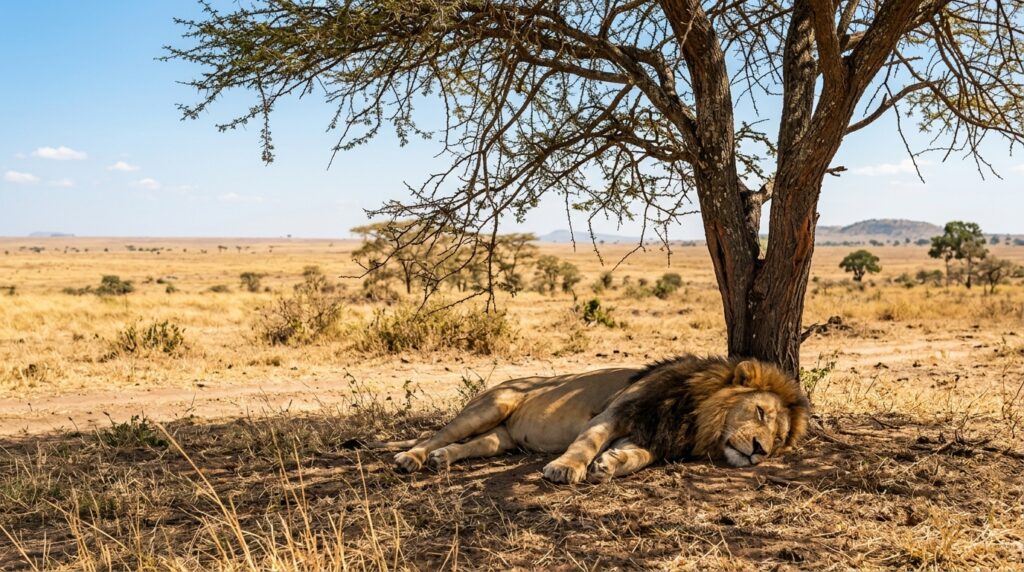
A lion resting in the shade of an acacia tree in the African savanna
The price of an impressive mane: overheating
If a large, dark mane is so useful, why don’t all lions have one? Because it is hot. Thick fur around the head and neck makes it harder for the body to cool down, and lions live under the African sun.
Research has shown that maned males cope with heat worse than lionesses, and dark-maned males have an especially hard time. During hot months, their skin heats up more, they eat less and they have more defective sperm.
This cost is what makes the mane an honest signal: only a strong, healthy lion can afford to carry a large, dark mane. A peacock’s tail works in a similar way: it hampers the bird, and precisely for that reason it reveals the bird’s strength.
Research has not confirmed that the mane protects the neck
The best-known explanation is that the mane shields the neck from teeth and claws, an idea proposed by Charles Darwin. Thick fur may indeed soften a bite or a swipe of the paw slightly.
In 2006, West, Packer and their colleagues tested this hypothesis. They examined where wild lions had wounds, how severe those wounds were and what kind of manes the injured lions had. They found that rivals did not target the neck more often than other parts of the body, and neck wounds were no more dangerous than others.
The researchers found no evidence that the mane provides good protection against injury. If it offers any protection at all, that is a secondary role.
Mane size depends on hormones and climate
Young cubs have no mane. According to the Russian popular science magazine Nauka i Zhizn (Science and Life), a mane may begin to grow at around six months of age, but it reaches full size much later. With age, the mane becomes longer and darker.
The role of testosterone
Hormones, primarily testosterone, strongly influence mane growth. In castrated males, the mane shrinks over time. The reverse also occurs: in Botswana, zoologists have observed several lionesses with manes. Some of them behaved almost like males, marking territory and roaring loudly.
The role of climate
Climate matters as well. On average, the hotter the environment, the shorter and lighter the mane. Lions kept in cooler zoos often grow thicker manes than they would in the savanna. Asiatic lions usually have more modest manes than African lions. For these reasons, a lion’s subspecies cannot be determined from its mane alone.