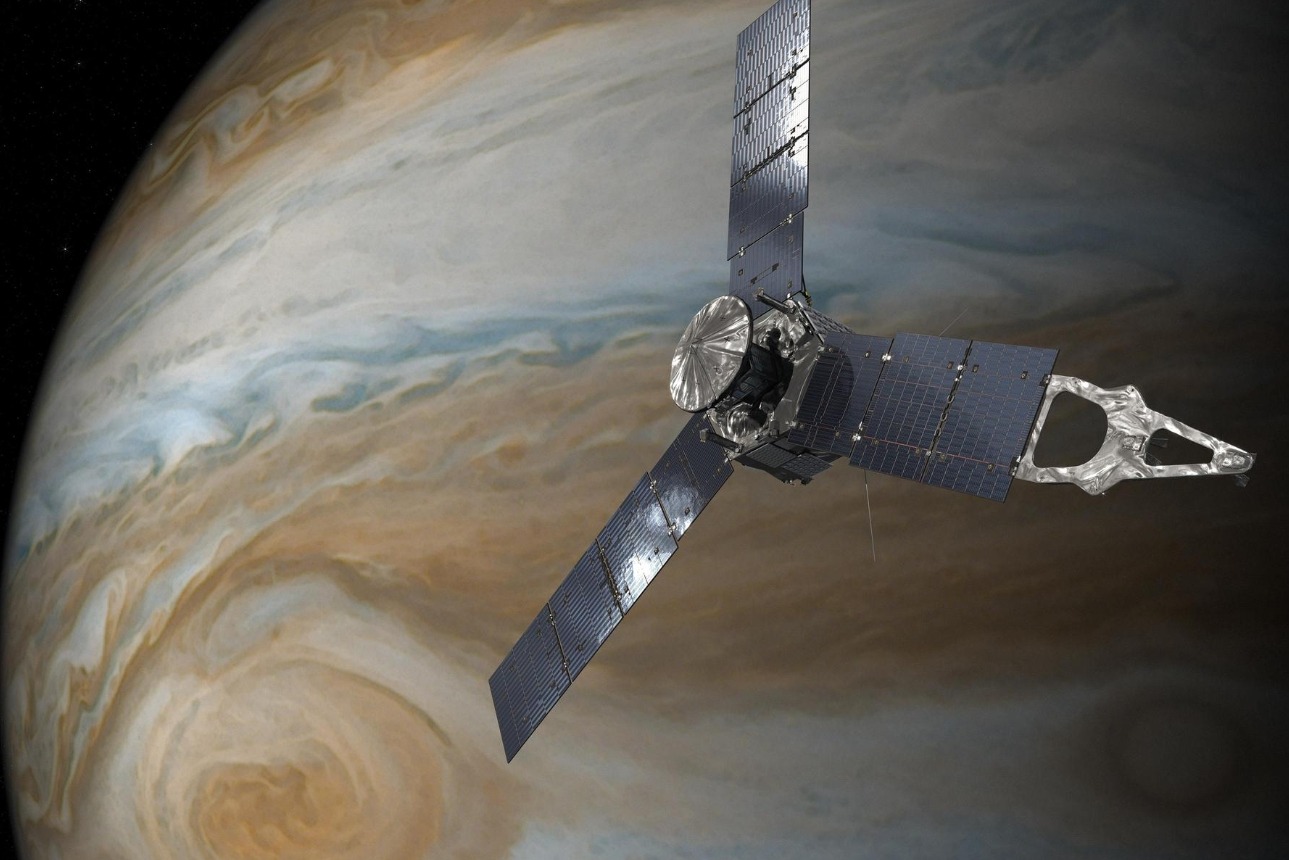
The Juno probe near Jupiter’s cloud bands. Image source: science.nasa.gov
A single Earth lightning bolt releases about 1 gigajoule of energy — enough to split a tree or knock out power to an entire neighborhood. But on Jupiter, the largest planet in the Solar System, lightning strikes are at least 100 times more powerful than ours. A new study has shown for the first time just how diverse and massive weather on Jupiter can be.
When Scientists Discovered Lightning on Jupiter
Lightning on Jupiter has been observed since 1979, when Voyager 1 flew past the gas giant. But all previous spacecraft only detected flashes on the planet’s night side, simply because they were more visible there. Because of this, scientists long couldn’t determine:
Does Jupiter only produce super-powerful discharges, or does it also have ordinary ones comparable to those on Earth?
The answer came from NASA’s Juno probe, which has been orbiting Jupiter since 2016. It flies closer to the giant’s atmosphere than any other spacecraft in history and scans it with a microwave radiometer — an instrument that detects radio emissions from lightning.
A lucky observation window for Jupiter’s lightning opened in 2021–2022. During this time, the planet experienced an unusually calm period in the North Equatorial Belt — a cloud band usually packed with storms. The lull allowed scientists to link specific lightning strikes to specific storms. In addition to Juno, the Hubble telescope also participated in the research.
The Power of Lightning on Jupiter
During four flybys over isolated storms, Juno detected radio pulses from lightning approximately three times per second. During one of the passes, the spacecraft recorded 206 individual flashes. In total, the team led by planetary scientist Michael Wong from the University of California, Berkeley, analyzed 613 microwave pulses.
The result was unexpected: the power of Jovian lightning ranged from the level of an ordinary Earth discharge to values exceeding it by at least 100 times. Other calculations showed that the total energy of a lightning bolt on Jupiter could be 500 to 10,000 times greater than an Earth one. Wong himself notes that since the comparison was made at different radio frequencies, the accuracy of the estimate is limited. In the most conservative case, it’s a hundredfold excess; in a less conservative scenario, the difference could reach a millionfold.
For perspective: a single Earth lightning bolt releases enough energy to power about 200 homes for an hour. If Jupiter’s lightning is thousands of times more powerful, we’re talking about energy capable of powering a small city for several days.
Why Lightning on Jupiter Is Stronger Than on Earth
On Earth, lightning occurs when water droplets and ice crystals collide in a thundercloud, separating positive and negative charges. When the potential difference becomes large enough, an electrical discharge occurs. On Jupiter, the mechanism is similar, but the conditions are completely different.
Earth’s atmosphere is composed mainly of nitrogen. Jupiter’s is made of hydrogen and helium. Hydrogen is heavier in the sense that moist air on Jupiter turns out to be denser than the surrounding gas, making it much harder for it to rise upward. But when moist masses do “break through” the atmosphere, they carry a colossal reserve of energy — and the discharges are correspondingly powerful.
There is another reason as well: the scale of the storms themselves. Jovian thunderstorms grow to heights of over 100 kilometers — that’s 10 times greater than a typical thundercloud on Earth. The higher the cloud and the greater the distance between charges, the stronger the lightning can be.
On Jupiter, charged crystals are made not only of water but also of ammonia — yet another difference from Earth’s thunderstorms that may affect the strength of the discharges.
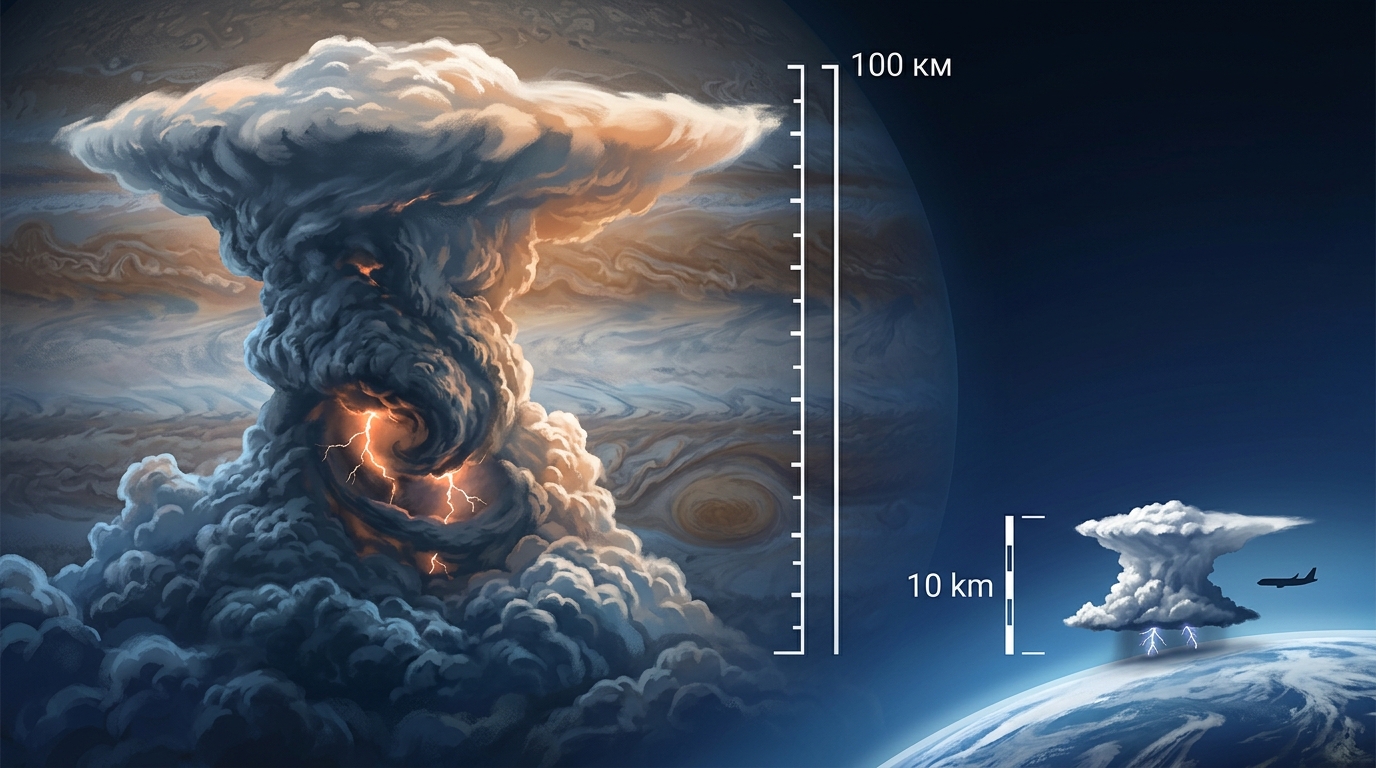
A Jovian storm can reach 100 km in height — 10 times greater than an Earth one
How Scientists Observed Lightning on Jupiter
Researchers gave a special name to the storms that Juno studied: “stealth superstorms.” These are powerful but isolated storms that emerged in Jupiter’s North Equatorial Belt as it transitioned from an unusually calm state to its more typical, turbulent configuration.
It was precisely the isolation of these storms that proved to be a scientific stroke of luck. Normally, lightning on Jupiter forms in wide belts encircling the planet, making it nearly impossible to link a specific discharge to a specific storm. But the stealth superstorms were compactly located — and this allowed scientists to precisely determine the location and power of individual lightning bolts for the first time.
The main surprise of the study was the diversity. Previously, it was believed that all lightning on Jupiter was comparable to Earth’s “superbolts” — the most powerful of our discharges. Now it has been revealed that Jupiter produces a wide spectrum of lightning: from quite “Earth-like” to monstrously powerful.
Lightning on Other Planets in the Solar System
Jupiter is not the only planet with lightning. On Saturn, the Cassini spacecraft detected thunderstorms with a frequency of up to ten discharges per second. On Venus, despite its dense atmosphere of carbon dioxide and sulfuric acid, no convincing evidence of lightning has been found: during its flyby, the Cassini probe did not detect characteristic radio signals. On Mars, bright flashes have been noticed in dust storms, but definitively classifying them as lightning is also not straightforward.
Jupiter, however, remains the absolute record holder for the power of individual discharges. This makes sense: a giant planet, giant storms, giant lightning.
Why Scientists Study Jupiter’s Lightning
Surprisingly, Jovian lightning helps us understand Earth’s thunderstorms. Even on our own planet, lightning remains largely a mystery. Only in recent years have scientists discovered so-called transient luminous events — fleeting electrical flashes in the upper layers of the atmosphere: sprites, jets, and halos. Their nature is still being studied.
Jupiter gives scientists the opportunity to observe “the same physics, but on a different scale.” By comparing lightning in Earth’s nitrogen atmosphere and Jupiter’s hydrogen atmosphere, researchers hope to determine exactly which factors determine the strength of a discharge: atmospheric composition, storm height, or the energy available for convection.