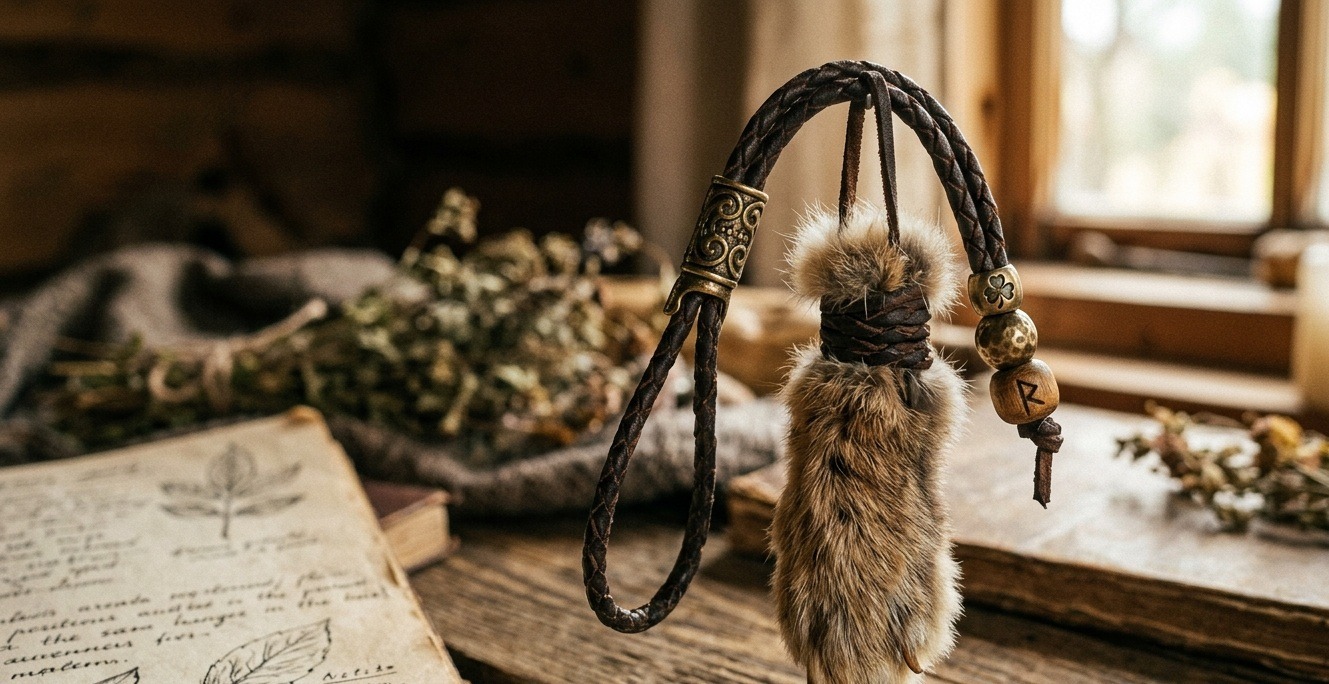
The belief that a hare’s foot brings luck dates back to ancient times
The rabbit’s foot is arguably the most recognizable good luck charm on the planet. People carry it as a keychain, it’s mentioned in movies and video games, and it’s given as a gift “for good luck.” But if you think about it, the idea of cutting off an animal’s paw and carrying it around for luck sounds pretty strange. Where did this superstition come from, and is there any cultural logic behind it?
The Lucky Rabbit’s Foot: How It All Began
The tradition of using parts of a rabbit’s body (or more precisely, a hare’s) as an amulet dates back at least to Ancient Rome. Pliny the Elder in his “Natural History” (77 AD) wrote that carrying a hare’s foot, cut from a living hare, could relieve gout and joint diseases. Of course, from the perspective of modern medicine, this makes no sense whatsoever. But for Romans of that era, the line between a medicinal remedy and a magical ritual was extremely blurred — Pliny’s recipes mixed observations of nature with outright superstitions.
From the 16th to the 19th centuries in Europe, rabbit (and hare) feet were already being used as protective amulets against cramps, rheumatism, and epilepsy. The tradition slowly shifted from “folk medicine” to pure superstition — the foot was less and less rubbed on the sore spot and increasingly just carried in a pocket.
But this talisman truly became a mass phenomenon not in Europe, but in the United States — and here the story takes an interesting turn.
How the Rabbit’s Foot Became a Symbol of Luck in America
The custom of carrying a rabbit’s foot for luck began to be actively documented in the Anglo-American tradition in the early 20th century, and early evidence suggests it was borrowed from African American folk magic. We’re talking about a belief system known as hoodoo — not to be confused with voodoo. Hoodoo is an African American folk magical practice that developed at the intersection of West African spiritual traditions and European folklore.
In West African folklore, the hare is a trickster — a cunning creature that defeats stronger opponents through wit and agility. In West Africa, the hare is not an unambiguously “good” character, but rather a sly one. And for enslaved people and their descendants, it was natural to admire a creature that wins not through strength, but through cunning and courage. The familiar Brer Rabbit from American folktales is precisely an echo of this African tradition.
In 1925, sociologist Newbell Niles Puckett described how in New Orleans, rabbit foot talismans set in silver or gold were displayed in the windows of major jewelry stores on Canal Street, and their sales were enormous. The rabbit’s foot transformed from a dark magical amulet into a popular commercial product.
Why the Left Hind Foot of a Rabbit Is Considered “Lucky”
One of the strangest aspects of this superstition is the strict rules for obtaining the “correct” foot. The luckiest was considered to be specifically the left hind foot. Even better — if the rabbit was killed in a cemetery, at midnight, on a rainy Friday or on Friday the 13th.
Folklorist Bill Ellis calls this logic “inverted elements.” In his view, the various prescriptions for obtaining the amulet are examples of “counterintuitive magic”: to create a lucky charm, one had to gather the maximum number of bad omens together. The left side was “evil.” The hind legs were “worse” than the front ones. A cemetery, midnight, Friday the 13th — all of these were associated with misfortune in folk consciousness. But according to this logic, it was precisely the concentration of “bad” that made the talisman a powerful protector against evil. It’s like a vaccine: a little bit of “poison” is supposed to protect against the “disease.”
It also mattered on whose grave the rabbit was killed. Puckett wrote that former President Grover Cleveland received as a gift the foot of a rabbit killed on the grave of the famous outlaw Jesse James — because “the more wicked the deceased, the stronger the amulet associated with their remains.”
What the Rabbit’s Foot Actually Symbolizes
In both European and African traditions, body parts — hair, bones, paws — were endowed with powerful symbolic meaning. Europeans believed that witches could transform into animals, including rabbits — and a rabbit’s foot could symbolize a “dead witch.” In other words, it wasn’t just a cute souvenir, but material evidence of a victory over evil.
Researcher Bill Ellis explains the general logic of the talisman as follows: possessing an object that embodies a “dangerous Other” — whether a trickster, a villain, or a witch — allows one to neutralize the threat that this “Other” represents. The rabbit’s foot is a fetish, meaning a material object endowed with special spiritual power, which serves as a way to gain control over complex social relations.
A parallel to this is the European superstition of the “Hand of Glory”: a hand cut from a hanged criminal, pickled and turned into a candle. Thieves supposedly could light it during a robbery, and all the inhabitants of the house would fall asleep. The rabbit’s feet sold in New Orleans likely served as a safer substitute for a far more taboo practice — using human remains as magical amulets.
The Rabbit’s Foot Today: A Symbol of Luck or Just a Keychain
Today, the rabbit’s foot is more of a pop culture element than an actual magical object. It’s familiar to players of Stardew Valley and Minecraft, appears in TV series like “Supernatural,” and is sold in souvenir shops around the world. The vast majority of modern “rabbit’s feet” are made from synthetic fur — which is certainly good news for the rabbits themselves.
But behind the cute keychain lies a truly deep cultural history. This small object has traveled a path from a Roman “remedy,” through European beliefs in witches, African trickster traditions, and African American folk magic — to become one of the most recognizable symbols of luck in the world.
From a scientific standpoint, a rabbit’s foot obviously doesn’t bring luck — any controlled study would confirm that. But from the perspective of anthropology and folklore studies, it tells us something important about people themselves: we tend to seek ways to control the chaos around us, even if the only available tool is superstition. And as long as this need exists, good luck charms aren’t going anywhere — only the material they’re made from will change.