Anyone who has ever held a foldable Samsung, Huawei, or Honor has noticed the same thing: there’s a noticeable crease running down the middle of the screen — a fold line that’s visible to the eye and felt by the finger. This isn’t a defect but a design limitation that no manufacturer has yet eliminated. Apple, according to rumors, is preparing its first foldable iPhone — and its main bet may be solving exactly this problem.
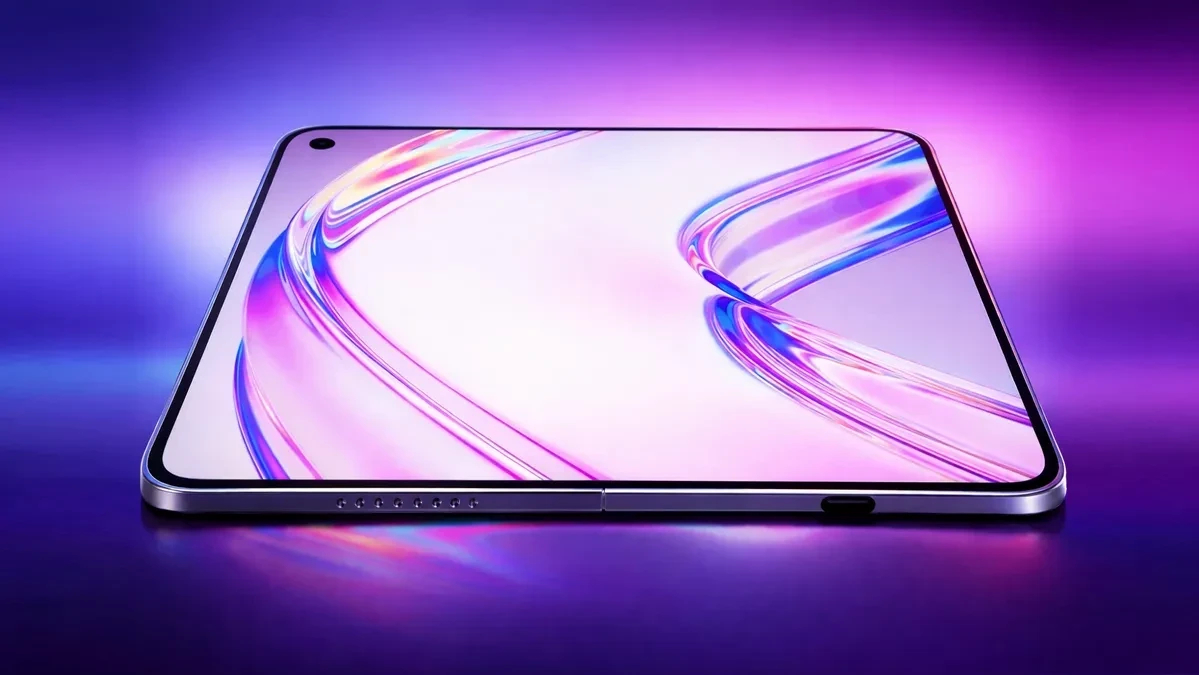
The inner screen of the iPhone Fold will be crease-free. Image: am730.com.hk
Where Does the Crease on a Foldable Smartphone Screen Come From
To understand why the crease appears at all, you need to understand how a flexible screen works. In a regular smartphone, the display is a rigid structure made of several layers: protective glass on top, the matrix underneath, backlighting, and so on. In a foldable phone, the glass is replaced with a thin polymer film, because regular glass would simply crack when bent.
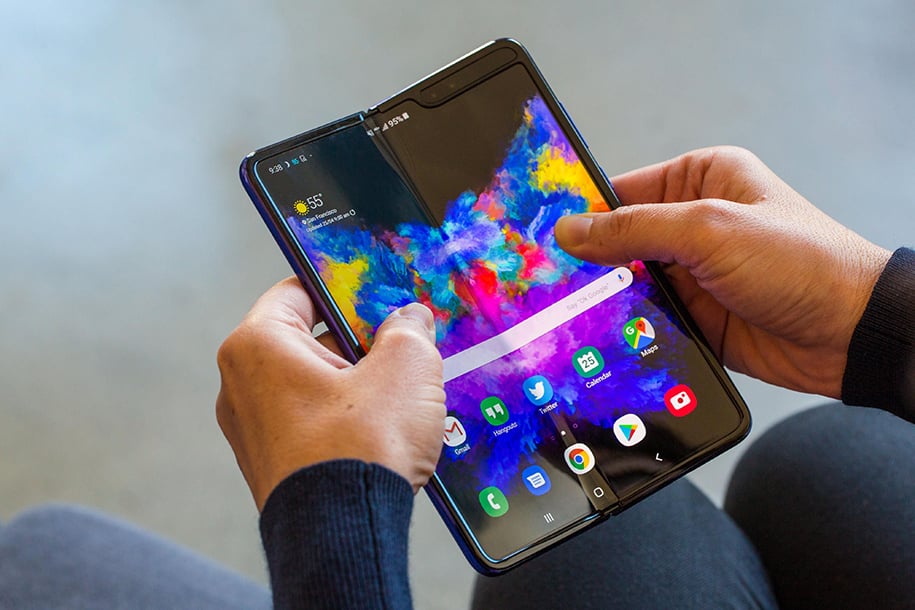
On Samsung devices, the crease is still clearly visible. Image: gsm-store.ru
The problem is that every time the phone is folded, all screen layers compress at the bend point. The polymer film gradually “remembers” this deformation — much like a sheet of paper folded in half: even if you unfold it, the crease mark remains. The smaller the bend radius (meaning the tighter the smartphone folds), the more noticeable the crease. And manufacturers strive to make the folded phone as thin as possible — a contradiction that no one has fully resolved yet.
Beyond the film itself, the internal layers also deform: the polarization filter, touch-sensitive layer, and adhesive layers. Each reacts to bending differently, and together they produce that visible and tactile crease. When watching videos or reading text, the crease is distracting, and it’s especially noticeable against a light background.
Is There a Crease on Samsung Fold and Huawei Screens
Foldable smartphone manufacturers have been fighting the crease for six years — since the release of the first Samsung Galaxy Fold in 2019. The main approaches are:
- Increasing the bend radius. The smoother the curve, the less noticeable the crease. But then the folded phone becomes thicker — a gap remains between the halves.
- Teardrop hinge mechanism. The hinge forms a teardrop-shaped loop when folding rather than a sharp angle. This reduces stress on the screen but doesn’t completely eliminate the crease.
- Improved film materials. Samsung uses ultra-thin flexible glass (UTG — Ultra Thin Glass) approximately 30 microns thick. It’s stronger than polymer but still deforms at the bend point.
- Multi-layer protective coatings. Additional layers distribute the stress but add thickness and cost.
OPPO Find N6, one of the newest foldable smartphones of 2026, is positioned as “the flattest foldable screen in the world.” The Huawei Mate X series and Honor Magic V6 have also significantly improved the crease situation compared to earlier generations. But upon close inspection and under certain lighting, the crease is visible on all these devices. No manufacturer has yet achieved a truly flat screen in the unfolded state.
How Apple Will Eliminate the Crease in iPhone Fold
Apple has not officially announced a foldable iPhone yet. Everything that is known is based on leaks, patents, and analyst predictions — so this information should be treated as rumors, not confirmed facts.
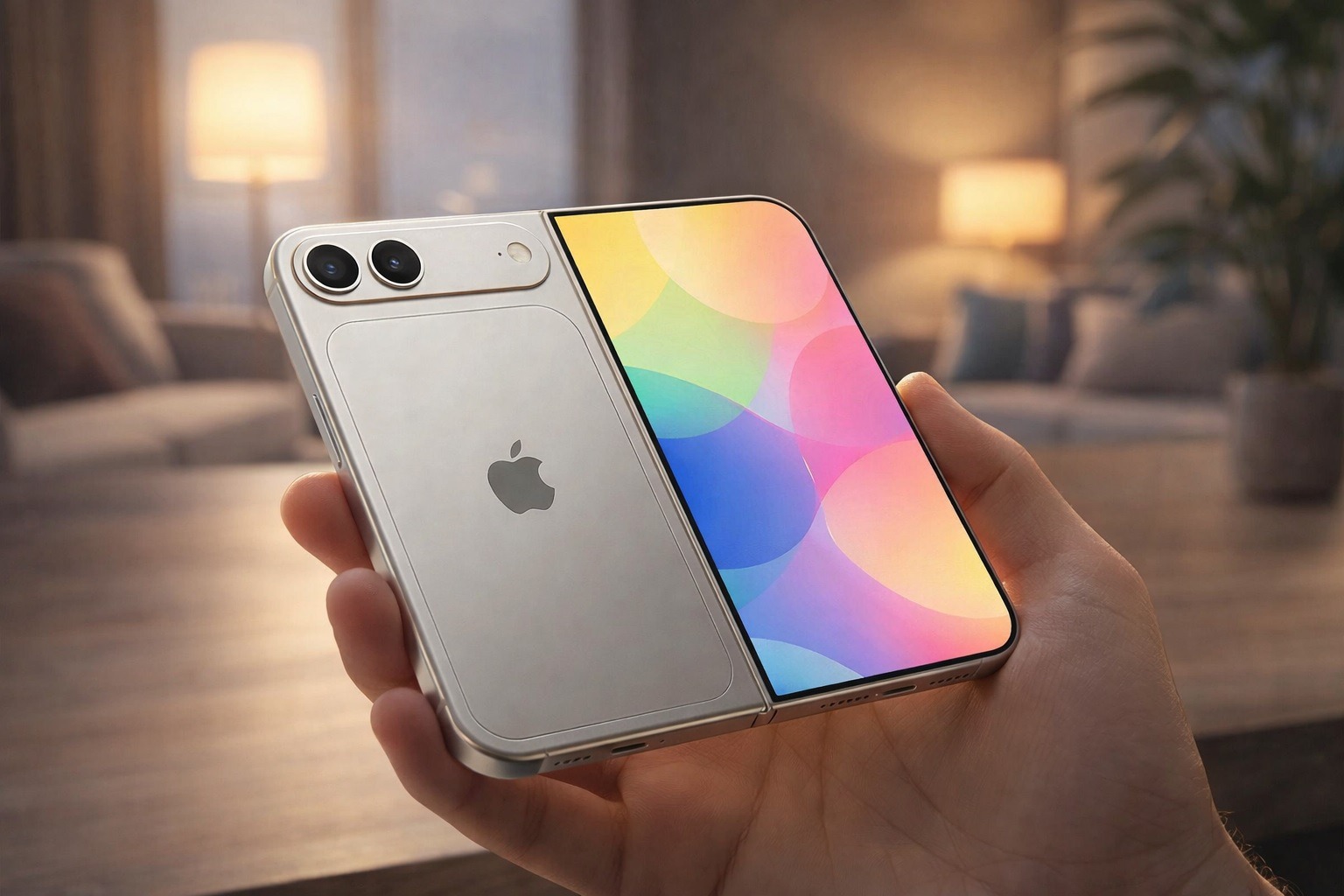
When unfolded, you’ll get a virtually full-fledged mini-tablet. Image: bez-kabli.pl
According to several sources, Apple is working on a fundamentally different approach to flexible display construction. Key directions mentioned in patents and industry reports:
- A special tension compensation system. Instead of simply bending the screen, the mechanism slightly “stretches” it at the fold point when opening, flattening the surface. This requires a more complex and precise hinge.
- A new type of protective coating. Reportedly, Apple is developing a coating in collaboration with suppliers that combines the properties of glass and polymer — rigid when unfolded, but flexible when folding.
- Increased bend radius without increased thickness. Through more sophisticated hinge mechanism engineering, the device can fold with a larger radius while remaining thin when closed — achieved by redistributing internal components.
It’s important to understand: all of this consists of engineering solutions that have not yet been confirmed by a finished product. But Apple’s approach is typical for the company: not to be first to market, but to enter when the solution to a key user problem has been refined to an acceptable level.
Why Samsung and Huawei Don’t Use Crease-Free Screens
If the solution is “obvious,” a logical question arises: why haven’t Samsung or Huawei done the same thing in six years? There are several reasons.
First, it’s a matter of cost. A more complex hinge with a tension compensation system means dozens of additional parts, each requiring micron-level precision. The manufacturing cost of such a mechanism can be several times higher than current solutions. For Samsung, which sells foldable smartphones by the millions and competes partly on price, this is critical. Apple traditionally operates in the premium segment and can afford to build this cost into the device’s price.
Second, mass-producing complex mechanisms is a separate challenge. It’s one thing to make a perfect prototype, another to manufacture millions of devices with consistent quality. Apple has spent decades building supply chains with strict quality control, giving it the ability to implement solutions that are still too risky for other manufacturers in mass production.
Third, competitors have already invested in their own technologies and are iterating on top of them. Switching to a fundamentally new design means devaluing years of development and restructuring production. Apple, having no legacy in foldable devices, starts with a clean slate and can immediately use a more advanced approach.
When Will iPhone Fold Come Out and How Much Will It Cost
According to analyst forecasts, a foldable iPhone may appear in 2026–2027, but Apple has not named exact dates. The iPhone Fold release date is one of the most frequent queries among those following Apple news, but for now it remains a matter of rumors.
As for the price, there are no specific leaks either. But logic suggests that a device with such a complex design will cost more than current foldable flagships from competitors. For comparison: the Samsung Galaxy Z Fold starts at $1,799, the OPPO Find N6 starts at 9,999 yuan (approximately $1,370). If Apple positions its foldable iPhone as an ultra-premium device, the price could exceed $2,000.
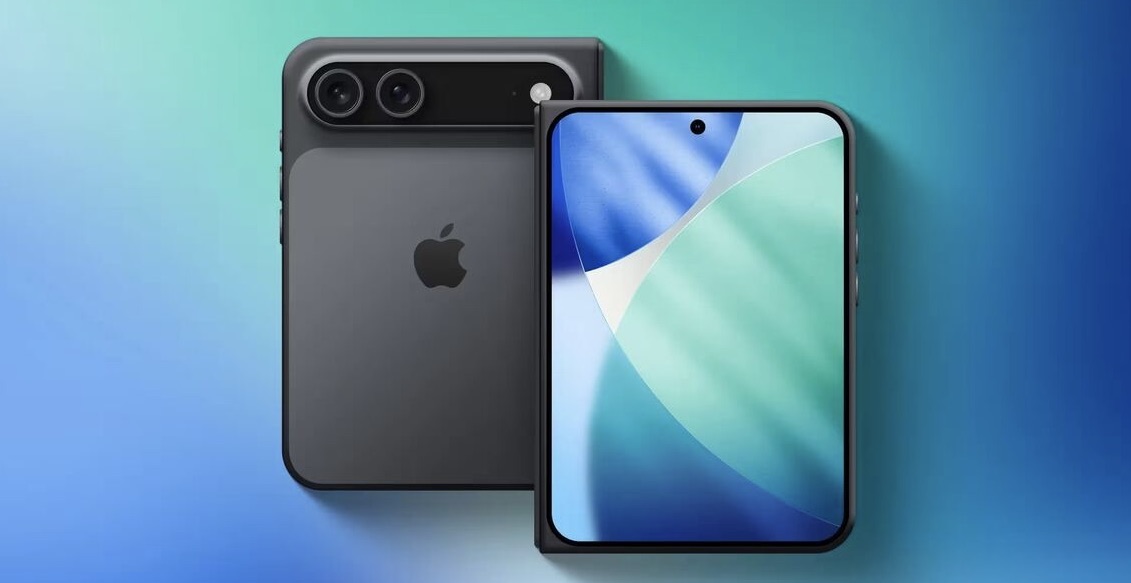
Also, the iPhone Fold will be more square than other smartphones in this form factor. Image: 9to5mac.com
Foldable smartphones are still a niche category. For most users, a regular iPhone covers all their needs. The foldable format makes sense for those who value a large screen in a compact body: for working with documents, multitasking, and watching videos.
If Apple truly solves the crease problem, it will remove the main irritant that turns away many potential buyers of foldable smartphones. A flat, smooth screen without a visible crease is not just an engineering achievement but a fundamentally different user experience: a screen that behaves like a regular display, not a compromise.