
A familiar sensation: the ice cream is delicious but too cold
Just take too big a bite of ice cream or a greedy gulp of an ice-cold drink — and your forehead is pierced by a short, not the most intense pain, but a very unpleasant one. This phenomenon is familiar to most people, and it has an official medical name that’s difficult to pronounce and remember: sphenopalatine ganglioneuralgia. In simpler terms — “brain freeze.” But behind this comical name lies a serious mechanism that interests neurologists around the world.
What Is ‘Brain Freeze’: Symptoms and Sensations
“Brain freeze” is a brief but intense headache that occurs when the palate (the roof of the mouth) is rapidly cooled. The scientific name — sphenopalatine ganglioneuralgia — describes a brief but intense headache caused by rapid cooling and subsequent rewarming of the palate.
The pain from “brain freeze” is sharp and acute — sometimes even more intense than a migraine. People describe it as throbbing or stabbing, and it is felt in the area of the forehead, temples, behind the eyes, or around the bridge of the nose. However, unlike other types of headaches, “brain freeze” comes and goes quickly — usually lasting from a few seconds to two minutes.
An important point: “brain freeze” is not the same as tooth sensitivity to cold, although both conditions can occur under similar circumstances. “Brain freeze” is specifically a headache, not a toothache.
Why Ice Cream Causes Headaches: The Mechanism of ‘Brain Freeze’
To understand where this pain comes from, you need to remember one important thing: the brain really doesn’t like when things change, especially too quickly, and “brain freeze” is a mechanism that prevents you from doing so. That’s how neuroscientist Dwayne Godwin from Wake Forest Medical Center explained it.
Here’s what happens step by step:
- When you eat or drink a large amount of very cold food or liquid, the temperature of the palate drops sharply.
- Blood vessels in this area automatically constrict — this is a survival reflex aimed at preserving body temperature.
- Then the vessels quickly dilate back, and this dilation sends a pain signal to the brain through the trigeminal nerve — a large nerve whose upper branch extends into the forehead area.
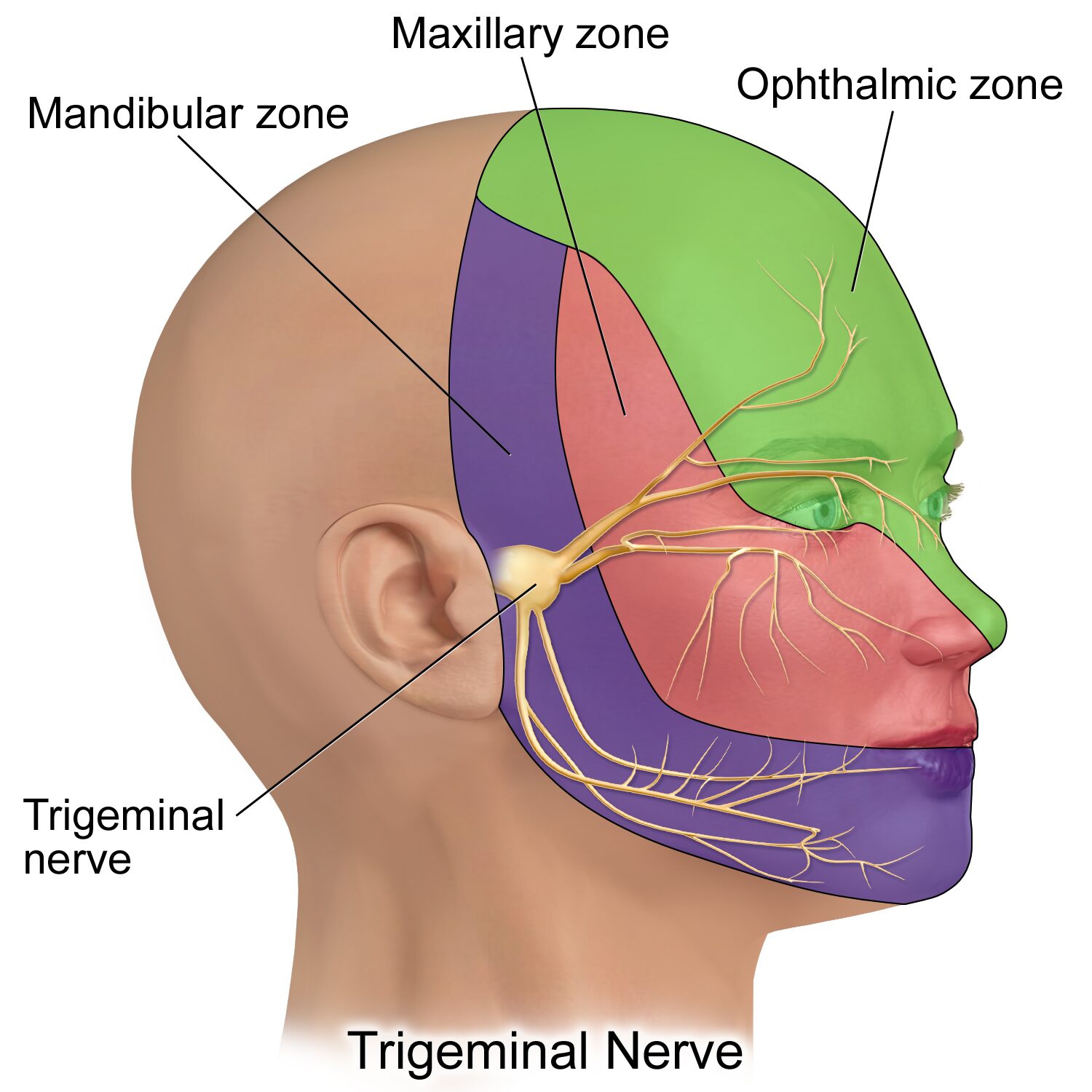
Diagram: cold affects the palate, blood vessels react, and the trigeminal nerve transmits the pain signal
Essentially, you don’t feel pain in the brain itself — the brain cannot feel pain, despite its billions of neurons, but the pain during “brain freeze” is perceived by receptors in the brain’s membranes (meninges), where two arteries meet.
There is another curious effect — so-called referred pain. Pain signals from the palate are transmitted through the maxillary branch of the trigeminal nerve, but since branches innervating the forehead and the rest of the face also extend from the same trigeminal nerve, the signal “spreads” — and you feel pain in your head, not in your mouth. This is exactly why cold in the mouth results in pain in the forehead.
Is ‘Brain Freeze’ Connected to Migraines and Headaches
The most interesting thing about “brain freeze” is not the pain itself, but what it can reveal about migraines. Research shows that the same vascular mechanisms and the same nerve — the trigeminal nerve — likely underlie both “brain freeze” and migraines.
One study showed that women who suffer from migraines were twice as likely to experience “brain freeze” compared to those who don’t get migraines. In a large Taiwanese study involving nearly 9,000 adolescents, 40% of participants experienced “ice cream headache,” and those who already suffered from migraines encountered it significantly more often.
Why does this matter? According to neuroscientists, studying “brain freeze” is useful for understanding other types of headaches. You can’t simply induce a migraine or cluster headache in people, but you can easily induce “brain freeze” without long-term consequences, and use this data to develop better treatment methods.

Researchers study changes in brain blood flow to better understand the nature of headaches
In a small study published in the FASEB journal, 17 participants drank ice water through a straw aimed at the palate, while researchers tracked changes in blood flow in their brains using ultrasound. It turned out that pain appeared when the anterior cerebral artery rapidly dilated and blood rushed to the brain, and disappeared when the artery constricted back. This is a direct indication that sudden changes in cerebral blood flow can cause pain — possibly the same principle is at work in migraines.
However, there is a nuance here. Some experts point out that the change in blood flow may be a consequence rather than a cause of the pain — the cold irritates the nerve, pain appears, and only then does blood flow change. The question of cause and effect has not been fully resolved.
How to Get Rid of ‘Brain Freeze’: Quick Methods
The good news is that “brain freeze” is completely harmless. It is a normal physiological reaction to a sudden temperature change in the mouth, and it does not indicate any diseases. In 98% of people, the pain passes in less than five minutes, usually just 30-60 seconds. But why endure it when you can help yourself faster?
Here are proven methods:
- Press your tongue or thumb against the roof of your mouth — the warmth from them will help warm up the cooled area faster and stop the pain reflex.
- Drink warm water — this will speed up the return of normal temperature in your mouth.
- Cover your mouth and nose with your palms and breathe — the warm exhaled air will help warm the palate and constrict the dilated blood vessels.
Taking aspirin or acetaminophen for “brain freeze” is practically pointless: for most people, the pain is so short-lived that it passes before a pill has time to take effect.

The simplest way to relieve ‘brain freeze’ — press your tongue against the roof of your mouth
Even better — just don’t rush. A study by Maya Kaczorowski showed that those who ate a serving of ice cream in less than 5 seconds experienced “brain freeze” more than twice as often (27%) compared to those who ate slower than 30 seconds (12%). Small portions, pauses between sips — and the problem simply won’t occur.
Why Does ‘Brain Freeze’ Occur and Is There Any Benefit to It
It may seem strange that the brain “punishes” you for eating ice cream. But this reflex most likely has an evolutionary purpose. Rapid dilation of blood vessels in the brain may be a protective mechanism: the sharp pain makes you slow down, and the body has time to adapt to the cold — this potentially prevents damage to brain tissue from overcooling.
It’s as if a fire alarm went off in your apartment — yes, it’s deafening and unpleasant, but that’s precisely why you pay attention. “Brain freeze” is the body’s way of hitting the brakes and telling you: “Slow down, don’t rush.”