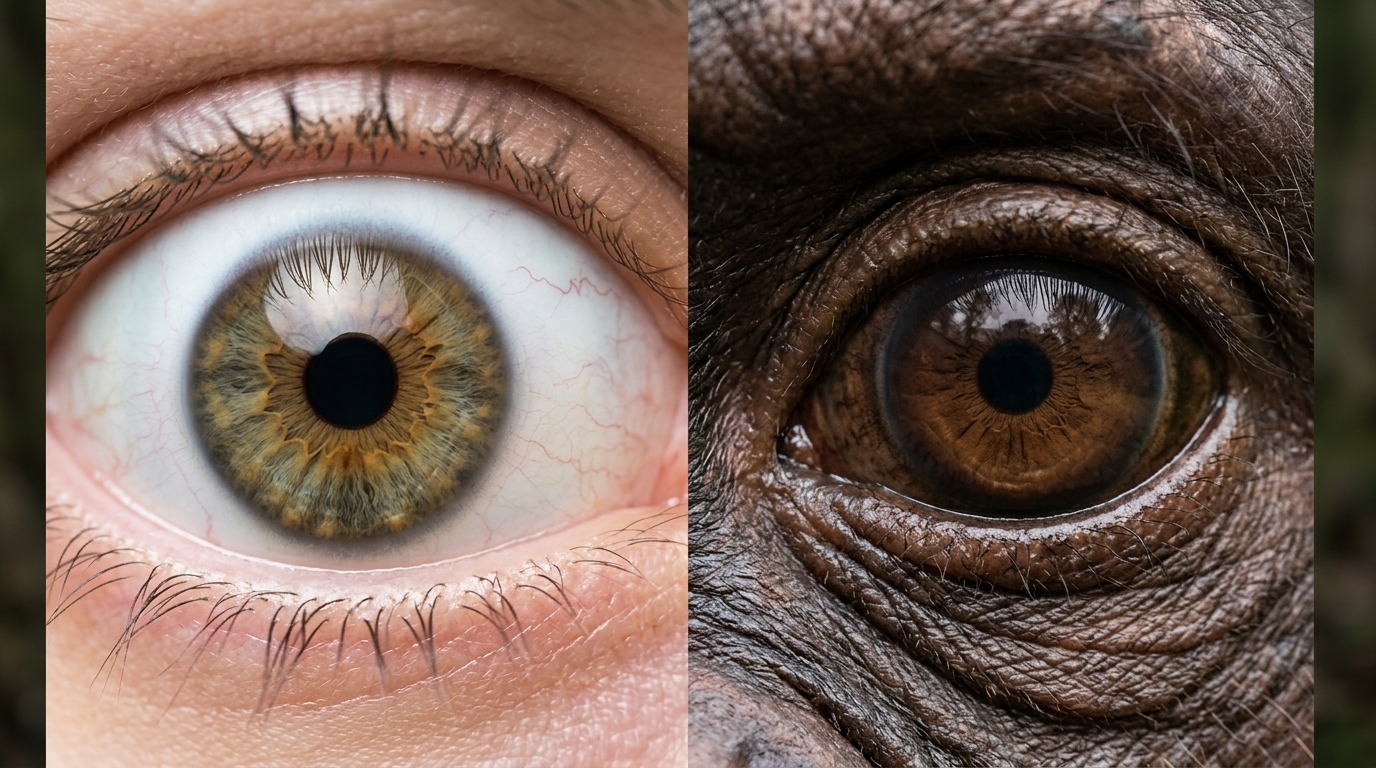
A human eye with a bright white sclera and a chimpanzee eye with a dark one — the difference is immediately visible
The human eye has an unusual design: the bright white sclera surrounding the colored iris makes it possible to instantly read where someone is looking. This feature was long considered a unique evolutionary tool of our species — a kind of superpower for silent communication. However, recent research shows that primates and even some other mammals also have light-colored whites of the eyes and are quite capable of tracking each other’s gaze.
Why Humans Have White Whites of the Eyes While Apes Have Dark Ones
If you’ve ever looked into a chimpanzee’s eyes, you may have noticed that the area around the iris isn’t white but dark, brownish. The sclera — the dense membrane of the eyeball visible around the iris — is pigmented in most primates. In humans, however, it is virtually devoid of pigment, which is why it appears bright white.
This contrast between the white sclera, the colored iris, and the black pupil turns the human eye into a “direction pointer.” Even from across a room, you can notice exactly where another person is looking or whom they’re glancing at.
Our closest relatives have a different situation. In chimpanzees, the sclera is usually noticeably darker than the iris — dark brown. In bonobos, on the contrary, the sclera is slightly lighter than the iris, but still far from white. It would seem this should prevent them from “reading” the gaze direction of their peers. But is that really the case?
What Is the Purpose of the White of the Eye
According to IFL Science, the main scientific idea explaining white whites of the eyes in humans is called the cooperative eye hypothesis.
The essence of the hypothesis is that the bright white sclera evolved in humans because it was advantageous for our ancestors to see where their peers were looking.
Imagine: a group of ancient hunters is tracking prey. One only needs to glance sideways — and the others instantly understand that he’s spotted something. No need to shout, gesture, attract a predator’s attention, or scare off the game. The white whites of the eyes became a kind of “silent walkie-talkie” for coordinating group actions.
Experiments confirmed that humans orient themselves specifically by eye movement rather than head turns. When human infants and apes watched an experimenter, children more often followed the direction of his eyes, while apes followed the turn of his head. This supports the idea that conspicuous eyes became a key channel of nonverbal communication in our species.

For ancient hunters, the ability to silently coordinate actions through gaze could have been a matter of survival
Another Function of the Eye’s Sclera
Cooperation during hunting is only part of the picture. According to scientists, the ability to accurately read gaze direction underlies many complex human skills: from language learning and joint attention (when two people look at the same object and both understand it) to the transmission of cultural information.
There are other hypotheses as well. One of them suggests that the white sclera may be a sign of health and youth, and therefore plays a role in sexual selection. Yellowed or reddened whites of the eyes in humans are indeed perceived as a signal of fatigue or illness.
However, not all scientists agree that cooperation was the driving force. Some point out that scleral depigmentation could have simply been a byproduct of reduced aggression during the so-called “self-domestication” of our species — similar to how domesticated animals often develop lighter coloring.
Can Apes Track Each Other’s Gaze
For a long time, it was believed that the dark sclera of primates made their gaze “invisible” to peers — supposedly helping them conceal intentions in a competitive environment. But in 2019, an international team of scientists tested this idea.
The researchers compared the coloring of the sclera and iris in more than 150 humans, bonobos, and chimpanzees and discovered an interesting pattern. Although the sclera of primates is indeed darker than that of humans, the contrast between the sclera and iris in all three species turned out to be comparable. In bonobos, the sclera is lighter than the iris — as in humans. In chimpanzees, it’s the opposite — the sclera is darker, but the iris is quite light, amber. As a result, gaze direction can still be read.
Gaze following is an important part of many types of behavior that were considered exclusively human, and the results of the study show that apes can also engage in such behavior. The work was published in the journal Proceedings of the National Academy of Sciences (PNAS).

In bonobos, the sclera is noticeably lighter than the iris — the contrast allows tracking gaze direction
Why White Sclera Is Not Exclusive to Humans
The next blow to the concept of the “unique human eye” came from a large-scale 2023 study. Scientists analyzed more than 1,000 photographs of 230 wild chimpanzees from the Ngogo community in Kibale National Park, Uganda. This is the largest sample of wild chimpanzees ever studied in this context.
The result was unexpected: 15% of chimpanzees had fully or predominantly white sclera in at least one eye. Another 41% had partially depigmented sclera — light brown with noticeable white patches. White whites of the eyes were especially common in infants under one and a half years old (about 70%), and the sclera typically darkened with age.
The researchers also examined the eyes of 70 species of zoo animals and found white sclera in at least 19 species — from gorillas and geladas to leopards and dingoes. The work was published in the Journal of Human Evolution.
One of the study’s authors, Aaron Sandel, noted that if white sclera gave an advantage to our ancestors, natural selection could have acted on developmental patterns that already existed in our ape ancestors. In other words, evolution didn’t invent white eyes from scratch — it reinforced a trait that was already occasionally present.
What White Whites of the Eyes Tell Us About Human Evolution
The story of white whites of the eyes is a good example of how scientific understanding changes as data accumulates. Until recently, it seemed that there was a chasm between human eyes and those of other primates: we are open and cooperative, they are secretive and competitive. Reality, as usual, turned out to be more complex.
White sclera in humans is still the norm — it is indeed rare among primates. But it is not an absolute uniqueness. Some chimpanzees and other species do have light-colored whites of the eyes, and these animals are quite capable of reading gaze direction. This doesn’t negate the fact that the human eye is one of the most powerful tools of nonverbal communication in nature, but it reminds us that the boundary between “human” and “animal” doesn’t always run where we are accustomed to seeing it.
So the next time you glance at someone across the room — know that your superpower is real, works excellently, and truly helped our species build the most complex social bonds. It’s just slightly less exclusive than previously thought. As for giving that kind of look to a chimpanzee — scientists recommend against it, just in case.