Ancient clay figurine of a human — our ancestors literally connected themselves with the earth
The word “human” seems so obvious that there’s nothing to explain. But behind it lies an astonishing history — from ancient roots meaning “earthly creature” to Diogenes’ plucked chicken and the Swedish naturalist who first placed humans alongside apes. How did we decide what it means to be human, and why is this question still not settled?
The Origin of the Word “Human”
The English word “human” came from the Latin humanus, which is related to homo — the Latin word for a human being. The root goes even deeper: in Proto-Indo-European, the word dhghem- meant “earth,” and the derived form literally translated as “earthly creature” — as opposed to gods. In other words, if gods were “sky dwellers,” then humans were “those who belong to the earth.” This same meaning can be traced in Sanskrit, Latin, Gothic, and other ancient languages: our distant ancestors called themselves “earthlings” long before any science fiction.
The Russian word “chelovek” (человек) is structured differently but is no less interesting. It consists of two parts. The first, chelo (чело), in Old Russian meant “forehead,” and in a broader sense — “top,” “front part.” The second part traces back to the word vĕkŭ (вѣкъ) — “strength, clan, generation” (from which the Russian word “vek” meaning “century” also derives). So “chelovek” literally means “the one who stands at the head of the clan” or “a being with strength and lineage.” Not from the earth, but from society.
What It Means to Be Human
The ancient Greeks were among the first to attempt a strict definition of a human being. When Plato defined a human as “a featherless biped,” Diogenes plucked a rooster, brought it to the Academy, and declared: “Behold, Plato’s human!” After this, Plato amended his definition, adding “with broad flat nails.”
This episode is not just a funny anecdote. It shows how difficult it is to formulate a definition that separates humans from all other living creatures. Any formal description — two legs, no feathers, has nails — can easily be refuted with a counterexample. Plato’s student Aristotle took a different approach: he called humans zoōn politikon — a “political animal,” emphasizing our ability to live in society and create laws.
During the Middle Ages and the Renaissance, humans came to be called animal rationabile — a “rational animal.” This definition held for centuries and, in general, worked fairly well. Until one Swedish naturalist decided to approach the matter from another angle.
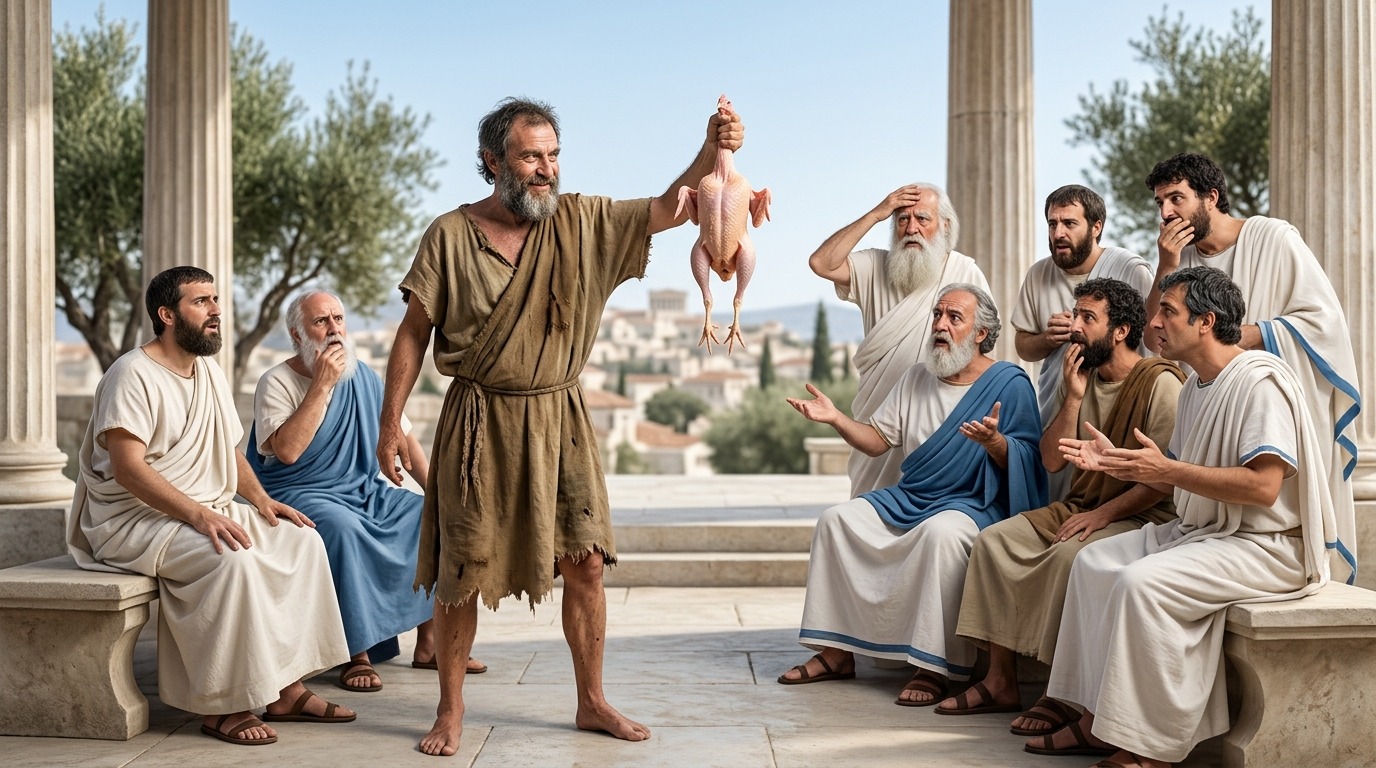
Diogenes with a plucked chicken in Plato’s Academy — one of the most famous philosophical disputes
Who Coined the Term Homo Sapiens
Carl Linnaeus (1707–1778), a Swedish biologist and physician, formalized binomial nomenclature — the modern system of naming organisms. He is considered the “father of modern taxonomy.” But one of his most revolutionary steps had nothing to do with flowers or beetles — it concerned us.
Linnaeus was the first naturalist to include humans in the animal kingdom. In 1735, he placed humans in the class of quadrupeds (Quadrupeds) and the order Anthropomorpha, which included the genera Homo (humans), Simia (apes), and Bradypus (sloths). Later, in the 10th edition of “Systema Naturae,” he introduced new names — Mammalia and Primates — and gave humans the full binomial name Homo sapiens.
The reaction was predictable. Not everyone accepted the decision to include humans among animals. The Dutch naturalist Gronovius wrote to Linnaeus in a letter dated September 1, 1735, stating that he disagreed:
Although man stands first among animals, he should be considered as surpassing all other living creatures, created by God for the pleasure and benefit of man.
But Linnaeus was stubborn: he challenged critics to name even one fundamental difference between humans and apes based on the principles of natural history. No one could.

Carl Linnaeus at work — the naturalist who classified all living things, including humans
Why Homo Sapiens Means “Wise Man”
Linnaeus not only placed us among the primates but also gave us the name we still carry. He distinguished humans from other animals of the same order Anthropomorpha by the ability to “know thyself” — Nosce te ipsum. This led Linnaeus to assign the genus Homo the species epithet sapiens — “wise” or “rational” — when he began using binomial nomenclature in the 1750s.
It turns out that our scientific name — Homo sapiens, “wise man” — is not so much a description of anatomy as a philosophical statement. Linnaeus was essentially saying:
What makes us special is not our teeth, not our nails, and not our bipedalism, but our capacity for self-awareness.
And here the story comes full circle: if Proto-Indo-European peoples millennia ago defined humans through their connection to the earth — “earthlings” as opposed to heavenly gods — then Linnaeus defined us through reason and self-awareness.
When Humans Stopped Seeing Themselves as Part of Nature
A separate question is when humans first began to think of themselves as something distinct from the rest of the living world. There is no exact answer, but a reasonable estimate is about 40,000 years ago. That is when the first evidence of myths, totems, and rituals appears — attempts to control the surrounding world and set oneself apart from it.
Then agriculture, religion, and cultural traditions increasingly reinforced the idea that humans are something separate. But biologically, of course, this is not the case: we are products of evolution just like a whale, a shrew, or a Gila monster. We are simply the only species that asks what makes it different from the rest.
And perhaps the main lesson of this story lies in a paradox. The more we learn about ourselves, the harder it becomes to draw a clear boundary between “us” and “them.” Proto-Indo-Europeans called themselves “earthlings.” Plato called us “featherless bipeds.” Linnaeus placed us in the same order as chimpanzees. Each successive definition was more precise than the last — and each shattered the illusion of our uniqueness. The question “what is a human?” remains open — and perhaps that very fact is what makes us human.