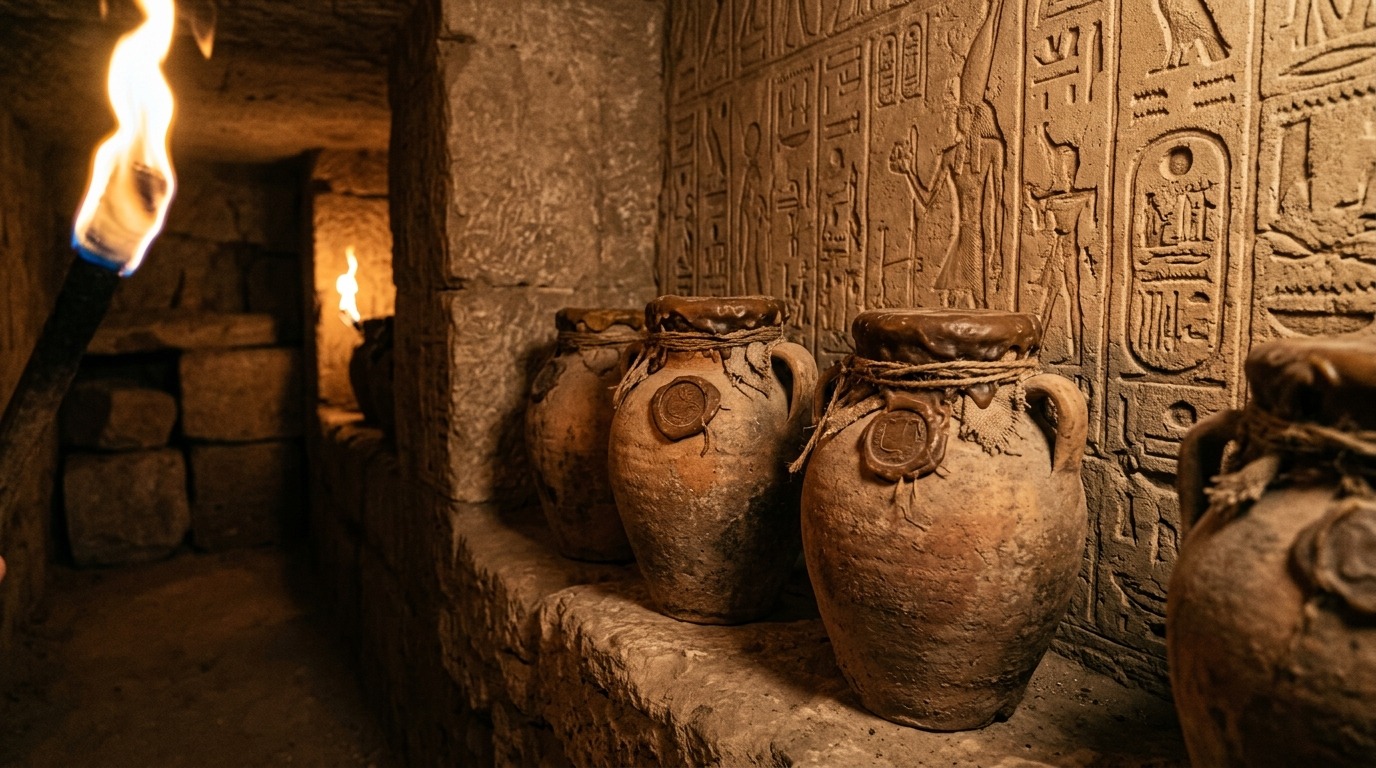
Ceramic vessels with wax seals in an Egyptian tomb
Honey is perhaps the only natural product that needs no refrigerator, no preservatives, and no vacuum packaging to remain edible for years and even centuries. Bread molds within a week, milk sours in days, yet a jar of honey sits calmly on the shelf and nothing happens to it. How does it manage this? The answer lies in an amazing combination of chemistry, biology, and the work of bees.
Was There Honey in the Egyptian Pyramids
You’ve probably heard the beautiful story: supposedly, pots of honey over three thousand years old were found in Tutankhamun’s tomb, and the honey turned out to be edible. This story is retold everywhere, even on niche popular science websites. But if you dig deeper, everything turns out to be more complex and interesting.
Indeed, archaeologists have repeatedly found vessels in ancient Egyptian tombs that once contained honey. In Tutankhamun’s tomb, opened by Howard Carter in 1922, there were also such vessels. However, all the honey in them had dried out, and scientists judge the contents by the dried residue on the walls.
Vessels were found in Tutankhamun’s tomb. All the honey had naturally dried out. But the residue discovered inside allowed researchers to determine that there had indeed been honey there.
Moreover, the story about archaeologists tasting ancient honey and finding it edible most likely arose from confusion. American researcher Theodore Davis, who worked in the Valley of the Kings, discovered a vessel with a thick liquid in the tomb of Tutankhamun’s ancestors and assumed it was honey. But it later turned out to be natron — a natural soda that Egyptians used for mummification. Nevertheless, the words about “possible honey” entered the literature and became surrounded by legends.
Does this mean honey can’t last that long? Not at all. The chemical properties of honey themselves indeed allow it to remain stable for millennia, and here’s exactly how it works.
Why Honey Doesn’t Spoil
For food to spoil, microorganisms must multiply in it: bacteria, fungi, yeasts. They need water to live. And it’s with water that the first secret of honey begins.
- Low moisture content. Natural honey contains only 15–18% water, while most foods contain 60–90% water. Scientists measure water availability for microbes using a metric called “water activity” — from 0 to 1. Most bacteria need a level of at least 0.75 for growth, mold needs at least 0.70. Honey’s water activity is only about 0.6. At this moisture level, bacteria literally become dehydrated and die: through osmosis, honey draws water out of their cells.
- High acidity. Honey’s acidity (pH 3.2–4.5) is comparable to that of orange juice. Most pathogenic bacteria prefer a neutral environment and simply cannot survive in such conditions. This acidity is provided by organic acids — primarily gluconic acid, which is formed by the action of bee enzymes.
- Hydrogen peroxide — a built-in antiseptic. Bees add a special enzyme to honey — glucose oxidase. It oxidizes glucose and in the process releases a small amount of hydrogen peroxide (H₂O₂) — yes, the same substance used to treat wounds. The concentration is low but sufficient to suppress microbial growth.
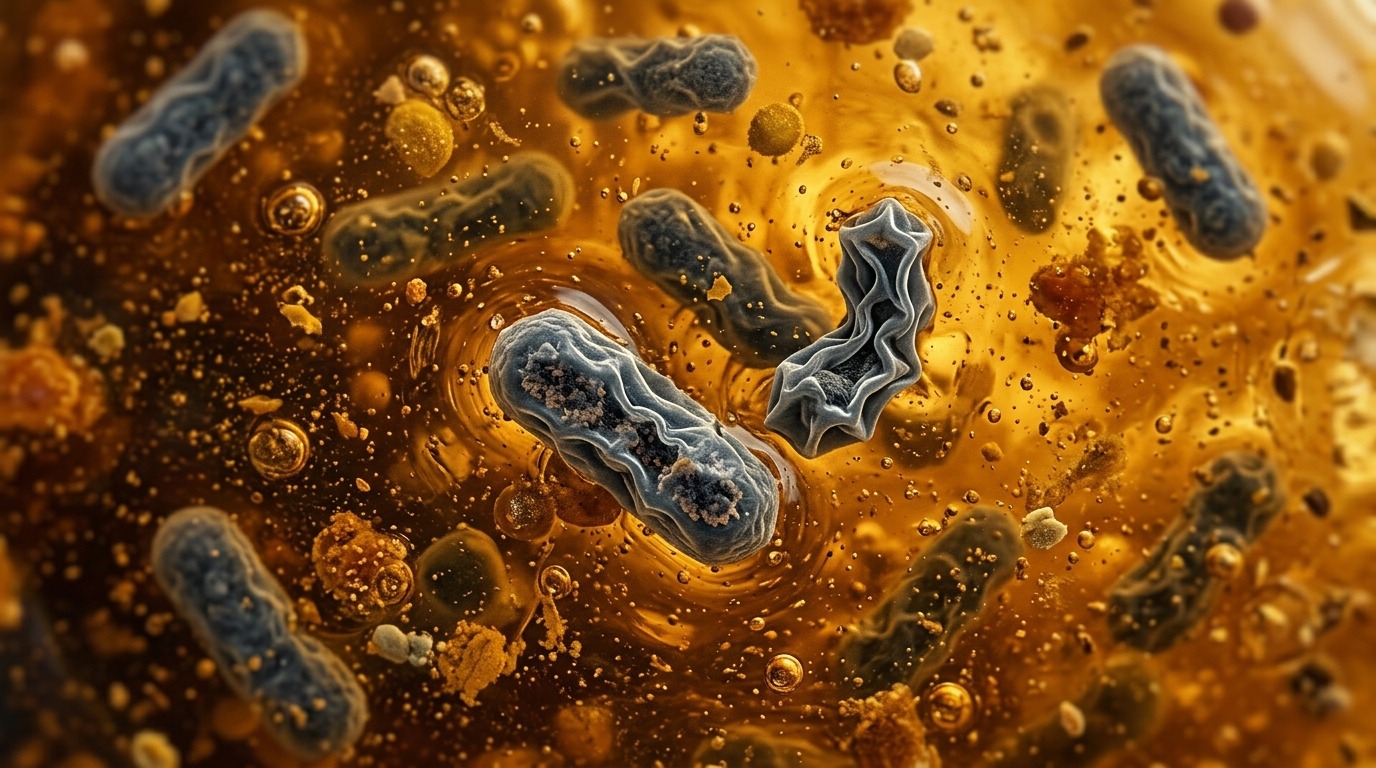
Bacterial cells lose water and die in a super-concentrated sugar solution
How Bees Turn Nectar Into Honey
Honey doesn’t appear in the hive ready-made — bees produce it from nectar collected from flowers. Nectar is an aqueous sugar solution containing 60–80% water. You’d think it would be an ideal environment for microbial growth. But bees radically change its composition.
First, bees repeatedly process the nectar, passing it to one another and adding enzymes. Then they spread the nectar across comb cells and vigorously fan their wings, creating an airflow. This evaporates excess water — moisture content drops from 60–80% to those same 17–18%. When the honey has “ripened,” bees seal the cell with a thin layer of wax, creating a naturally airtight package.
In essence, bees serve as a natural preservation factory: they remove water, add antibacterial enzymes, and hermetically seal the product. The result is a super-concentrated sugar solution (about 80%) in which life for microorganisms is virtually impossible.
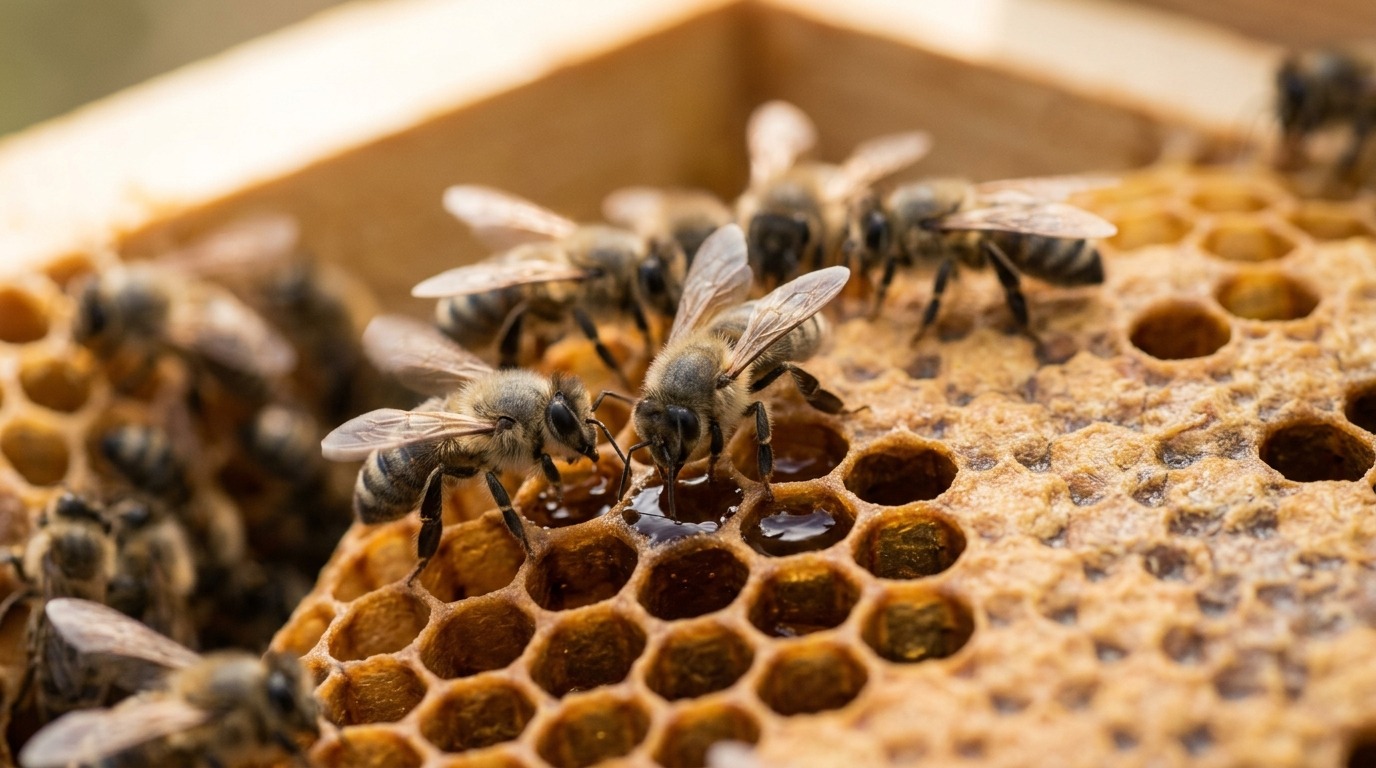
Bees fan the nectar cells with their wings, evaporating excess water
How Honey Was Used in Medicine
Honey isn’t just a product that doesn’t spoil on its own. It’s capable of protecting other things from spoilage as well. Ancient civilizations knew this long before chemistry existed as a science.
Ancient Egyptians used honey for medical purposes: they applied it to wounds and burns, and used it to treat skin and eye diseases. The logic is simple: honey creates an environment on the wound surface where bacteria cannot multiply, while simultaneously drawing excess moisture from damaged tissues and releasing micro-doses of hydrogen peroxide.
Greek physicians used honey for wound healing, and Roman soldiers carried honey-preserved foods on their campaigns. There are even suggestions that Alexander the Great’s body was placed in honey after death for preservation. However, his tomb has still not been found.
Modern medicine confirms that honey does indeed possess antibacterial properties. There are even medical dressings based on honey that are used to treat chronic wounds and burns.
Can Honey Spoil
Despite all its superpowers, honey is not absolutely invulnerable. It has one Achilles’ heel — moisture.
The thing is, honey is hygroscopic: it actively absorbs water from the surrounding air. If you leave a jar open in a humid room, honey will start absorbing water. When the moisture exceeds the critical threshold, yeasts can multiply in it and the honey will begin to ferment. Incidentally, this is exactly how mead is made: honey is diluted with water, and natural yeasts turn it into an alcoholic beverage.
Therefore, the main storage rule is to keep honey in a tightly sealed container. This is exactly what the ancient Egyptians did: clay vessels with wax stoppers ensured airtightness, and Egypt’s dry climate with humidity below 20% eliminated the risk of absorbing excess water.
Another process that often frightens people is crystallization. Over time, honey thickens and white crystals appear in it. But this is not spoilage: glucose simply precipitates out of the supersaturated solution into solid form. Crystallized honey is completely safe and retains all its properties. To restore it to liquid form, simply warm the jar gently in warm water.
Why Honey Lasts Forever but Jam Doesn’t
A question might arise: if it’s all about high sugar concentration, why do sugar syrup or jam spoil? The answer lies in that very complex of protective mechanisms that only work together.
Regular sugar syrup does indeed have a high sugar concentration and also dehydrates bacteria. But it lacks honey’s acidity, hydrogen peroxide, or antioxidants — flavonoids and phenolic acids that additionally protect honey from oxidation and degradation. Jam typically contains more water and lacks bee enzymes.
Honey is not simply sugar dissolved in water. It’s a complex system of more than a hundred different substances: enzymes, minerals, vitamins, organic acids, and antioxidants. It is precisely their combined action that makes honey what it is — a natural preservative created by evolution over millions of years.