Researchers blocked the activity of the gene responsible for the bitter taste of grapefruits
Grapefruit is one of the most beneficial citrus fruits (although it has a controversial reputation: grapefruit should not be eaten while taking medications), but millions of people avoid eating it because of its characteristic bitterness. An Israeli team from the Volcani Center used CRISPR/Cas9 technology to disable the gene that makes grapefruit bitter. Bitter compounds in the leaves of the edited plant completely disappeared — but results in the fruit are still several years away. Here’s how it works and why the story is more complex than it appears at first glance.
Why Grapefruit Is Bitter and Which Gene Is Responsible for the Bitter Taste
The bitterness of grapefruit is not accidental — it’s the work of a specific biochemical mechanism. The bitter taste of citrus fruits is caused by substances from the group of flavanone neohesperidosides, and their accumulation depends on a single enzyme — 1,2-rhamnosyltransferase (1,2RhaT), which operates in both leaves and fruit. Simply put, it’s a molecular “switch”: it directs chemical flavor precursors down the bitter pathway instead of the neutral one.
The key gene and bitterness enzymes were identified back in the late 1990s by molecular biologist Yoram Eyal and his colleagues at the Volcani Center in Israel. But it took about 25 years from understanding the mechanism to editing it.
In grapefruit, two enzymes — 1,2RhaT and 1,6RhaT — compete for the same substrate. The first converts it into bitter compounds: naringin, poncirin, and neohesperidin. The second converts it into tasteless rutinosides: narirutin, didymin, and hesperidin. Imagine a fork in the road: if 1,2RhaT is “active” — the fruit is bitter; if 1,6RhaT — it’s not.
Tangerines and oranges are not bitter precisely because they lack a functional version of the 1,2RhaT gene — they simply didn’t inherit it through evolution and crossbreeding. In citrus fruits generally, taste is often determined by very precise genetic mechanisms: just recall why lemons are so sour.
How CRISPR Works and How Scientists Removed the Bitterness from Grapefruit
Using CRISPR/Cas9 genome editing technology, the team inactivated the 1,2RhaT gene in ‘Duncan’ grapefruit (Citrus paradisi) and ‘Carrizo’ citrange (a hybrid of orange and trifoliate citrus). In the edited lines, frameshift mutations occurred that introduced premature stop codons — and the synthesis of bitter neohesperidosides ceased.
What does this mean in plain language? CRISPR works like molecular scissors for DNA: the scientists precisely introduced a tiny error into the 1,2RhaT gene. Because of this error, the plant stopped synthesizing the protein, and the production of bitter chemicals effectively stopped.
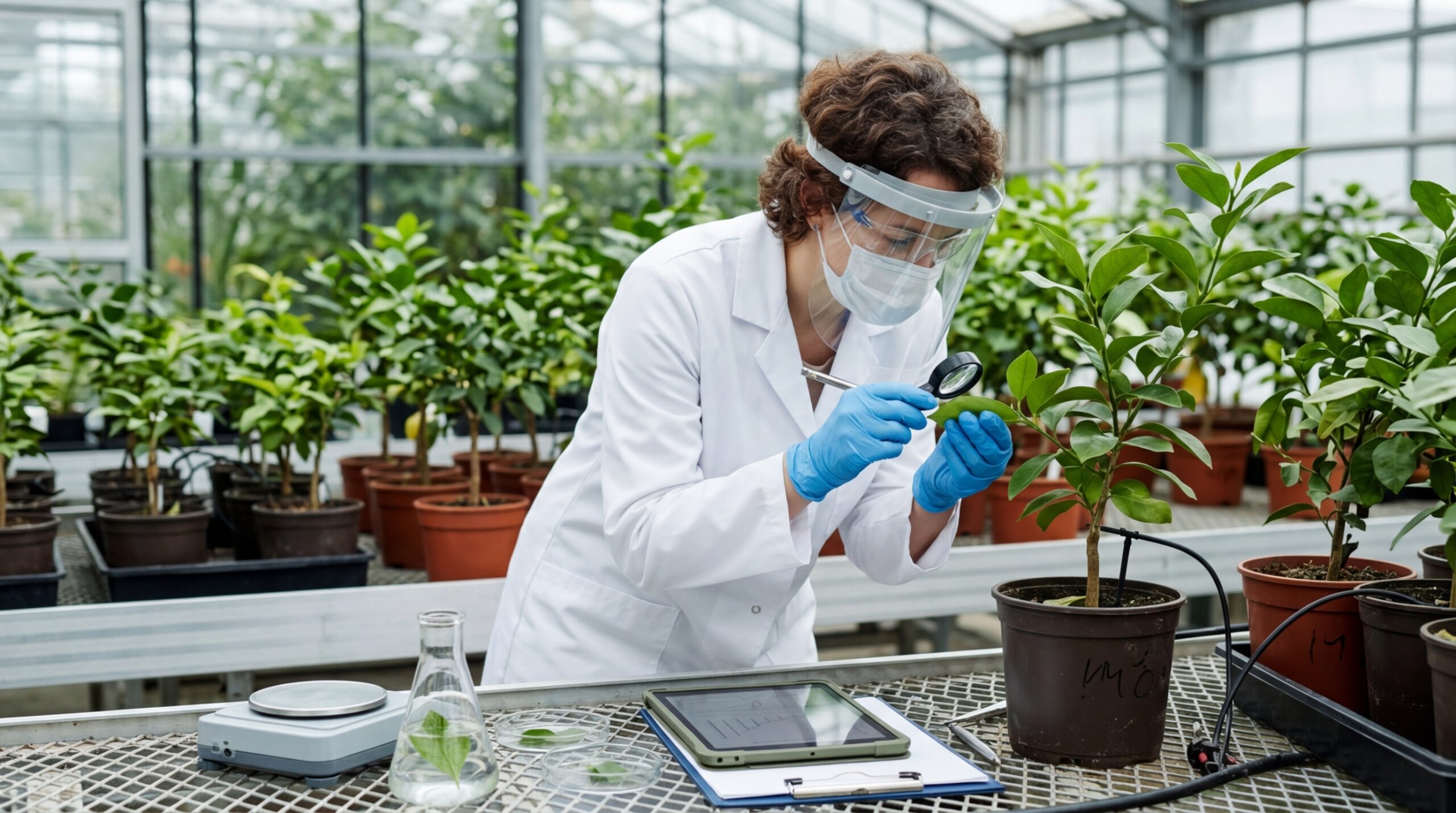
A researcher examines the leaves of a young citrus tree after gene editing
Metabolomic analysis of the mutant line leaves confirmed the complete absence of bitter flavanone neohesperidosides and a compensatory increase in tasteless rutinosides — hesperidin, didymin, and narirutin. That is, the overall level of flavonoids did not decrease — their balance simply shifted from bitter to neutral. This is exactly what the scientists were aiming for: removing the bitterness while preserving the overall level of flavonoids, which are considered beneficial for health.
When Will Bitterness-Free Grapefruit Appear and Why Hasn’t It Been Tasted Yet
It’s important to note here: scientists have so far only tested the leaves, not the fruit. The study detected metabolic compounds only in leaves, although the team expects identical results for the fruit as well. Why can’t they just wait a few months and check?
Grapefruit trees require several years to begin bearing fruit, so the edited fruit has not yet been evaluated for taste. Since 1,2RhaT is represented by a single gene in citrus, its removal will likely eliminate or significantly reduce fruit bitterness. But “likely” is not “certainly.” As noted by Jeffrey Thomson, a plant genomic engineering specialist from Yale University who was not involved in the study, they need to wait for the fruit and check how the metabolic composition of the pulp and juice changes.
What Happens to the Health Benefits of Bitterness-Free Grapefruit
The bitter compounds in grapefruit are not just an unpleasant aftertaste. Naringin — the main flavonoid in grapefruit — possesses a whole spectrum of biological activity: anti-inflammatory, antioxidant, and immunomodulatory. Flavonoids are associated with antioxidant, anti-inflammatory, and anti-tumor effects, and grapefruit and its juice are among the richest sources of them, especially naringin.
A logical question arises: will bitterness-free grapefruit lose its health benefits? The study authors honestly acknowledge: it is not yet known whether the genetic modification will change the nutritional value of the fruit or the resilience of the tree itself. However, in the leaves, the overall level of flavonoids did not decrease — bitter substances were simply replaced by tasteless “relatives” from the same group. Whether this pattern will hold in the fruit — only time will tell.
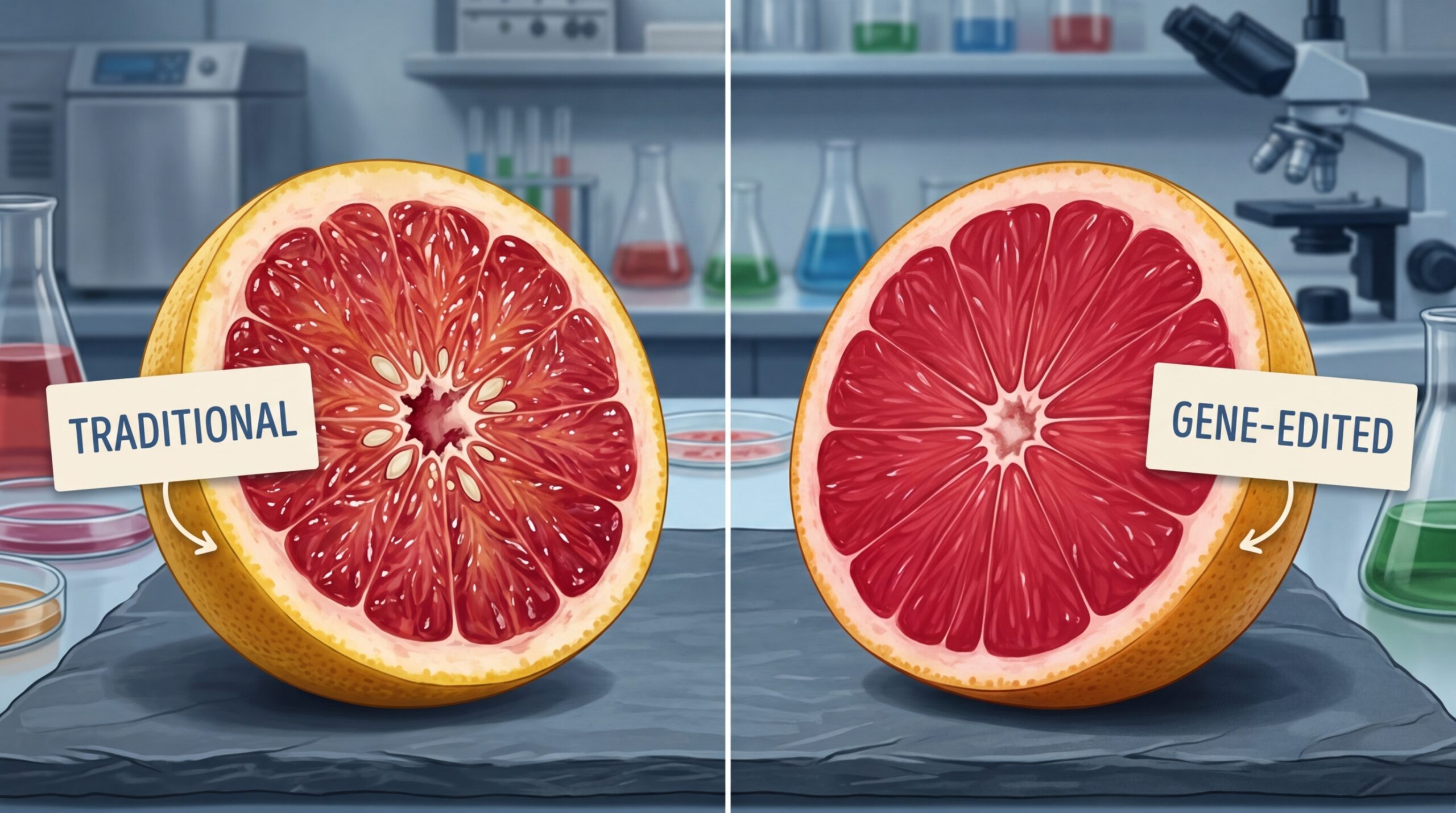
Comparison of regular and edited grapefruit — still hypothetical, as the fruit has not yet ripened
Additionally, naringin is known for the fact that it and related flavonoids affect the absorption of certain medications, which is why grapefruit juice is not recommended to be consumed alongside medication. If the bitter compounds disappear, this effect may also change — but this is still only speculation for now.
Why Scientists Are Removing Bitterness from Grapefruit and Who Benefits
The commercial logic is simple. Bitterness is the main reason many consumers avoid grapefruit. “Children usually don’t like grapefruit because it’s too bitter for them,” explains Dr. Nir Carmi from the Volcani Center. Jeffrey Thomson from Yale University notes that eliminating bitterness in citrus is a trait that will be attractive to many citrus juice consumers.
Yoram Eyal, one of the leaders of the study, believes that the work opens up a broader market for grapefruits and any future citrus varieties. But there’s another interesting aspect: ‘Carrizo’ citrange was chosen for editing not just for taste — this hybrid is used in breeding as a rootstock that provides frost resistance and tolerance to a dangerous citrus disease — huanglongbing (HLB). Wild citrus relatives are more resistant to cold, and the study’s author is interested in crossing wild plants with cultivated ones to create varieties resistant to cold snaps.
It’s important to understand: this is not a classic GMO into which a foreign gene is inserted. Here, scientists introduced small mutations into the plant’s own gene — essentially replicating an error that could have occurred in nature, only they did it precisely and quickly. CRISPR/Cas9 technology doesn’t add anything new to the grapefruit — it simply “switches off” one of its own mechanisms.
When Will Bitterness-Free Grapefruit Appear and Will It Reach Store Shelves
The road to the store shelf is still long. A grapefruit tree is not wheat: according to Eyal, editing a specific trait in a tree is technically more difficult than in agricultural crops. They need to wait for the first fruits, analyze the composition of the pulp and juice, and evaluate the taste, nutritional value, and behavior of the tree.