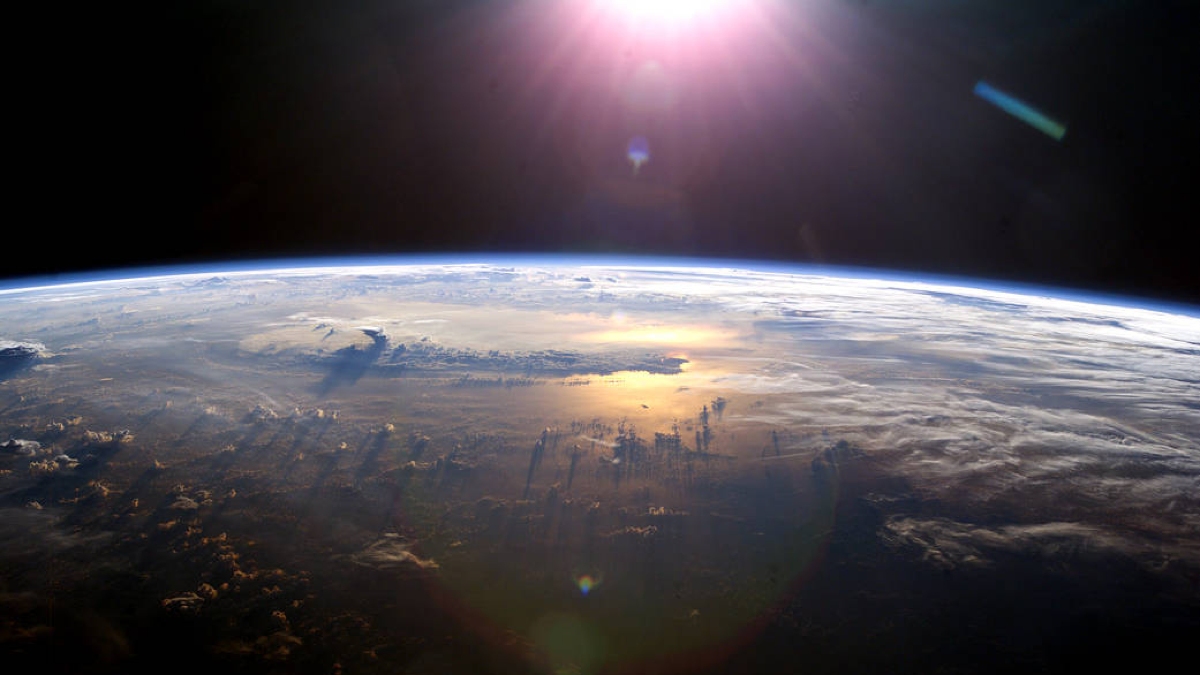
Melting polar ice redistributes Earth’s mass from the poles to the equator. Image source: sciencealert.com
Days on Earth are getting longer — and for the first time in geological history, the main cause may not be the Moon’s tidal forces, but human activity. A new study by scientists from the University of Vienna and the Swiss Federal Institute of Technology Zurich (ETH Zurich) has shown that the current rate of day lengthening has no analogue in the past 3.6 million years. The difference is on the scale of tenths of a millisecond — but the consequences are far more serious than they might seem at first glance.
Why Earth’s Rotation Is Slowing Due to Ice Melt
Strictly speaking, the 24-hour day is a convention. The length of a day changes due to the Moon’s gravitational influence, geophysical processes in the planet’s interior, on its surface, and in the atmosphere. But in the 21st century, a new factor has been added to these natural mechanisms.
From 2000 to 2020, days were lengthening at a rate equivalent to 1.33 milliseconds per century — due to climatic factors, and primarily due to the redistribution of mass between continents and ocean as a result of melting polar ice sheets and mountain glaciers. The mechanism is understandable even without formulas: when ice melts at the poles, water spreads toward the equator. The planet’s mass shifts away from the axis of rotation toward its “waist.”
The same principle is at work as with an ice skater. When she pulls her arms close to her body, she spins faster. When she extends her arms — she slows down. Earth is currently “extending its arms”: the mass that was concentrated at the poles as ice is spreading toward the equator as water. The planet becomes slightly more oblate — and rotates more slowly.
A day on Earth gets longer when it rotates more slowly around its axis.
How Scientists Measured the Length of Day Over 3.6 Million Years
The key question of the study was simple: has this happened before? Perhaps the climate previously lengthened days just as quickly? Until now, this remained unclear.
To answer this, the team reconstructed ancient fluctuations in the length of day using fossil remains of single-celled marine organisms — benthic foraminifera. These are tiny creatures that build their shells from seawater minerals. They have lived on ocean floors for hundreds of millions of years, and their fossils function as natural climate archives: the chemical composition of their shells stores information about sea level during the era when the foraminifera was alive.
“From the chemical composition of fossil foraminifera, we can reconstruct sea-level fluctuations and mathematically calculate the corresponding changes in the length of day,” explains first author Mostafa Kiani Shahvandi from the University of Vienna.
To deal with the inevitable gaps and inaccuracies in paleoclimatic data, the scientists applied a probabilistic deep-learning algorithm — a physics-informed diffusion model.

Planktonic foraminifera living near the ocean surface — natural keepers of climate information. Image source: sciencealert.com
Earth’s Slowest Rotation in Millions of Years: What the Data Showed
This is the first study in which fossil archives were used to investigate the history of climatic influence on the length of day. The results were striking. Throughout the entire Quaternary period — the last 2.6 million years — the growth and melting of large continental ice sheets repeatedly caused noticeable changes in the length of day through sea-level fluctuations. But none of those events can compare to what is happening today.
“Only once — about 2 million years ago — was the rate of change in the length of day approximately comparable, but neither before nor after that did the planetary ‘skater’ extend her arms and raise sea levels as fast as in 2000–2020,” says Kiani Shahvandi.
“This rapid increase in the length of day means that the rate of modern climate change is unprecedented at least since the late Pliocene, 3.6 million years ago. The current rapid increase in the length of day can be explained predominantly by human influence,” summarizes Benedikt Soja, professor of space geodesy at ETH Zurich and co-author of the study.
How Day Lengthening Affects Technology and Precise Timekeeping
1.33 milliseconds per century — sounds like nothing against the backdrop of 86,400 seconds in a day. Everyday life won’t change because of this: the biological clocks of humans, animals, and plants are tuned to an approximately 24-hour cycle and simply won’t notice such shifts. But for technologies that rely on precise timekeeping, even milliseconds matter.
“By the end of the 21st century, climate change will likely affect the length of day more strongly than the Moon. Although the changes amount to only milliseconds, they can cause problems in many areas, such as precise space navigation, which requires accurate data on Earth’s rotation,” notes Benedikt Soja.
For reference: due to tidal friction, the Moon slows Earth by approximately 1.72 milliseconds per century — and this “lunar brake” has until now been the main force lengthening our days.
More pessimistic models suggest an even more alarming scenario. If the world continues to warm due to greenhouse gas emissions, by the end of the century the climate’s influence on the length of day could add about 2.62 milliseconds per century — and that is already more than the Moon’s contribution.
Since 1972, international timekeepers have been introducing leap seconds to synchronize atomic clocks with Earth’s slowing rotation. But these corrections were designed for predictable deceleration. Rotation speed that changes irregularly and increasingly depends on human influence makes the leap second system harder to manage.
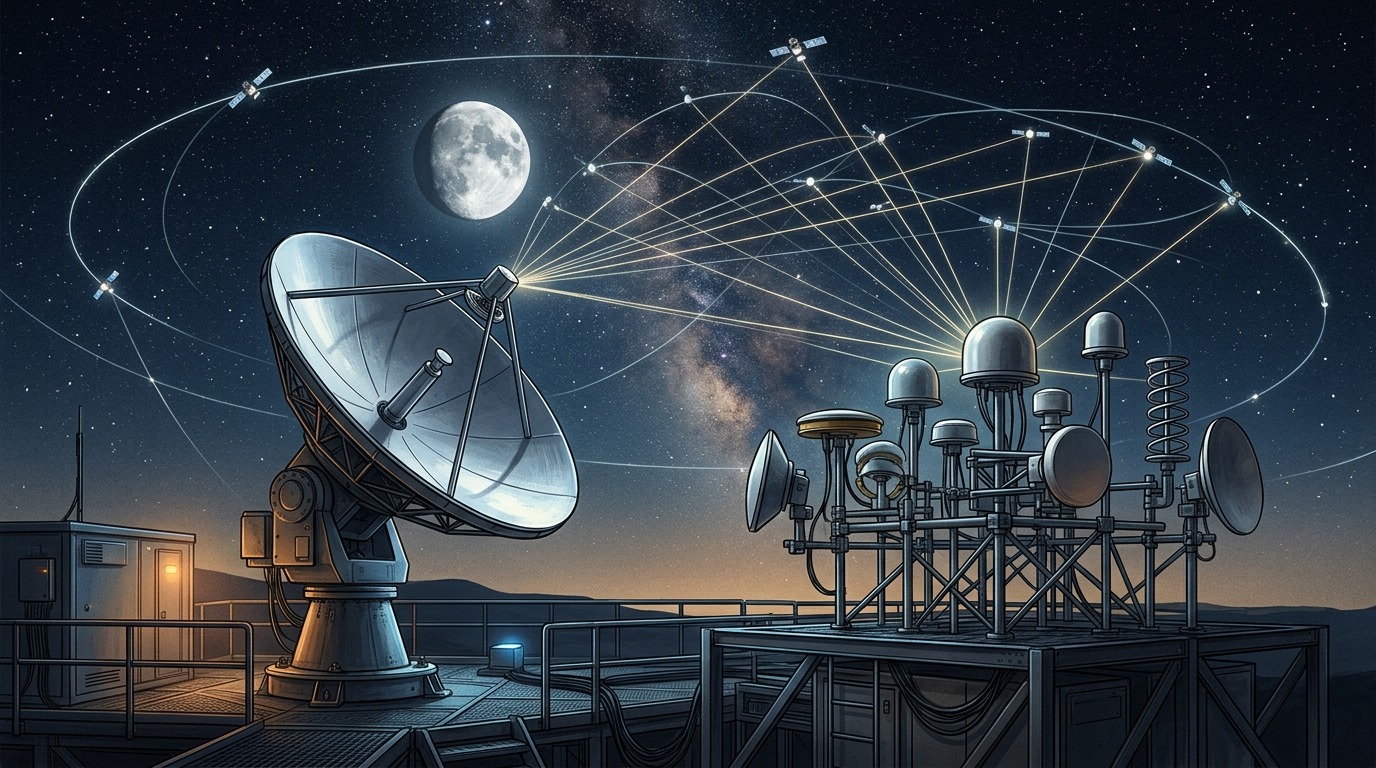
Space navigation systems require the most precise data on Earth’s rotation
Are Humans Really Slowing Down Earth: What Has Been Proven
It is worth emphasizing: the study does not claim that we are on the verge of some catastrophe due to day lengthening. The point is that the rate of climatic impact on Earth’s rotation is currently uniquely high compared to the geological past. This, in turn, serves as yet another indicator of how rapidly the climate is changing today.
Earth’s rotation is an extremely complex system. It is affected by tidal friction from the Moon, mantle adjustment after ice ages, movement of the liquid core, atmospheric flows, and even major earthquakes.
An illustrative example: in the mid-2010s to early 2020s, Earth’s rotation even temporarily sped up due to short-term fluctuations. And on June 29, 2022, the shortest day was recorded in the entire atomic clock era — approximately 1.59 milliseconds shorter than usual. This is precisely why the authors emphasize that their method — comparing paleoclimatic data spanning millions of years — makes it possible to separate the long-term climatic trend from short-term fluctuations.
This is the first study linking fossil archives to the history of climatic influence on the length of day, and it bridges the gap between past and future climate effects on Earth’s rotation. The study was published in the Journal of Geophysical Research: Solid Earth.
We are accustomed to thinking about the consequences of climate change in terms of temperature, sea level, and extreme weather. But it turns out that human activity is capable of changing something even more fundamental — the rotation speed of an entire planet. This is not cause for panic, but cause for recognizing the scale: for the first time in millions of years, the planet’s rotation is being shaped not by orbital mechanics or natural glacial cycles, but by the movement of water set in motion by humans.