Dogs remember routes better than humans. How do they build a “map” of the area?
Have you ever noticed that a dog unerringly leads you home even after a long walk? Sometimes it seems as if it keeps a real map of the neighborhood in its head. While a person stares at their phone trying to figure out where to turn, the dog confidently follows familiar paths. Scientists have long studied this phenomenon and have come to the conclusion: dogs truly navigate space differently than humans, and can even find their way home on their own. Their brains process route information based on completely different principles. And thanks to this, our four-legged companions often turn out to be better navigators.
How Dogs Remember Routes and Find Their Way Home
When a person memorizes a route, they most often rely on visual landmarks: buildings, signs, intersections. Dogs, however, create a much more complex picture of space. For them, not only objects matter, but also smells, sounds, and even wind direction.
During a walk, a dog constantly collects a massive array of sensory information. The scents of other animals, soil moisture, characteristic street sounds — all of this becomes part of a unique “map.” That’s why even if a familiar route changes slightly, a dog can still find its way.
An interesting fact: a dog’s sense of smell is tens of thousands of times more sensitive than a human’s. This allows them to literally “read” scent trails that are completely invisible to us, including their own chemical marks.
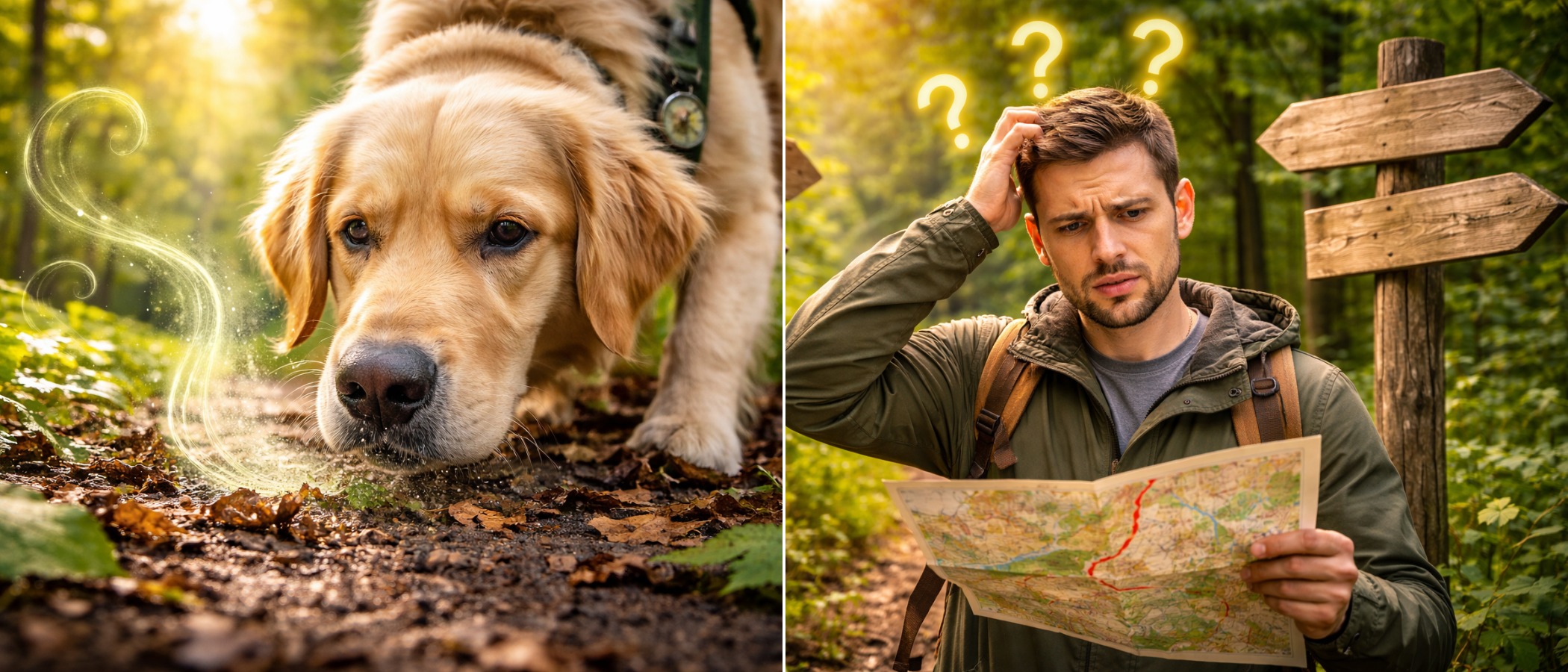
Dogs rely not only on vision but also on smells for navigation.
Why Humans Are Worse at Remembering Routes and Navigating
The human brain is structured differently. We more often rely on visual memory and logical landmarks: street names, road maps, phone navigation. But this approach has a weakness — if familiar landmarks disappear, we easily get lost.
Moreover, modern technology is gradually reducing our ability to remember routes. When a person constantly uses GPS, the brain stops actively forming spatial maps.
For dogs, the situation is the opposite: they are always training their navigation. Every walk is a new exercise for memory and perception of the surrounding environment.
Why Dogs Navigate Better Than Humans
Research shows that dogs have a particularly active hippocampus — the brain region responsible for spatial memory. It is precisely this area that helps form stable routes and quickly recognize familiar places.
But it’s not just about brain anatomy. Dogs perceive the world in a much richer sensory way. Where a human sees just a street, a dog senses an entire network of smells, sounds, and micro-signals from the surrounding environment.
That’s why, when you next go for a walk and let your dog choose the route, it’s quite possible that it knows the way home better than you do.