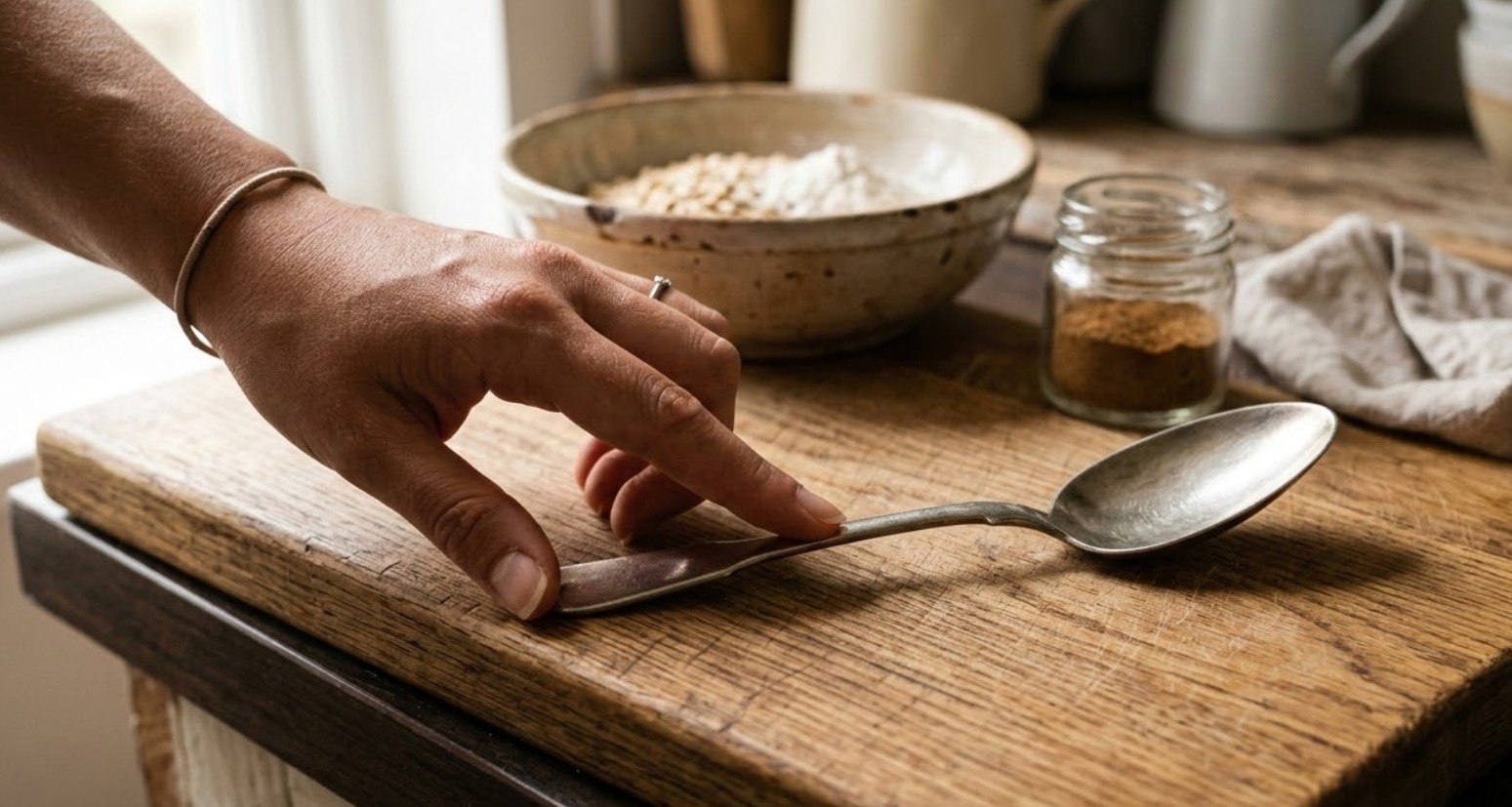
Both objects have the same temperature, but try convincing your fingers of that
Pick up a metal spoon and a wooden cutting board from the kitchen counter. They’ve been sitting side by side all night, which means they are at exactly the same temperature. But the moment you touch the spoon, it feels icy cold, while the board feels pleasantly neutral. The trick is that our skin doesn’t actually know how to measure temperature at all — it reacts to something entirely different.
Why Metal Feels Colder Than Wood
In everyday life, we’re used to equating an object’s temperature with the sensation of “cold” or “hot.” The logic seems airtight: the higher the temperature, the warmer the object feels to the touch.
But this misconception is easily shattered by one simple experiment:
Fill a pot with room-temperature water, about 25 degrees Celsius, and put your hand in it. The water will feel cool. Most of us certainly wouldn’t want to take a bath at that temperature. Now hold your hand for a minute in a bowl of ice water (about 0 degrees), and then immediately plunge it into the same pot of 25-degree water. Suddenly, that water will feel warm, almost hot. The temperature hasn’t changed by a single degree, yet the sensation is the opposite.
This paradox proves a simple but non-obvious thing: humans have no sensory organ that directly measures temperature. Our receptors respond not to degrees, but to something else entirely. And it’s precisely this “something else” that explains why metal feels icy while wood does not.
How Skin Actually Senses Cold and Heat
It turns out that the receptors in our skin respond not to temperature as such, but to heat flux — that is, the rate at which heat leaves or enters the body. Put simply, the skin senses not “how many degrees the object is” but “how quickly I’m losing or gaining energy right now.”
When you touch an object whose temperature is lower than your skin temperature (usually around 33–36 degrees), heat begins to flow from your hand into that object. The faster the heat leaves, the stronger the sensation of cold. And this is where a key property of the material comes into play — thermal conductivity.
Metal conducts heat hundreds of times better than wood. For comparison: the thermal conductivity of aluminum is about 235 W/(m·K), while wood’s is only 0.1–0.2 W/(m·K). This means metal “sucks” heat from your hand roughly a thousand times faster. The skin’s receptors detect a powerful outflow of energy and send a signal to the brain: “Cold!” Wood, on the other hand, draws heat so slowly that the skin barely notices any difference.
Why Metal Burns More Than Wood
Now here’s the really interesting part. If metal at room temperature feels colder than wood, then at high temperatures the situation reverses, and metal becomes more dangerous. This is exactly why handles on wood-burning stove doors are made of wood, not cast iron.
The logic is the same, just in the opposite direction. When an object’s temperature significantly exceeds skin temperature, the heat flow is directed into the hand. Once again, metal’s thermal conductivity plays a key role: it transfers heat to your skin at enormous speed. The brain receives a powerful signal: “Hot!” A wooden handle on the same stove may be at the same temperature, but it releases heat so slowly that you can grab it with a bare hand.
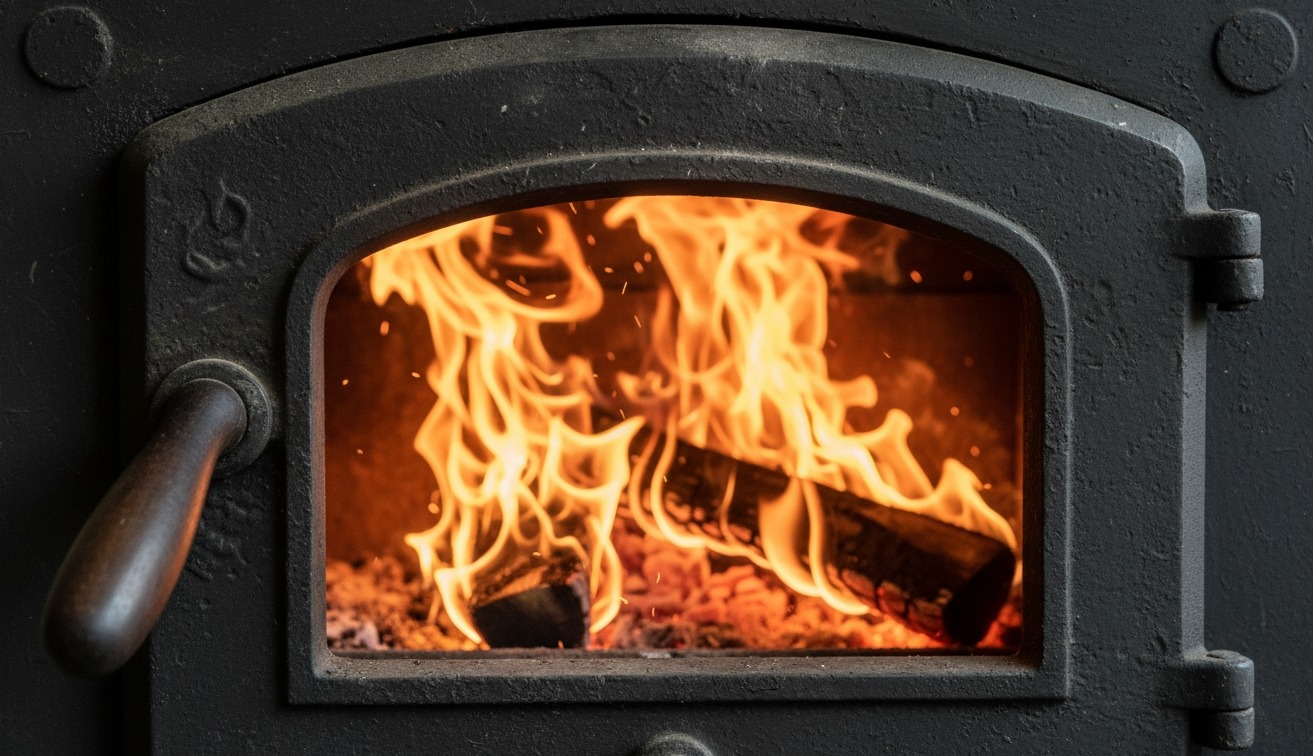
A wooden handle on a red-hot stove door is not a design whim
The thing is, besides thermal conductivity, the heat capacity of a material also matters. Metal not only transfers heat quickly but is also capable of storing a large amount of it per unit volume. Wood, being porous and lightweight, contains a lot of air, which is itself an excellent thermal insulator. This is precisely why wooden spoons are a chef’s best friend: you can stir boiling soup with them without getting burned.
So it turns out that one and the same mechanism — the difference in the rate of heat flow — explains both effects. At low temperatures, metal feels colder; at high temperatures, it feels hotter. It’s all about the direction of heat flow and how efficiently the material conducts it.
How to Easily Trick Your Temperature Perception
Since skin reacts to heat flow rather than degrees, it’s fairly easy to “fool” it. The water experiment we discussed above is a classic example. After contact with cold, the skin cools down, and the temperature difference between it and “room-temperature” water increases. The heat flow into the hand grows, and the brain interprets it as warmth — even though the water is objectively cool.
This principle, by the way, is the basis of the famous three-bowl experiment: the left hand is placed in hot water, the right in cold water, and then both are plunged into warm water. The left hand perceives the water as cool, the right as hot. The same glass of water, two opposite sensations. So trusting your hands on matters of temperature is not the best idea.
Why Tile Feels Colder Than Carpet
This same effect works in everyday life as well. For example, ceramic tile on the bathroom floor feels icy in the morning, even though its temperature is the same as the carpet in the bedroom. Tile simply conducts heat better and “steals” it from bare feet more quickly. If you want the floor to feel warmer, you don’t need to raise the room temperature — just change the flooring material.

Tile and carpet are the same temperature, but your feet categorically disagree
Understanding heat flow has long gone beyond laboratory experiments. Engineers and designers deliberately choose materials to manage our sensations. Tool handles are covered with rubber or plastic not just for grip, but so they don’t “stick” to skin in freezing temperatures. Car seats are made from materials with low thermal conductivity — otherwise sitting in a car in winter would be quite an ordeal.
In medicine, the same principle helps in developing cooling and warming compresses. Gel packs are selected so that the heat flow is sufficient for a therapeutic effect but doesn’t cause burns or frostbite. And space suits use multi-layer insulation that slows heat flow in both directions, protecting the astronaut from +120 degrees on the sunny side and from −160 degrees in the shade.
So next time a metal spoon feels icy to you, know this: it’s no colder than the wooden one. Your skin is simply measuring not the temperature, but the speed at which heat is leaving your body. And this ancient mechanism, devised by evolution for survival, works flawlessly — even if it sometimes leads us astray.