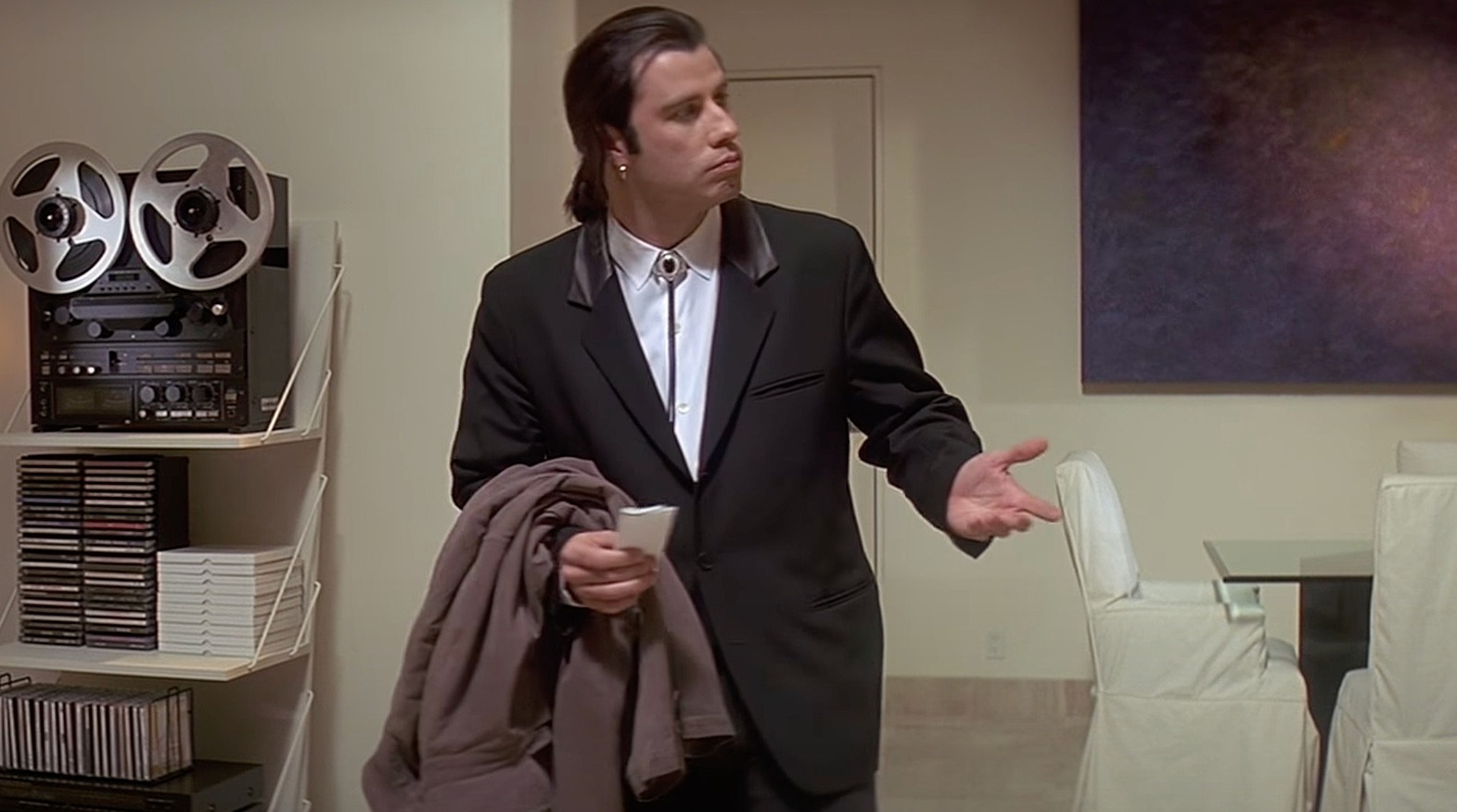
An ordinary door can make us forget what we were doing. A still from the movie “Pulp Fiction”
Have you ever noticed yourself standing in the middle of a room, desperately trying to remember: “Why did I come in here, exactly?” Just a moment ago you were briskly heading to the kitchen to grab the remote, but halfway there the phone rang, you glanced at the screen, and after taking a couple more steps, you suddenly realize: you’ve arrived, but the purpose of your visit has completely evaporated from your mind. Sound familiar? Don’t worry, you’re not losing your mind — it’s just an amusing glitch in how our brain works.
The authors at Science ABC write that scientists used to think human memory works like a giant cabinet. It has many shelves and drawers where we store boxes of memories. Need to remember something? Just go to the right shelf, grab the box, and look inside. A beautiful theory, right? The problem is that our brain is far more cunning than that. It’s not a warehouse but a complex system that is constantly changing.
Our memories are episodic. They’re not a movie with a clear plot but rather a collection of separate scenes that heavily depend on context and the individual. It’s precisely this feature that plays a cruel trick on us when we walk through a door. And this effect can be especially strong in the evening, because at the end of the day our brain works less efficiently, and there’s an explanation for that.
What Is the Doorway Effect
One day, American scientists decided to test this phenomenon in the laboratory. They conducted several experiments, and the results turned out to be very revealing.
The scientists gathered a group of volunteers and sat them in front of a screen with a virtual world. On the screen there were 55 rooms of different sizes. The participants’ task was simple: pick up an object from a table in one room, carry it to another, place it on the table, and pick up the next one.
The main trick was that the object disappeared as soon as the participant “picked it up.” That meant people had to keep in mind exactly what they were carrying. And here’s what they found: memory failed participants precisely when they walked through an open door. If, however, a person moved the same distance but within the same room, they remembered the object much better.
To make sure it was specifically the doors and not some quirk of the virtual environment, the scientists repeated the experiment in real-world conditions. People walked through actual rooms. And again the same mechanism kicked in: passing through a door seemed to erase information about what the person had been carrying.

No, the Men in Black are not to blame for our forgetfulness
How Walking Through a Door Erases Our Memory
Why does this happen? Scientists don’t have a definitive answer yet, but there is a very convincing theory.
Psychologists believe that a door, for our brain, is not just an opening in a wall. It’s an event boundary. Imagine that your life is a book and walking through a door is the end of a chapter. When you finish one chapter, the brain essentially says:
Stop, this scene is over, let’s start a new one.
It resets the context to free up space for fresh information about the new room.
Scientists call this process the location updating effect. The brain decides that since you’re in a new “chapter” (a new room), the old details from the previous chapter are no longer as important. The information about your goal (“grab the remote”) is still stored somewhere deep down, but access to it is temporarily lost because the brain has already switched to processing the new surroundings.
How to Remember Why You Walked Into a Room
The good news: these memory lapses — when you walk into a room and forget why — are completely normal. They have nothing to do with your memory, intelligence, or certainly not with Alzheimer’s disease, which destroys the brain. It’s simply an amusing feature of how our brain works as it tries to organize our lives into separate episodes.
So the next time you find yourself in the kitchen and can’t remember why you came there, just smile. Your personal “doorway effect” has kicked in. And to remember, psychologists recommend… going back to the room you came from. The context will be restored, and the right “box” in your memory will open up again.