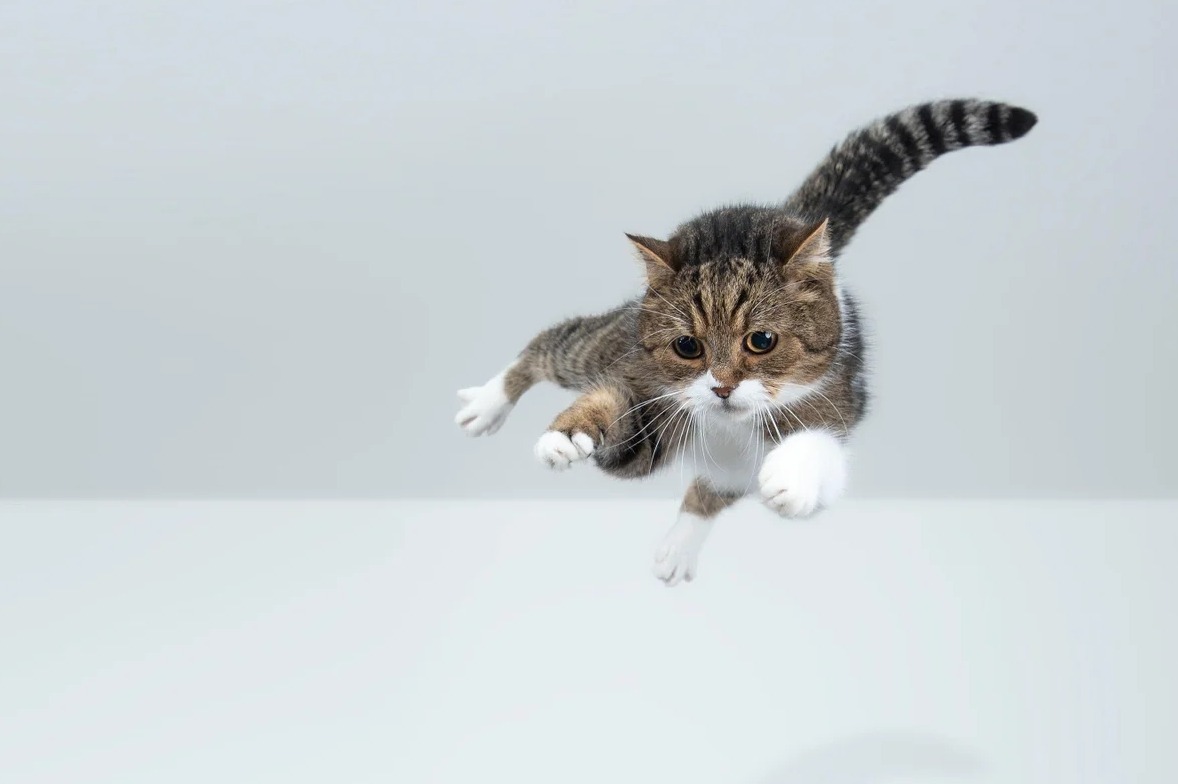
Figure skaters and cats use the same principle. Only figure skaters need years of training, while cats are born with this skill. Image source: scientificamerican.com
In 2018, a cat fell out of a 32nd-floor apartment window in New York City and landed on hard asphalt. Two days at the vet, treatment for broken teeth and a damaged lung — and the animal returned home alive. Stories like this gave rise to talk about cats having nine lives, but in reality the secret of feline survival lies not in mysticism but in pure physics. And the explanation turned out to be far more elegant than anyone could have imagined.
What Is the Falling Cat Problem
Surprisingly, scientists were initially amazed not by cats falling from great heights. In the late 19th century, physicists were stumped by photographs showing a cat, released upside down, somehow flipping in mid-air and landing on all four paws. In photos from that era, you can see a person holding a cat by its paws with its back facing the ground, letting go — and the animal, which was just hanging upside down, completes a rotation in a fraction of a second.
The problem was that this contradicted a fundamental law of physics — the law of conservation of angular momentum. Simply put, an object that is not rotating cannot suddenly start spinning without an external force. It was previously believed that cats simply pushed off from the surface they were falling from, gaining an initial rotational impulse. But the photographs clearly showed: there was no push. The cat falls straight, and then bam — it’s already oriented paws-down.
Even James Clerk Maxwell worked on this puzzle — the very physicist who described electromagnetic waves. He conducted experiments dropping cats from various heights onto beds and tables. But the “falling cat problem” wasn’t fully solved until 1969.
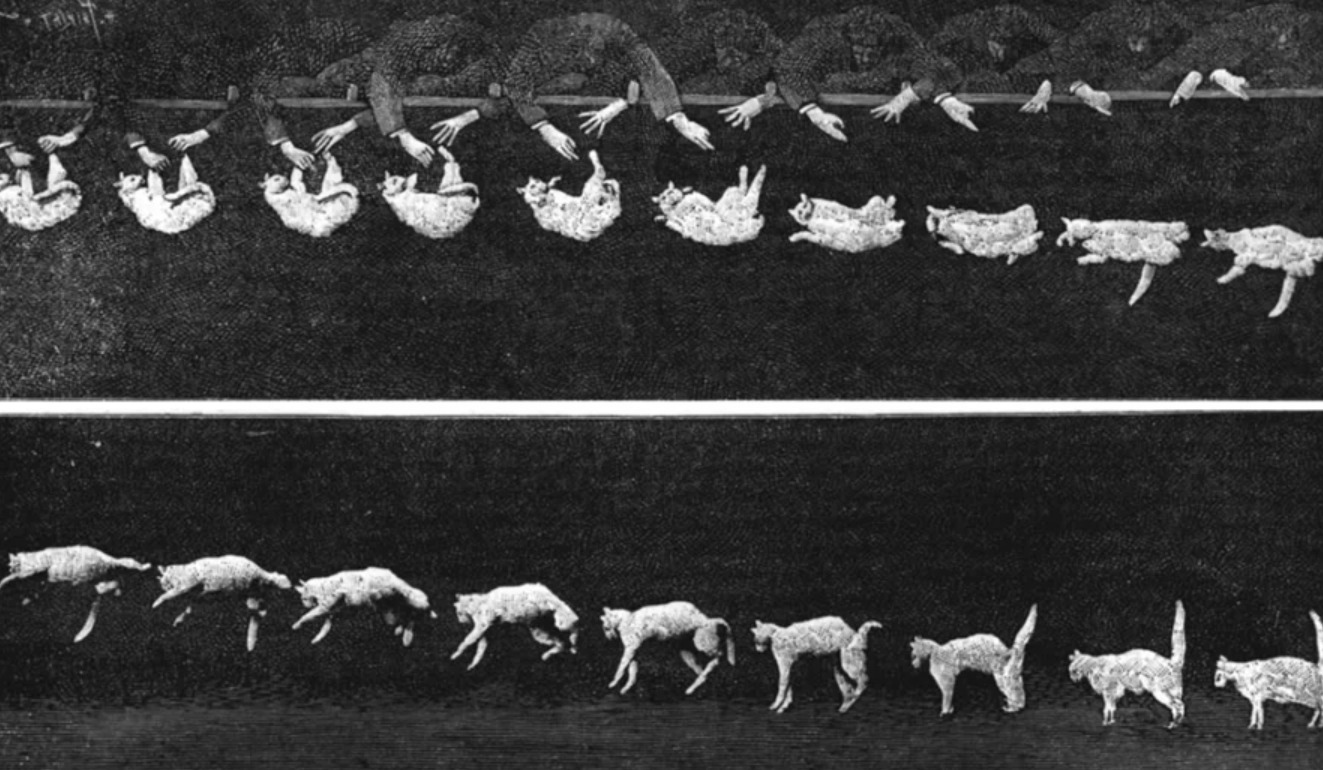
It was precisely these photographs from the late 19th century that baffled an entire generation of physicists. And no wonder — the cat was literally breaking the laws of nature on camera. Image source: scientificamerican.com
How Cats Flip in Mid-Air
It turned out that scientists had been oversimplifying the model of a cat’s body. They imagined it as a single cylinder that inexplicably starts rotating. But upon closer inspection, it becomes clear: the upper and lower halves of a cat’s body rotate in opposite directions. It’s similar to a pepper grinder — the top half turns one way, the bottom half turns the other. The total angular momentum remains zero, and the conservation law is not violated.
But how does the cat manage to land on its feet rather than just endlessly spinning its halves back and forth? The animal uses the same trick as figure skaters on ice. The cat tucks its front paws close to its body, reducing the moment of inertia of the upper half. Thanks to this, the torso rotates quickly and through a large angle. The hind legs, meanwhile, are extended — their moment of inertia is at its maximum, so the lower body rotates in the opposite direction only slightly.
When the upper half is already “facing” the right direction (head up), the cat switches tactics: it extends its front paws, tucks its hind legs — and repeats the “pepper grinder” motion in the opposite direction. Now the hind legs end up pointing downward too. All of this is possible thanks to the incredibly flexible spine of cats, which contains more than 50 vertebrae. It is precisely this flexibility that allows the two halves of the body to work virtually independently of each other.
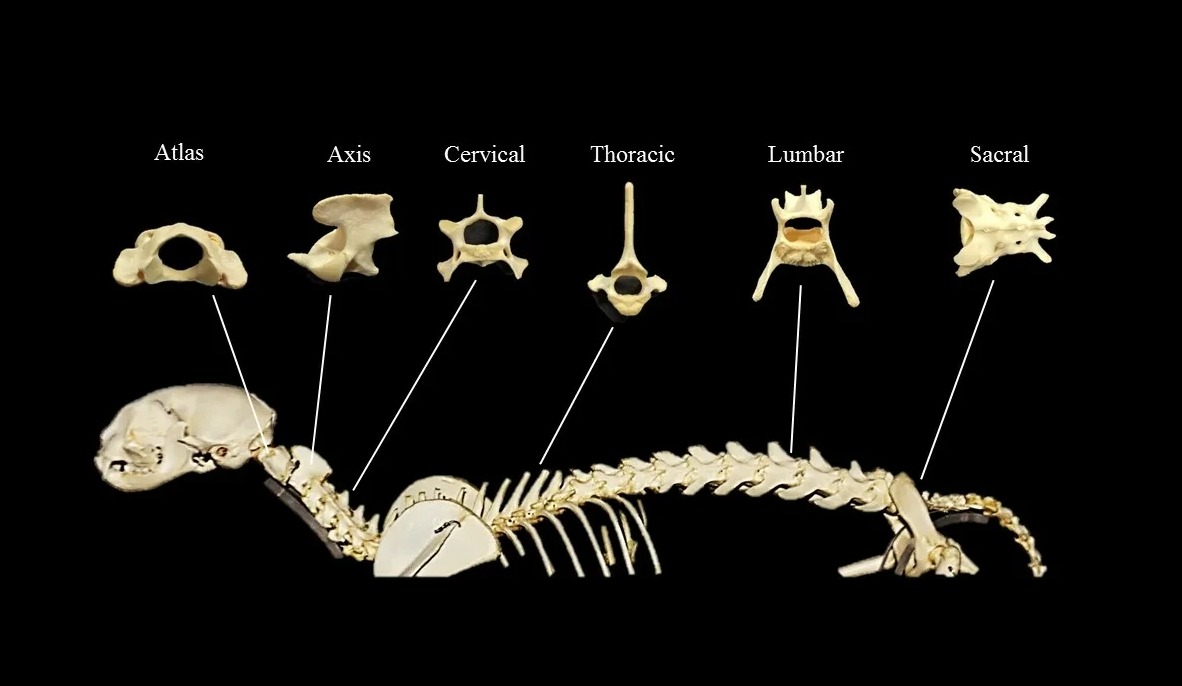
Cats have more than 50 vertebrae, while humans have 33. Image source: courses.lumenlearning.com
From What Height Can a Cat Fall and Survive
Since cats flip so skillfully, does that mean a fall from any height is no big deal for them? Not quite. In 1987, veterinarians in New York conducted a study examining 132 cases of cats falling from high-rise buildings. The results were paradoxical: cat survival rates were indeed surprisingly high, but injuries depended on height in ways that weren’t quite what you’d expect.
Cats need about 0.3 seconds to fully rotate in mid-air. This corresponds to approximately one and a half meters of free fall. From a lower height, the animal may simply not have enough time to complete the maneuver. But here’s where it gets really interesting: when falling from a very great height, a cat reaches what’s called terminal velocity — about 100 km/h (60 mph). For comparison, a human’s terminal velocity is nearly twice as high — about 200 km/h (120 mph). The cat’s small body mass and relatively large surface area act as a natural parachute.
But there’s a nuance. Some researchers noticed that upon reaching terminal velocity, cats stop tensing up, relax their bodies, and spread their legs out to the sides — somewhat like a flying squirrel. This helps distribute the impact upon landing. However, veterinarians warn: survival does not mean the absence of injuries. Fractures, lung damage, and jaw injuries are common even among the luckiest “parachutists.”
Bottom line: The most dangerous range is considered to be from the 2nd to the 6th floor, where the animal may not have enough time to properly position itself for landing.
Why Science Studies Falling Cats
You might think — so a cat flipped in the air, so what? In reality, the “falling cat problem” proved incredibly fruitful for science. The flipping mechanism that cats use has found applications in robotics and space engineering. Engineers design robots capable of stabilizing themselves during a fall using the same “pepper grinder” principle — rotating different parts of the body in opposite directions.
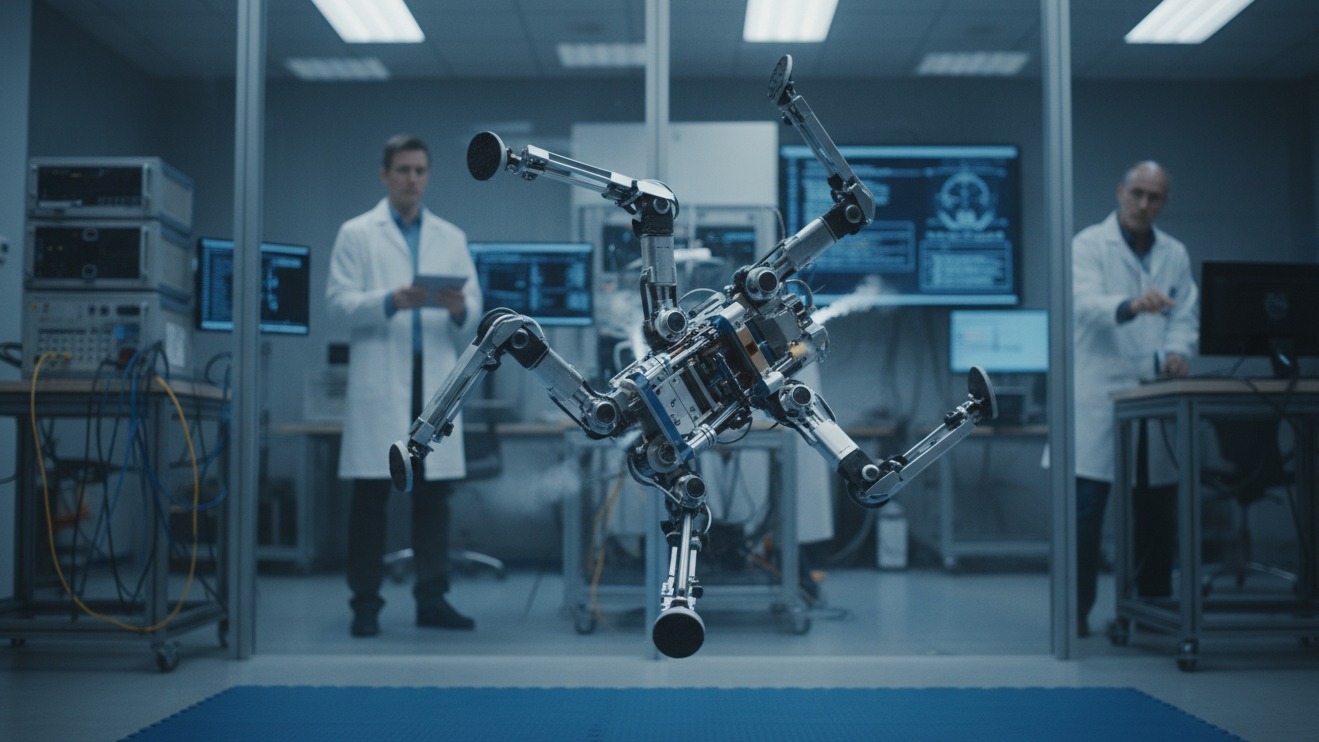
Modern robots are learning to fall “cat-style.” Though so far without purring after landing
An even more unexpected connection was discovered with satellite orientation in space. Spacecraft sometimes use a similar method to change their position without expending fuel — by redistributing angular momentum between rotating parts of the structure. Essentially, a space telescope and a house cat are solving the same physics problem.
Mathematically, the problem is described using differential geometry — the same branch of mathematics used in Einstein’s general theory of relativity. A cat’s movement through space is described by what’s called a “geometric phase shift” — the body performs a cycle of internal movements and returns to its original configuration, yet ends up rotated. This is pure elegance of nature expressed in the language of mathematics.