
A car wheel spinning at high speed
When a car on video drives forward but its wheels appear to roll backward, or briefly freeze while the car keeps accelerating, the footage is not glitching. The illusion comes from two things working together: a camera records motion as separate frames, and the brain fills in the gaps between them by matching each detail to the most similar one in the previous frame. Because wheel spokes all look alike, that matching can go the wrong way. The effect is not random, either: the speeds at which it appears can be calculated.
What you need to know
- At 30 frames per second, a typical car with five-spoke wheels and 205/55 R16 tires appears to have frozen wheels at about 43 km/h; at 24 fps this happens at about 34 km/h.
- Wheels freeze again at multiples of that speed (about 86 and 129 km/h at 30 fps), so an accelerating car’s wheels can stop and reverse several times on video.
- Rolling shutters in most phones and webcams create a separate distortion that bends propeller and rotor blades into arcs.
- The backward-wheel illusion can also be seen in continuous sunlight; the leading explanation involves competing motion-detecting cells in the visual system, but scientists still disagree on the exact mechanism.
The camera records frames; the brain fills in the gaps
The eye sees the world continuously, while a camera captures it as individual frames. Film typically uses 24 frames per second, and phones more often record at 30 or 60. Nothing is recorded between frames. What an object did during that 1/30 or 1/24 of a second is filled in by the brain, which links each detail in the new frame to the most similar detail in the previous one.
With wheel spokes this produces a strange result because they are all identical. Suppose that between two frames the wheel turns through 90% of the distance between neighboring spokes. In the new frame, each spoke then sits just behind the spot where its neighbor used to be. The shorter path looks more plausible to the brain, so the wheel seems to roll backward. This is an example of aliasing, known as the wagon-wheel effect. If the wheel advances exactly one spoke gap per frame, the spokes appear to stand still.
At 30 fps, spokes freeze at about 43 km/h
Take an ordinary passenger car with five-spoke wheels and 205/55 R16 tires. Such a wheel is about 63 cm in diameter, with a circumference of about 2 meters. For the wheel to appear frozen at 30 frames per second, it must turn exactly one-fifth of a revolution per frame. That works out to six revolutions per second, or roughly 43 km/h. At 24 frames per second, the same thing happens at about 34 km/h.

The wheel of a moving car with spokes that look almost still
If the car goes slightly slower, the wheels on video creep backward; slightly faster, and they creep forward. The wheel freezes again when it advances exactly two spoke gaps per frame. At 30 fps that is about 86 km/h, and the next freeze comes at about 129 km/h. That is why in footage of an accelerating car, the wheels can stop and change direction several times even though the speed rises continuously.
The number of spokes matters too. On a ten-spoke wheel the gaps are half as wide, so the wheels first appear to freeze at just 21 km/h.
Why the wheels only stand still for a moment
For a wheel to look completely frozen, the car’s speed has to match the calculated value to within a few percent. If the car travels 5% slower than 43 km/h, at 30 fps the spokes drift backward by one and a half gaps every second. The drift is slow but clearly visible.
On a real road, speed constantly varies a little, so the wheels freeze only briefly, for a couple of seconds, before appearing to move again.
A helicopter rotor freezes only with a lucky match
The same rule applies to rotors. Helicopter blades are also identical, so what counts is how many blades pass a given point each second. For example, a five-blade rotor turning at 300 revolutions per minute produces 25 blade passes per second. If it is filmed at 25 frames per second, every frame catches the blades in the same positions, and the rotor appears to hang motionless. The exposure time must be short, however, or the blades will blur.
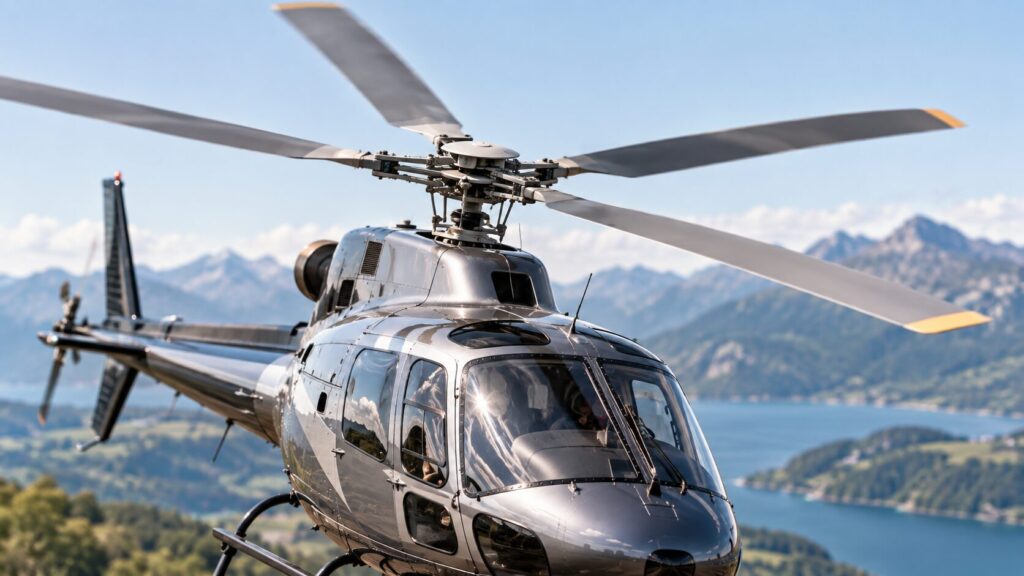
A helicopter whose rotor blades appear motionless
Real helicopters rarely line up with common frame rates. The five-blade main rotor of the Mi-8 turns at about 192 revolutions per minute, or 16 blade passes per second. It could appear frozen at 16 frames per second, but not at 24 or 30. The two-blade rotor of the Robinson R44 spins at 408 revolutions per minute, which is 13.6 passes per second.
To freeze at 30 fps, a five-blade rotor would need 360 revolutions per minute, and a two-blade rotor 900. Neither of these rotors turns that fast. As a result, in ordinary footage a rotor more often seems to turn sluggishly, jerk, or run backward. Quadcopters and other craft with fast propellers behave the same way on video. When a rotor needs to look stationary on camera, operators choose a matching frame rate in advance.
Rolling shutters bend blades into arcs
There is a second illusion that has nothing to do with frame rate. The sensors in most phones and webcams read the image line by line, from top to bottom, rather than all at once. This is called a rolling shutter. By the time the camera reaches the bottom rows, a fast-spinning rotor has already turned, so the same blade is captured in different positions at different heights in the frame.
As a result, a straight blade bends into an arc, and helicopter blades appear more swept back than they really are. An airplane propeller can turn into a set of curved stripes, and sometimes the blades even seem to detach from the hub.
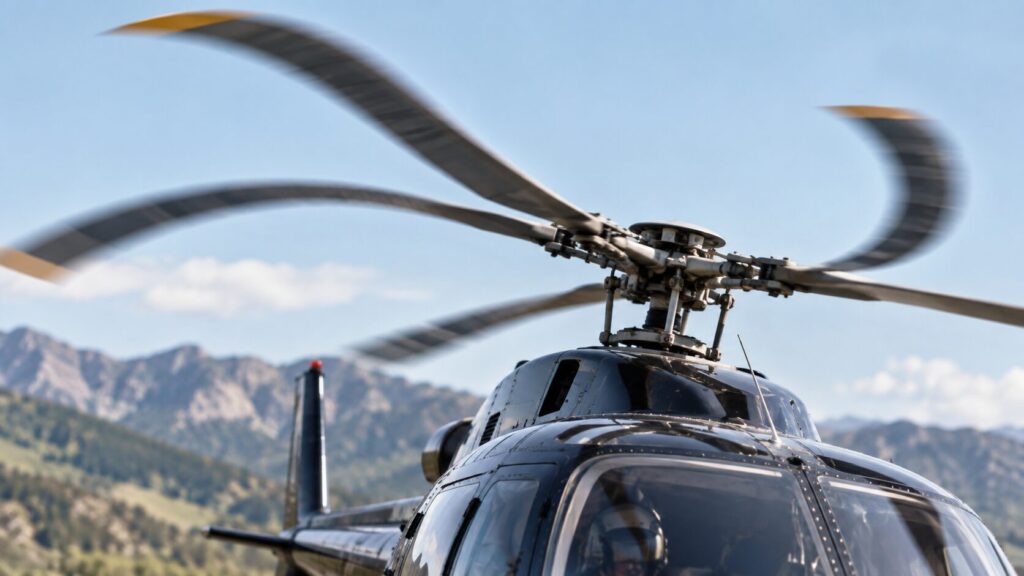
Helicopter blades bent by a rolling shutter
Cameras with a global shutter read the entire frame at once and do not produce this distortion, but they are more expensive. High-end cinema cameras read out each frame faster, so the skew they produce is weaker.
Wheels can seem to spin backward even without a camera
Perhaps the most curious part is that the effect can sometimes be seen with the naked eye. In sunlight, the spokes of a wheel occasionally seem to spin in the opposite direction for a moment. Yet sunlight is continuous, and there are no frames involved.
The first hypothesis was that the brain, like a film camera, also sees the world in discrete snapshots. But experiments undermined this idea. Two identical rotating patterns placed side by side did not reverse direction at the same time, whereas a brain taking whole-scene snapshots would have flipped both at once.
More evidence now supports a different explanation. The visual system contains cells that respond to motion in one direction and cells that respond to motion in the opposite direction, and these compete with each other. When a person watches rotation for a long time, the cells tuned to the opposite direction sometimes win out and override the true perception. Exactly how this happens is still debated among scientists, and there is no single agreed answer yet.