
Bees almost never collide — it’s all about their special vision.
Every warm day, true aerial chaos unfolds over blooming meadows. Hundreds of bees simultaneously fly out of the hive, return back, search for flowers, and pass information to others. If you imagine such traffic on a city scale, crashes would be inevitable. But bees almost never have them, even though they supposedly shouldn’t be able to fly at all. These insects can coordinate their flight so precisely that an airstream of hundreds of individuals turns into perfectly organized movement. And scientists have long been trying to understand how they manage to do it.
How Bees Navigate in the Air and Detect Obstacles
The main secret lies in how bees perceive their surrounding space. Their eyes are structured entirely differently from human eyes. Insects in general have one of the most unusual types of vision in nature.
A bee has about 5,000–6,000 ommatidia — tiny “eyes” inside the large eye, each of which captures a portion of the image. As a result, they see the world not as a single picture, but as a huge mosaic.
This provides several advantages:
- A very wide field of view — close to 360 degrees.
- Instant detection of moving objects.
- The ability to determine the direction of movement of other bees.
When two bees fly toward each other, their visual system quickly determines from which side an object appears and how fast it is approaching. If their trajectories intersect, the bees simply adjust their course.
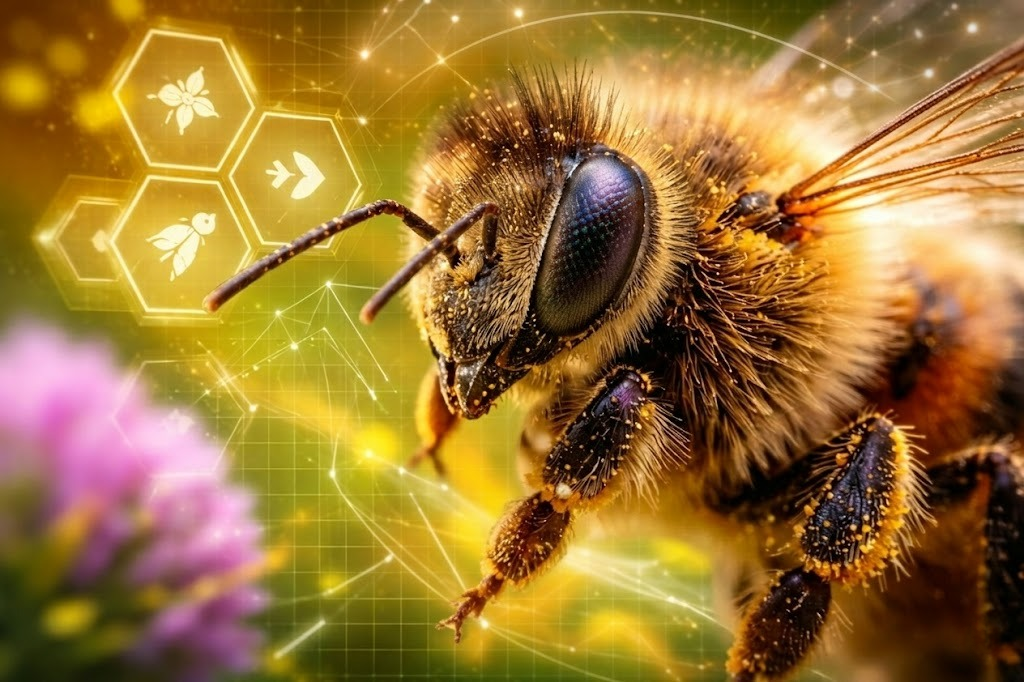
Bees avoid collisions in flight primarily through visual cues. When encountering an obstacle, they begin maneuvering based on the rate of expansion of the object’s image on the retina in the frontal field of view.
Why Bees Almost Never Collide With Each Other
But vision alone isn’t enough. Research has shown that bees use another important mechanism — optic flow. This is the change in the image around them during flight.
Simply put, a bee constantly analyzes how quickly the surrounding world “moves” at the edges of its vision. If an object starts growing too rapidly, the insect understands that it’s getting too close and changes direction.
Interestingly, this principle is now being actively studied by engineers. Algorithms for controlling drones and autonomous vehicles are often built on the same principles. But so far, tiny drones still lose to bees in the ability to navigate complex environments.
But nothing is perfect: collisions among bees do happen, though very rarely. This is evident in experiments: under certain conditions, some individuals did clip obstacles.
How a Bee’s Tiny Brain Controls Complex Flight
The most amazing thing is the size of the bee’s “computer” that processes all of this. A bee’s brain contains about one million neurons, while a human brain has approximately 86 billion. Yet this is enough to handle complex navigation, memorize routes, and avoid collisions. Yes, bees are smarter than they seem.
In essence, bees manage air traffic better than many modern systems. And that’s exactly why scientists increasingly call them one of the best natural examples of efficient navigation.
So the next time you see a swarm of bees over flowers, know this: what you’re looking at is not a chaotic crowd, but an perfectly organized airstream controlled by tiny yet incredibly precise “pilots” who are even capable of experiencing emotions.