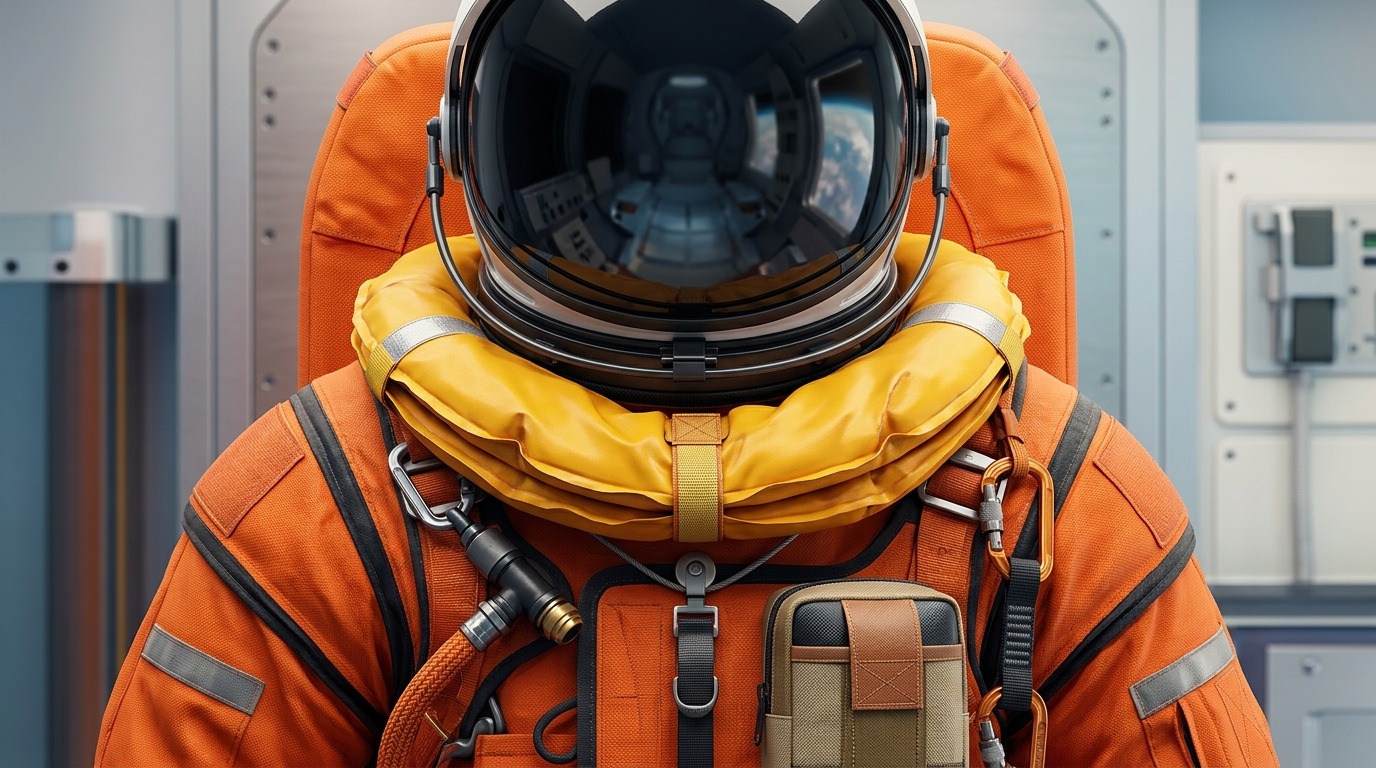
The new spacesuits are colored orange, and there are reasons for that
For the first time in over 50 years, humans have flown to the Moon, and they did so in bright orange spacesuits. The Artemis 2 mission launched on April 1, 2026, from Kennedy Space Center in Florida, and the four crew members were dressed in suits of a color NASA calls “international orange.” This is not a design whim — there is a real history and specific engineering logic behind the color choice.
The First Moon Flight in the 21st Century
The Artemis 2 crew — NASA astronauts Reid Wiseman, Christina Koch, Victor Glover, and Canadian astronaut Jeremy Hansen — became the first humans to head to the Moon since the Apollo 17 mission in 1972, more than 50 years ago. During the ten-day flight, they will orbit the Moon and return to Earth at a speed 30 times the speed of sound.
The crew will not land on the lunar surface. Instead, the astronauts will test the life support systems of the Orion capsule for future crewed missions to the Moon’s surface. A lunar landing is planned for the Artemis 3 mission, with launch targeted for 2027.
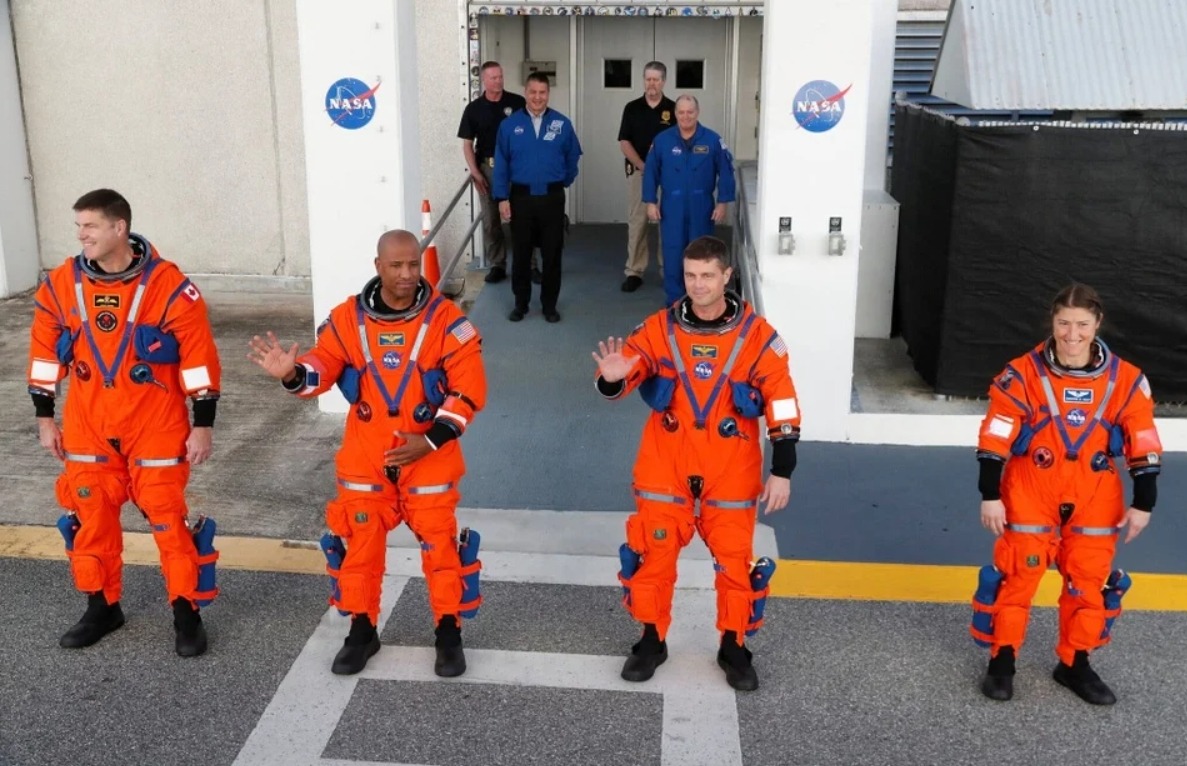
The Artemis 2 crew in orange spacesuits heads to the launch pad. Image source: NASA
Orange Spacesuits for the Moon Flight
The orange suits the astronauts wore at launch are officially called the Orion Crew Survival System (OCSS). These spacesuits are worn during launch, the most risky segments of the flight near the Moon, and during return to Earth.
Even if the Orion capsule loses cabin pressure on the way to the Moon, while in orbit, or on the way back, the suit can sustain an astronaut’s life for up to six days — enough to get home. This is a fundamental difference from the Shuttle-era suits: previously, flights never went beyond low Earth orbit, and in case of an emergency, astronauts could return to Earth within hours.
Shane Jacobs, chief technologist at the manufacturer David Clark Company, explained: the suits will protect astronauts if the capsule loses pressure on the way to the Moon. In that case, you can’t simply turn around — you have to continue, fly around the Moon like Apollo 13 did, and come back.
Jacobs compared the suit to a car seatbelt: if the mission goes nominally, it seems unnecessary. But every time you buckle up, you’re glad it’s there — just in case something goes wrong.
Why NASA Chose Orange for the Spacesuits
It might seem like orange is just tradition. But in reality, there is a very practical reason behind the color. NASA switched from white spacesuits to bright orange in 1988 to make astronauts easier to spot during ocean splashdowns.
This happened after the Challenger shuttle disaster in 1986. Before the tragedy, starting with the STS-5 mission, shuttle crews flew in lightweight blue flight suits. After Challenger’s loss, NASA required the return of suits with emergency escape systems and full pressure protection. The first eight new suits were dark blue, but they were never used on actual missions — the color was quickly changed to bright orange so it would contrast with the dark blue ocean water.
This fluorescent shade is extremely rare in nature, making it easy to spot. Sailors have used orange for rescue equipment for generations — it stands out excellently against the dark ocean and any natural landscape. In search-and-rescue operations, time is everything, and a color that’s easy to see becomes critically important. Officially, this shade is called “international orange” and is specifically chosen so rescuers can spot it against the contrasting background of water.
For comparison: the white spacesuits we’re used to seeing in photos of spacewalks serve an entirely different purpose. White reflects solar heat and stands out well against the black of space. Orange, on the other hand, is about safety on Earth, after splashdown.
How the New Spacesuits Differ from the Old Ones
Although the new OCSS outwardly resembles the orange spacesuits from the Space Shuttle program, inside it’s a completely different suit. The key difference is that the OCSS is designed for long-duration survival beyond low Earth orbit.
Here are the main improvements compared to the old ACES (Advanced Crew Escape Suit):
- Shuttle-era suits came in standard sizes — S, M, L. The new OCSS suits are custom-tailored for each crew member;
- The helmet has become lighter and stronger, and noise insulation has been improved — making it easier for the crew to communicate with each other and with mission control;
- Gloves have become more durable and touchscreen-compatible, while boots are more flexible and fire-resistant;
- A redesigned zipper allows for faster donning and doffing;
- An improved thermal regulation system helps astronauts stay dry and avoid overheating. A special undergarment with liquid cooling tubes is worn under the suit — it has also been updated to be more breathable.
The suit’s cut has been revised to eliminate pressure points that shuttle astronauts experienced during prolonged wear under pressure. For a ten-day flight to the Moon, rather than a ninety-minute ascent to orbit, this is essential.
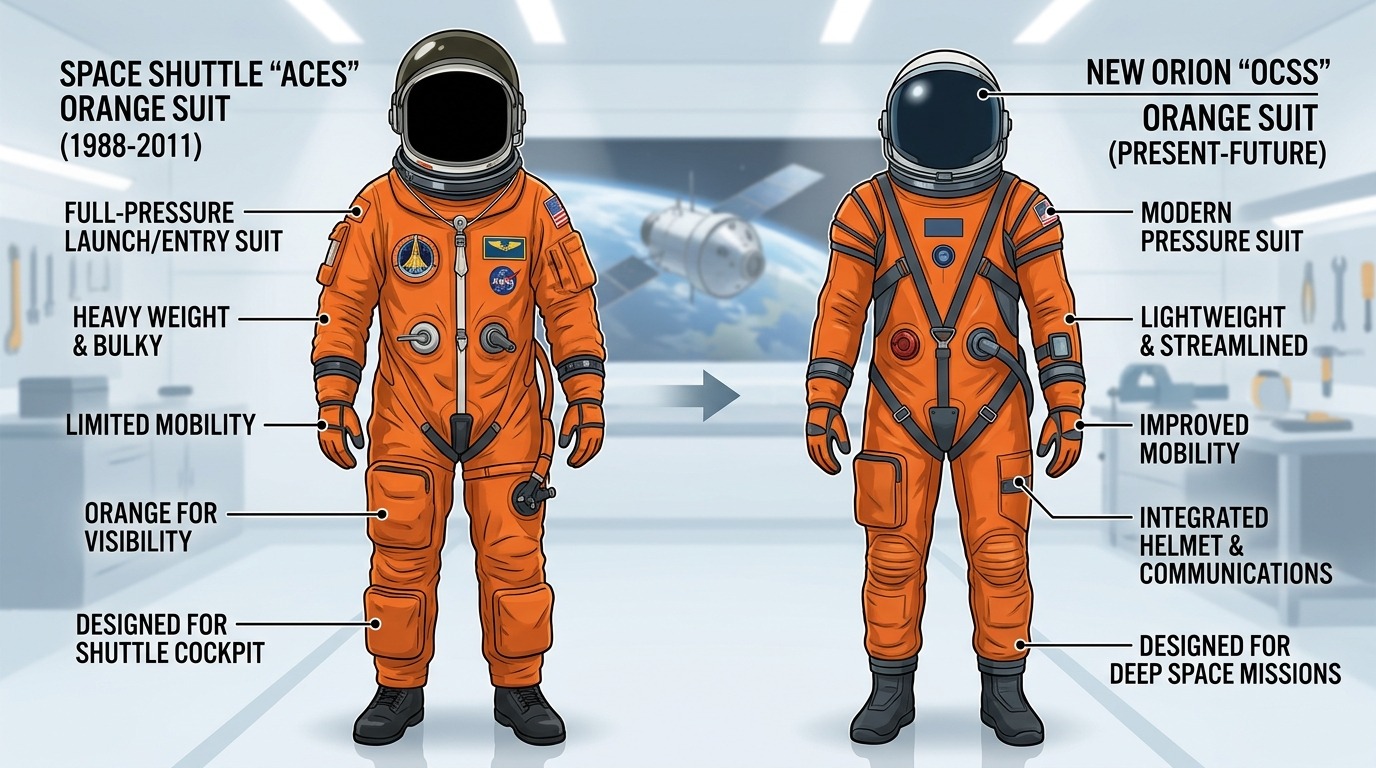
Comparison of spacesuits: the old Shuttle-era ACES and the new OCSS for Artemis missions
What’s Included in the Survival Kit Inside the Spacesuit
The OCSS spacesuit is more than just a pressurized suit. The spacesuits are equipped with survival gear in case astronauts need to leave the Orion capsule after splashdown before rescuers arrive.
Each suit includes its own life vest with a personal radio beacon, rescue knife, and signaling kit — a mirror, strobe light, flashlight, whistle, and glow sticks.
In addition, the suits feature reflective blue stripes — these also help locate astronauts. Hidden beneath the stripes is a harness system that rescuers can securely grab during evacuation.
New adaptable interfaces supply air and remove exhaled carbon dioxide. Unlike its predecessor, the OCSS uses a closed-loop system that conserves resources — a critically important feature when Earth is six days away.
Who Manufactures the Spacesuits for Moon Flights
The OCSS spacesuits are made by the David Clark Company from Worcester, Massachusetts. Each suit is custom-sewn for a specific astronaut. The company has been developing spacesuits since the early 1940s — founder David Clark himself participated in creating the first anti-G suit. Later, they made suits for the Gemini program and equipment for the Apollo lunar missions.
The suit itself is a direct descendant of U.S. Air Force high-altitude suits worn by SR-71 Blackbird reconnaissance pilots, U-2 high-altitude aircraft pilots, experimental X-15 pilots, and Gemini program astronauts. The history of this lineage is a continuous evolution from aviation high-altitude suits of the 1960s to modern equipment for deep space flights.
OCSS project manager Dustin Gohmert, who also worked on the Shuttle program, describes the process this way: designers propose a concept, discuss it with the crew, test how it works under real spaceflight conditions, and adapt the suit based on feedback to ensure both safety and real comfort.
Artemis 2 is just the beginning. The Artemis program is NASA’s long-term and costly plan to return humans to the Moon and establish a permanent presence. The goal is to build a lunar settlement at the south pole, where water ice reserves are believed to exist that could be used for drinking, breathing, and producing rocket fuel. In the long term, Artemis is meant to lay the foundation for crewed missions to Mars.
And the orange OCSS spacesuits are that very detail that shows how seriously NASA is approaching the safety of every crew member on this historic journey.