Editor’s note: the original Russian article was published with an advertising label, and the e-reader it discusses was promoted with a sponsored retail link. Purchase links and local pricing have been removed from this adaptation.
An iPad seems ideal for books, but a writer at AppleInsider.ru says it did not work that way for him. The tablet kept pulling him toward chats, video and social feeds, while the book he meant to read stayed open on the same page for months. He then switched to an inexpensive 6-inch E-Ink reader, the Digma Pro Moon 6, and reports that he now reads every evening. His account also covers the reader’s weak points: a black-and-white screen, poor handling of complex PDFs, slower page turns and an outdated version of Android.
What you need to know
- The author had long blamed himself for reading less. He now attributes it to the iPad’s notifications and apps.
- The Digma Pro Moon 6 has a 6-inch E-Ink Carta screen (758×1024, 212 ppi) with a front light, 32 GB of storage plus microSD, and USB-C charging.
- He reports reading for 1.5 to 2 hours without eye strain, but he did not measure battery life.
- The reader runs Android 8.1, which may not support newer apps, and it is poorly suited to comics, color books and complex PDFs.
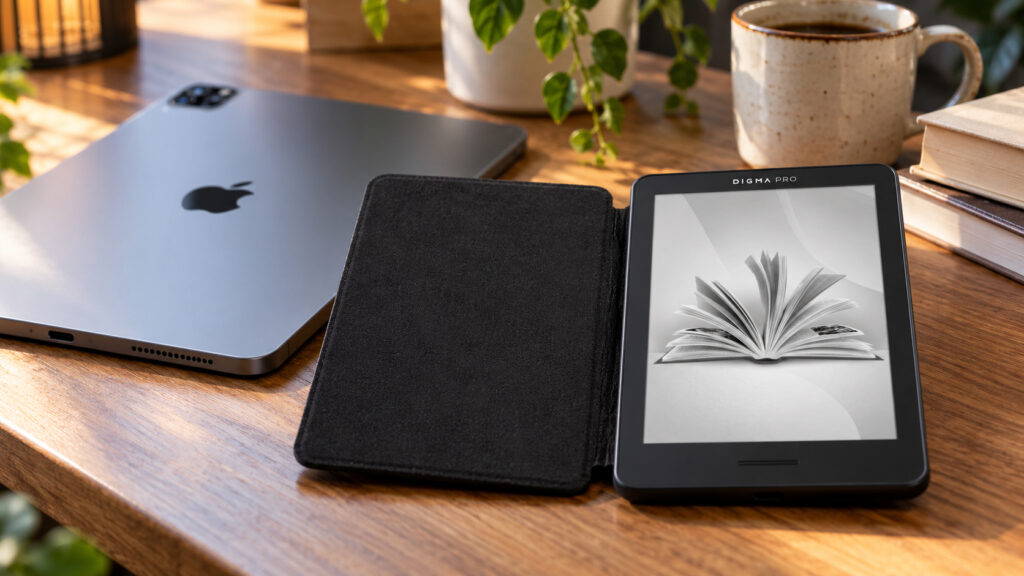
The Digma Pro Moon 6 e-reader in its case next to a set-aside iPad
Why the iPad never became a reading device
On paper, the iPad has a lot going for it as an e-reader. It offers a large screen, Apple Books and bookmarks that sync with an iPhone. The author says he still uses his iPad every day. He just no longer opens books on it.
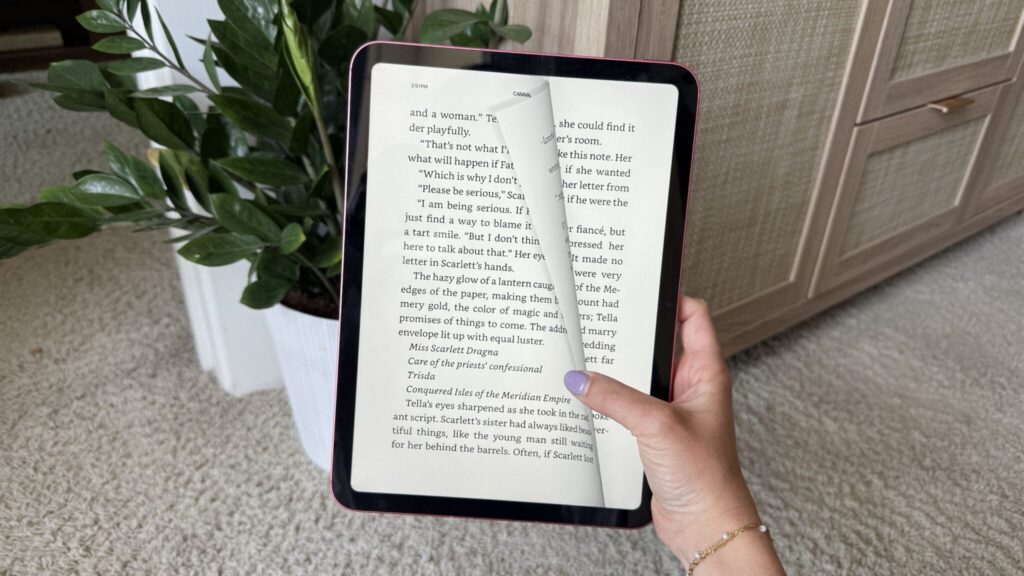
An e-book open on an iPad
In his view, the problem is that the tablet is too capable. He describes a familiar pattern. He sits down to read, a work-chat banner appears, and he replies. With Telegram already open, he checks a few channels, and someone has shared a video. About forty minutes later, he finds himself watching a car-restoration clip while the book sits minimized. His conclusion is blunt: a tablet is built to distract, and it does that job very well.
Comfort was another issue. The author says that in the evening, even with Night Shift on and brightness at the minimum, his eyes began to sting after about an hour. Reading while lying down was also awkward. He calls the iPad nearly half a kilogram to hold in one hand and recalls that it once fell on his face when he dozed off.
Trying a budget e-reader as an experiment
The author did not want to spend a lot on an experiment that might fail. A black-and-white screen in 2026 struck him as a step backward. So he chose a basic model with reasonable specifications, the Digma Pro Moon 6. A case comes in the box, so it does not need to be bought separately.
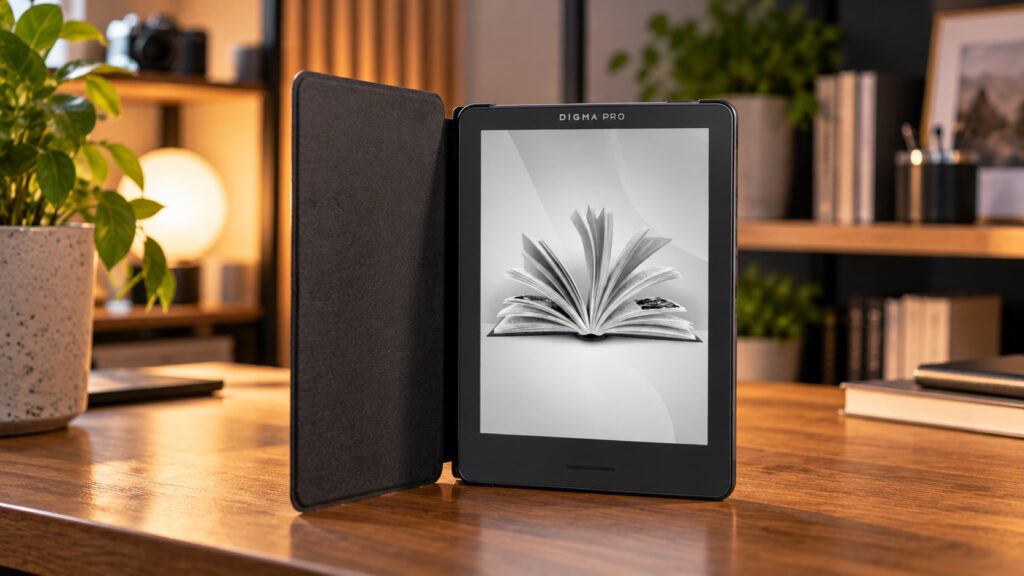
The Digma Pro Moon 6 in its case
Key specifications
- 6-inch E-Ink Carta touchscreen, 758×1024 resolution, 212 ppi, with a front light
- 1.8 GHz processor and 1 GB of RAM
- 32 GB of storage, expandable with microSD
- Android 8.1, Wi-Fi and Bluetooth
- 2,200 mAh battery with USB-C charging
After using an iPad, the author says, six inches felt toy-like for the first half hour. However, it is roughly the size of a pocket paperback, and by the next day he had stopped noticing. In return, the reader can be held in one hand almost anywhere: on the metro, in a clinic queue or lying on one side under a blanket. He also notes that 32 GB is far more than enough for books, because text files are tiny.
What changed in the first weeks
The author says the usual claims about E-Ink turned out to be true. The screen does not emit its own light. Instead, it reflects ambient light, much like paper. He was skeptical until he took the reader onto a balcony during the day and found that more sunlight made the text easier to read. With the iPad in the same situation, he says, he would usually squint and look for shade.
He acknowledges that 212 ppi is not impressive on paper, since any iPhone has a sharper image. For text, though, he finds it more than sufficient. He reports smooth letters and no shimmer. Most importantly for him, his eyes do not get tired, and he can read for 1.5 to 2 hours in a row. For evening use, the front light illuminates the surface of the screen rather than shining toward the reader. He says that, in a dark bedroom, it does not feel like sitting under a spotlight.
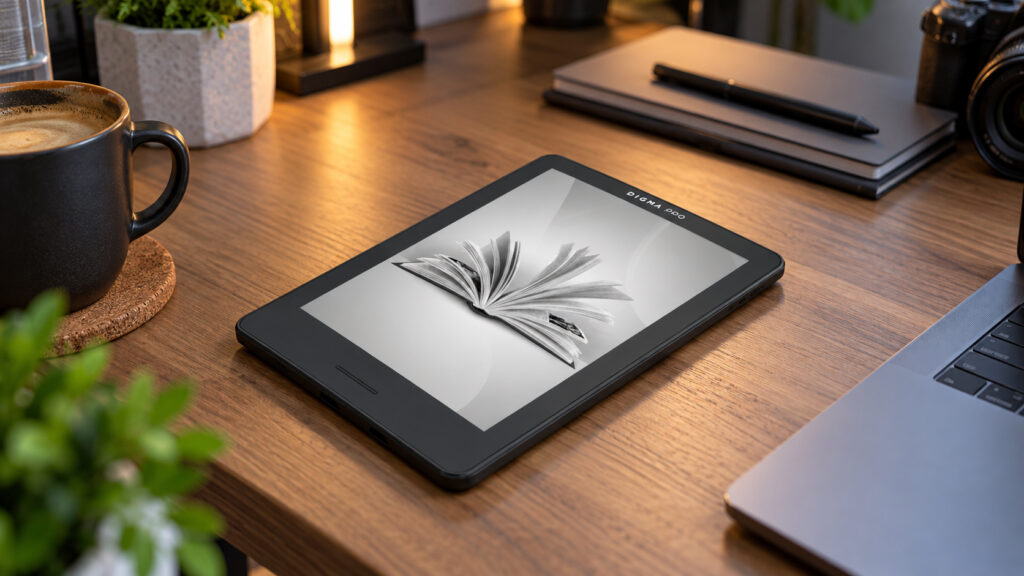
The Digma Pro Moon 6 on a table
Boredom as a feature
The biggest surprise for the author was that the e-reader is boring, in a good way. There is nothing on it except the book. He suggests that his brain quickly registered this and stopped reaching for notifications. As a result, he began reading every evening without setting himself any goals.
Battery and charging
The author says plainly that he did not time the battery life. He explains that E-Ink uses power when a page changes, because the image stays on the screen without needing to be refreshed. As a result, he says he simply forgets about charging and charges the reader only occasionally. It uses the same USB-C cable as his iPhone and iPad, so he does not need an extra cable when traveling.
Getting books onto the device
According to the author, books can be transferred by cable from a Mac, copied to a memory card or downloaded directly over Wi-Fi, because the device runs Android. Wireless headphones can be connected via Bluetooth for audiobooks.
The catches
The author stresses that his account is not meant to sound like an advertisement for happiness. He lists several drawbacks worth knowing in advance.
- Black-and-white screen. Comics, magazines and books with color illustrations look dull. PDFs with complex layouts are frustrating on a 6-inch screen, because the reader must keep zooming and panning. He would not use the device for textbooks with charts.
- Page-turn lag. Pages change after a short pause, and the screen sometimes flickers slightly. He describes this as a characteristic of E-Ink shared by all such readers. He got used to it in about two days, although it irritated him on the first evening.
- Old software. Android 8.1 is outdated, and some newer apps may not install. In his words, the e-reader will not replace a tablet; it is for books, and that is all.
So should you swap an iPad for an e-reader?
The author did not sell his iPad. He still uses it for video, work documents and everything else. He simply stopped trying to read novels on it and says he is better off for it.
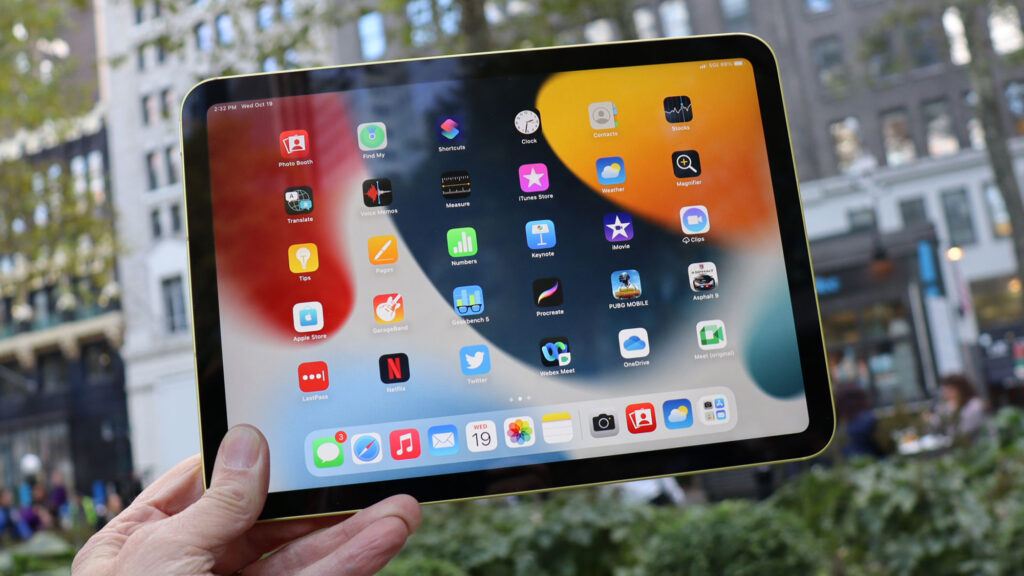
An iPad (2022) held in a hand
His advice is straightforward. If you bought a tablet partly for reading but open books on it only about once a month, an inexpensive e-reader may be worth trying. If you mostly read comics or illustrated PDFs, he says you should stick with the iPad. He also suggests that a microSD card and a spare USB-C cable are useful additions to the reader.
His experience is a single user’s account rather than a controlled test. The reading-habit and eye-comfort benefits he describes are personal observations.