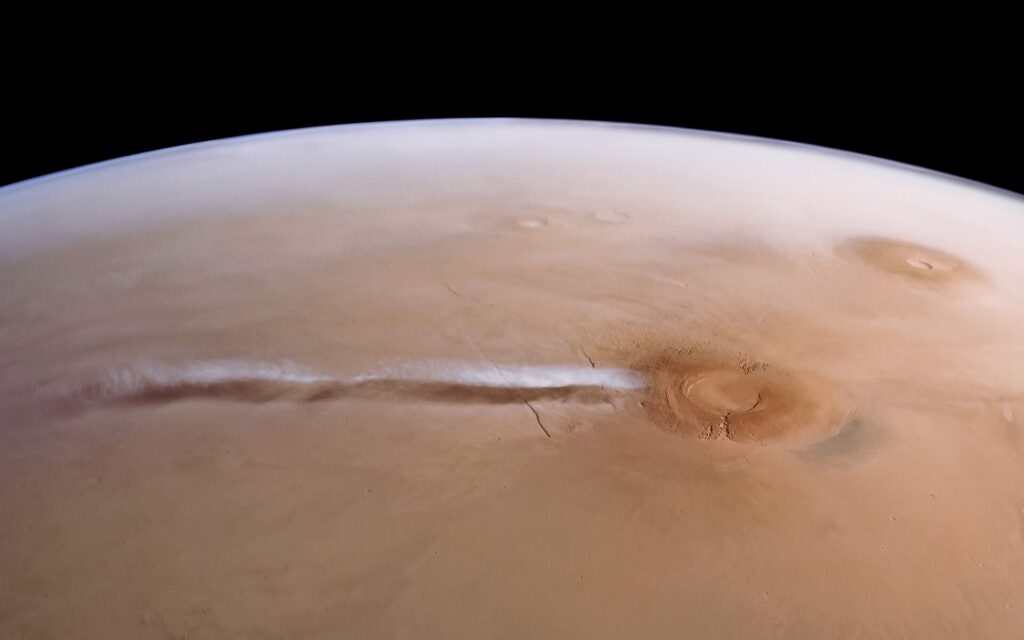
A long white cloud above volcanic calderas on the surface of Mars
Almost every day during Martian spring and summer, an elongated cloud forms over the Martian volcano Arsia Mons. It stretches for hundreds or even thousands of kilometers, then disappears within a couple of hours. Computer modeling suggests why: ice in the cloud appears to form directly from water vapor, without the dust or salt particles that usually seed cloud droplets and ice crystals on Earth. Scientists describe this as a process that has not been observed in nature on Earth.
What you need to know
- The Arsia Mons Elongated Cloud (AMEC) can reach about 1,800 km in length, roughly one-twelfth of Mars’ circumference, yet it lasts only a couple of hours.
- Models built on Earth-style cloud physics failed to reproduce it; adding homogeneous nucleation, in which water molecules clump together without a seed particle, produced a cloud matching orbital observations.
- In the model, a powerful wave lifts air high above the volcano, where it cools by 30 degrees in 10 minutes, causing humidity to spike.
- The source of the cloud’s water is not established; frost on the volcano’s summit is a hypothesis.
A giant cloud over Arsia Mons
The cloud is known as AMEC, short for Arsia Mons Elongated Cloud. It appears above the volcano almost daily in Martian spring and summer and can stretch up to 1,800 kilometers. That means a single cloud can span roughly one-twelfth of the planet’s circumference. Despite its size, it is short-lived: it dissipates after a couple of hours.
The volcano beneath it is also enormous. Arsia Mons is second in height only to Olympus Mons, and its slopes rise about 20 kilometers, more than twice the height of Everest.
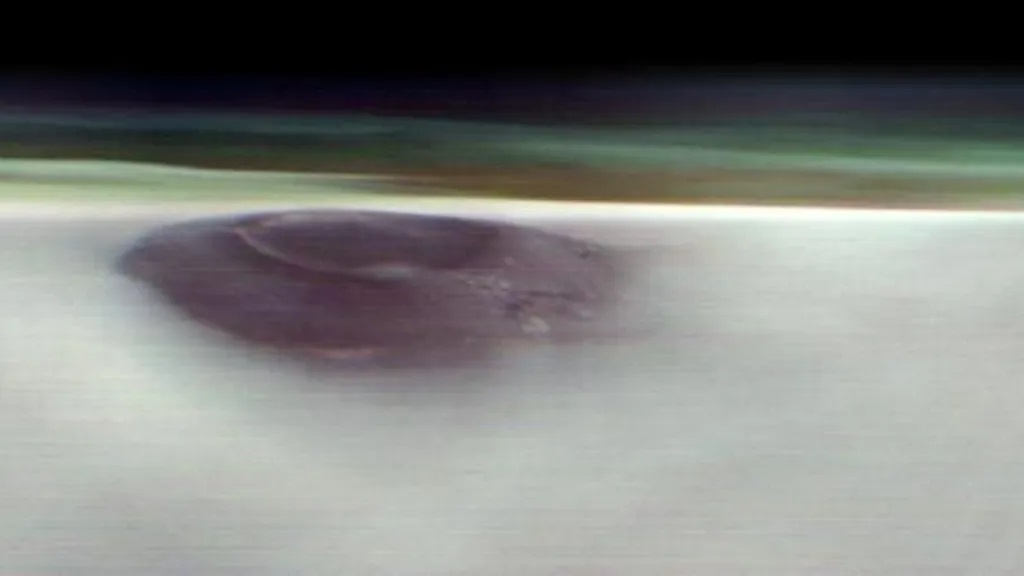
Arsia Mons is the second-tallest volcano on Mars after Olympus Mons and is twice as high as Everest. This image was taken by NASA’s Odyssey orbiter.
Why such a cloud is surprising on dry Mars
Mars does have dust storms and rare cirrus clouds made of carbon dioxide. But its atmosphere contains very little water vapor, so thick, Earth-like clouds are rare there. A cloud of this size remained a puzzle for a long time.
At first glance, its formation looks familiar. Wind pushes moist air up a mountainside, the air cools, and vapor turns into ice or droplets. Clouds like this are called orographic, meaning they are produced by terrain. On Earth, a similar cloud sometimes hangs over the Rock of Gibraltar in southern Europe. However, computer models built on Earth’s rules could not reproduce the Martian cloud.
Ice forming straight from vapor, without dust seeds
On Earth, a droplet or ice crystal usually needs a “seed”: a tiny particle of dust or salt on which vapor can condense. There is another route, in which water molecules stick together on their own with no seed at all. Physicists call this homogeneous nucleation.
It requires extreme humidity, roughly 100,000 times higher than at Earth’s surface. For that reason it was regarded as an elegant textbook theory that almost never occurs in nature. It had been considered possible only in the upper layers of Earth’s atmosphere or in the skies of Venus, and even there it was judged unlikely.
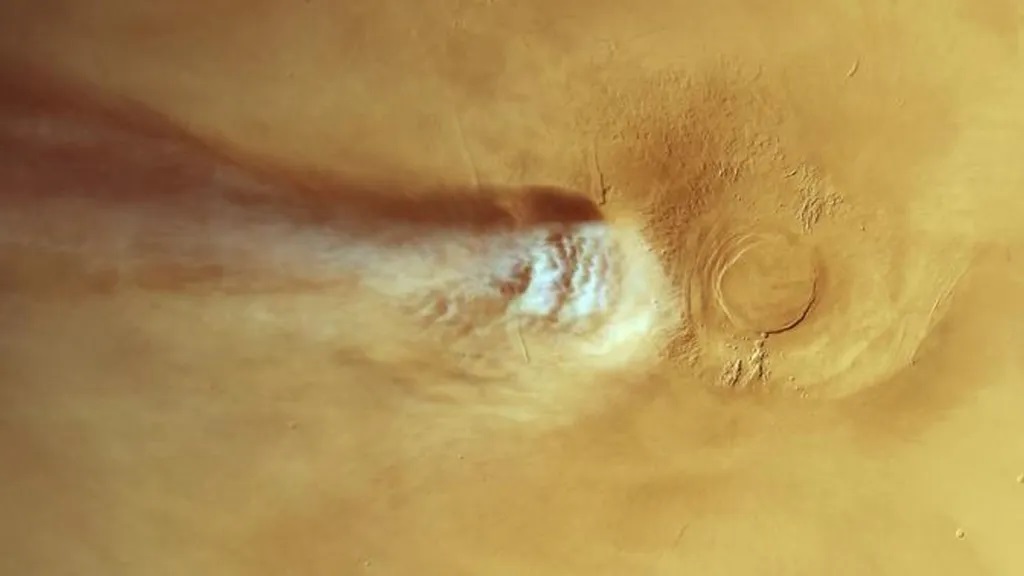
AMEC forms when summer winds push water vapor up and over the 12-mile slopes of Arsia Mons. But it lasts only a couple of hours at a time.
How the model reproduced the cloud
When this mechanism was added to the calculations, the modeled cloud appeared just as it looks from orbit. As wind climbs the slopes of Arsia Mons, it generates a powerful wave that throws air high into the atmosphere at great speed. Up there, the air cools by 30 degrees in 10 minutes. Humidity inside the wave rises sharply, and ice begins to form directly from the vapor.
Where the water comes from
Some of the water is already present in the thin Martian air. Scientists suggest that another portion comes from the summit of Arsia Mons, which is covered by a thick layer of frost. This remains a hypothesis: the origin of the water has not been firmly established.
The cloud has been monitored since 2018 by the Mars Express orbiter, the spacecraft that originally discovered it. Three of its instruments track day by day how the cloud forms and changes. Mars Express is also one of the few spacecraft able to observe Arsia Mons in daylight.
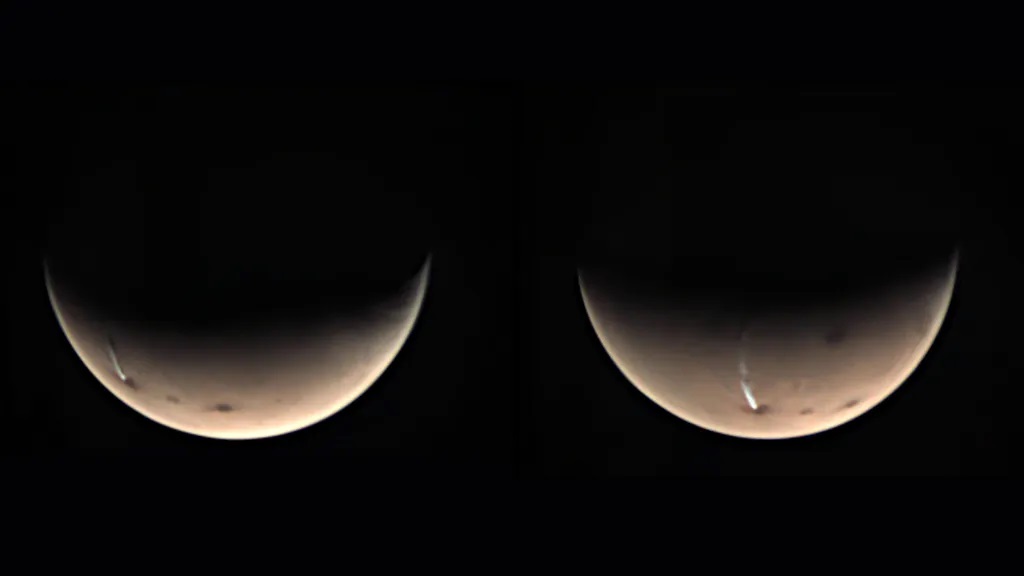
Mars Express has closely monitored AMEC since 2018. These images show the cloud appearing over several consecutive days in July 2020.
Limits of the finding
The mechanism comes from computer modeling grounded in observations. Much less is known about the Martian atmosphere than about Earth’s, which is why such a close match between the model and reality is already regarded as a significant success.
Weather on other worlds follows its own rules
Weather on Earth and Mars is governed by the same laws of physics, but those laws play out differently. Something that remains largely theoretical on Earth may happen daily on a neighboring planet. Scientists believe the same could apply to distant exoplanets, which is worth keeping in mind when studying their atmospheres and searching for signs of life there.
The Arsia Mons cloud shows that even ordinary weather on a neighboring planet is far from fully understood.