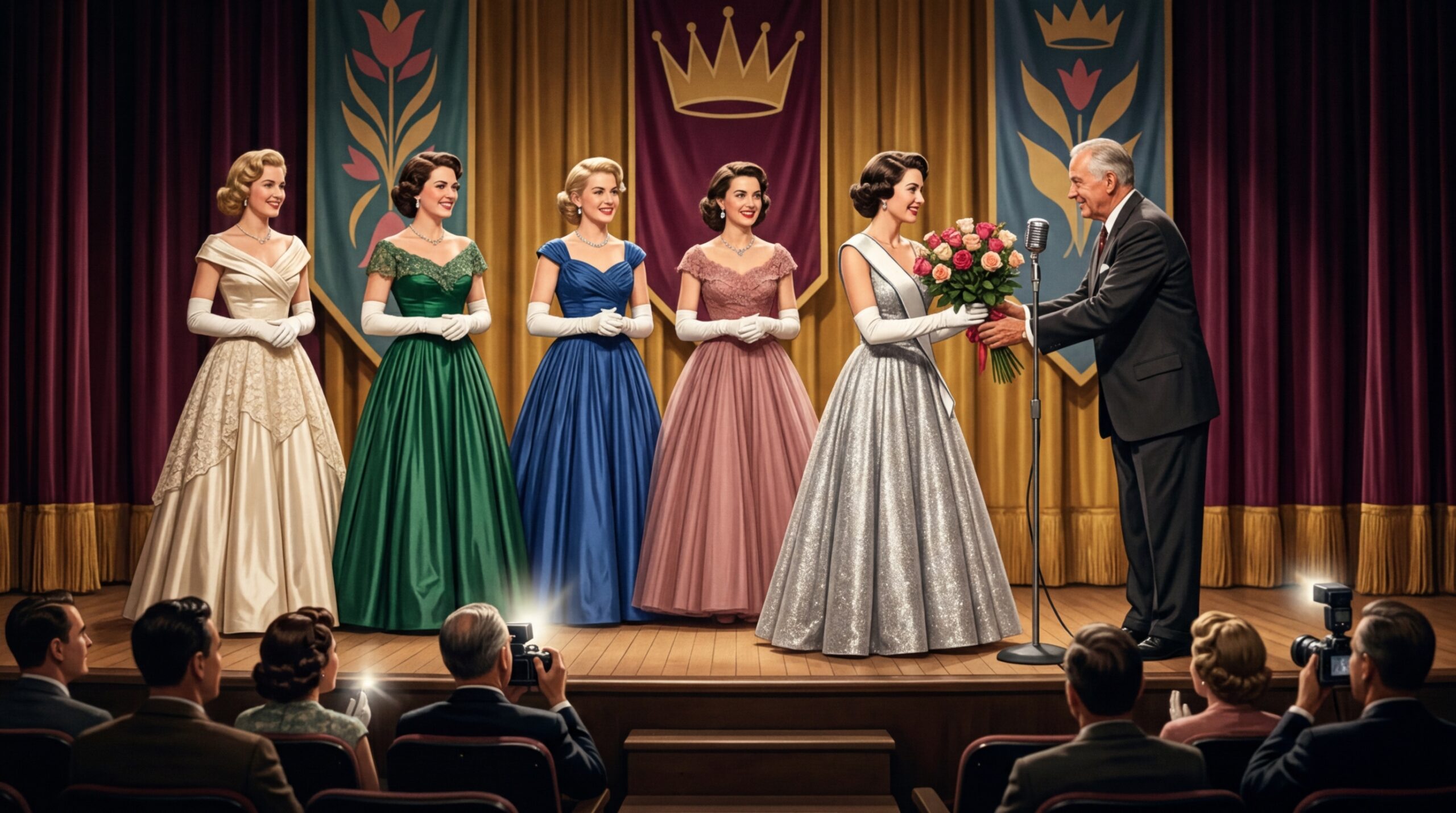
A beauty pageant from the 1950s — this is where the 90-60-90 standard originated
The measurements 90-60-90 are familiar to almost everyone — even those who have never been interested in fashion or fitness. These three numbers have become something of a cultural code: they are mentioned in songs, jokes, advertisements, and everyday conversations. But where exactly did this set of numbers come from, why did it become established as the standard, and does it have any scientific basis at all? The story turns out to be far more interesting than simply “fashion designers decided so.”
Where Did the 90-60-90 Parameters Come From
To understand the origin of this standard, we need to go back to the mid-20th century, the golden age of beauty pageants. It was the organizers of “Miss World” and “Miss Universe” in the 1950s–1960s who began recording contestants’ measurements: bust, waist, and hip circumferences. These were not arbitrary measurements — organizers needed clear, “objective” criteria for comparison. That’s how three numbers turned into a formula.
The measurements 90-60-90 (in centimeters) correspond to approximately 36-24-36 in inches, and it was in the imperial system that they first became known as a standard in the English-speaking world. Interestingly, these numbers were not the result of any scientific calculations. They simply reflected the average measurements of beauty pageant winners of those years — women of a certain height (around 170–175 cm), build, and age. Over time, the average came to be perceived as the ideal.
The fashion industry picked up this formula and amplified it. Designers began making clothes calculated for specific proportions, mannequins in stores began reflecting the “ideal,” and magazines distributed it in millions of copies. That’s how a pageant standard became a cultural norm.
Why the 90-60-90 Figure Seems Attractive
It would be too simple to say that the 90-60-90 standard is purely an invention of the fashion industry. Evolutionary psychologists have long noted that in many world cultures, independently of each other, a certain waist-to-hip ratio is considered attractive. The key number here is not the centimeters themselves, but the proportion.
In 1993, psychologist Devendra Singh from the University of Texas published a study showing that men across very different cultures rated a waist-to-hip ratio of about 0.7 as most attractive. If you divide 60 by 90, you get 0.67 — very close to that value. Singh suggested this was linked to reproductive health: women with this ratio statistically more often have normal hormonal levels and fertility.
It’s important to note that this hypothesis is just that — a hypothesis. Subsequent studies produced contradictory results. In some cultures preferences differed, in others they depended on standard of living and food availability. Science has not yet confirmed a universal biological “ideal” body shape — but the connection between certain proportions and the perception of attractiveness has indeed been recorded in numerous experiments.

The waist-to-hip ratio is a key parameter studied by evolutionary psychologists
Is the Golden Ratio Connected to the 90-60-90 Proportions
Discussions about ideal body proportions inevitably lead to the golden ratio — the number 1.618 (also known as Phi), which appears in nature, architecture, and art. Some authors claim that the “ideal” female figure also follows this proportion: for example, the ratio of leg length to torso or facial proportions.
In practice, it’s more complicated. The golden ratio can indeed be “found” in practically any object if the measurement points are chosen flexibly enough. Serious research shows that people do prefer certain facial proportions — symmetry, average cheekbone width, a certain distance between the eyes. But there is no rigid connection specifically to the number 1.618. It is more of a beautiful metaphor than a strict law.
The same applies to the body. Attractiveness is too complex and multidimensional a phenomenon to reduce to a single number or formula. Context, culture, personal experience, even mood — all of these influence perception. The golden ratio works here roughly like a horoscope: it sounds convincing, but upon closer examination turns out to be too vague.
How the Ideal Female Figure Has Changed Across Eras
One of the strongest arguments against a “universal standard” is history. Ideas about the beautiful body have changed radically, and 90-60-90 is just one of many ideals.
- Antiquity. Greek and Roman sculptures depict women with soft bellies, wide hips, and small breasts. A slender waist was not a priority.
- Middle Ages. The ideal was a fragile body with a high waist and pale skin — a sign of aristocratic origin;
- Renaissance. Rubens and his contemporaries celebrated voluptuous forms — plumpness meant health and prosperity;
- 1920s. A fashion for androgyny: flat chest, narrow hips, boyish silhouette;
- 1950s. Marilyn Monroe and the cult of the “hourglass” — this is where the roots of the 90-60-90 standard lie;
- 1990s. The era of “heroin chic” — sickly thinness on the runways;
- 2010s–2020s. A trend toward athleticism and toned buttocks, largely shaped by social media.
Every era was convinced that its standard was the “natural” and “correct” one. Looking back, it becomes obvious that beauty standards are primarily a mirror of culture, economics, and social relations, not a biological constant.

The ideal female figure has changed dramatically from era to era
What 90-60-90 Proportions Look Like in Real Life
Many people who search for “90-60-90 proportions — what does it look like” imagine something very specific. But in reality, the same centimeters on different heights, with different muscle-to-fat ratios, with different leg and torso lengths, look completely different.
For a woman who is 168–172 cm tall, measurements of 90-60-90 mean a fairly slender “hourglass” figure. For a woman who is 160 cm tall, the same numbers would look considerably curvier. And for a height of 180 cm — on the contrary, very delicate. Three numbers by themselves, without accounting for height, build, and body composition, say very little about a figure.
This is precisely why modern medicine and nutrition science use entirely different indicators: body mass index (BMI), body fat percentage, waist-to-height ratio. They are not perfect either, but at least they account for more variables than three circumferences.
Why the 90-60-90 Standard Still Lives On in Culture
If this standard is not universal from a biological standpoint and doesn’t suit most real women, why is it so persistent? The answer most likely lies in its simplicity. Three round, memorable numbers — it’s the perfect meme long before the age of memes. They are easy to say, easy to remember, and easy to use as a cultural reference.
Furthermore, the standard is sustained by industries: fashion, advertising, cinema. Even when official rhetoric shifts toward “body positivity” and acceptance of diversity, marketing images often remain remarkably uniform — simply because familiar proportions “sell” well.
Interestingly, the relationship between clothing sizes in different countries also affects perception. A European size 38, a Russian size 44, an American size 6 — these are approximately the same parameters.