
Early rising isn’t always the key to productivity: much depends on your chronotype
Some people easily wake up at six in the morning and manage to get everything done by lunchtime. Others truly “switch on” closer to midnight, and early rising is sheer torture for them. Intuitively, it seems like early birds live more correctly, while night owls are just lazy. But science says it’s not about discipline — it’s about biology. Why are people divided into owls and larks? And which of them is healthier? Let’s find out.
What Types of Chronotypes Exist
When people say “I’m a night owl” or “I’m an early bird,” they’re talking about their chronotype. This is an individual characteristic of the body’s daily rhythms — essentially, your internal biological clock that determines when you fall asleep, wake up, and at what time of day you work best. A chronotype consists of evolutionarily developed and genetically predetermined features of the human body’s daily rhythms.
It’s important not to confuse chronotype with habit. A habit can be changed through willpower: force yourself to go to bed earlier for a couple of weeks, and the body will adjust. Circadian rhythm can be “trained” by following a strict schedule, but the chronotype itself exists on a more permanent basis. Simply put, you can get up at seven in the morning by alarm, but if your chronotype is evening, your peak productivity will still come closer to evening.
Three main chronotypes are usually distinguished: early (morning), intermediate, and late (evening), colloquially called “larks,” “pigeons,” and “owls.” About 60% of the adult population belongs to the intermediate type, while the remaining 40% fall into one of the extreme variants. So most of us are neither pure owls nor pure larks, but something in between.
Do Night Owls and Early Birds Really Exist?
Skeptics often say that the division into owls and larks is just an excuse for lazy people. But there is quite real physiology behind chronotypes. Melatonin — the sleep hormone — plays a key role. Circadian rhythms are conducted by melatonin, which is produced by the pineal gland (epiphysis) — a small gland in the brain. It begins synthesizing melatonin during dark hours and stops when it becomes light. In different people, hormone production may begin slightly earlier or slightly later — and depending on this, the chronotype is formed.
According to Popular Science, in early birds, melatonin starts being released earlier in the evening, and the peak concentration of cortisol, the alertness hormone, falls at 4–5 AM — earlier than in most people. In night owls, this same cycle is shifted forward by several hours: the rise and fall of melatonin occurs approximately 3 hours later than in early birds.
And this is not a matter of autosuggestion. Twin and family studies have estimated the genetic contribution to chronotype formation at approximately 50%. Several genes have shown a connection to chronotype — for example, PER1, PER2, CLOCK, and ARNTL2. And a large-scale genetic study based on UK Biobank and 23andMe data identified 351 genetic loci associated with the morning chronotype — based on data from nearly 700,000 participants.
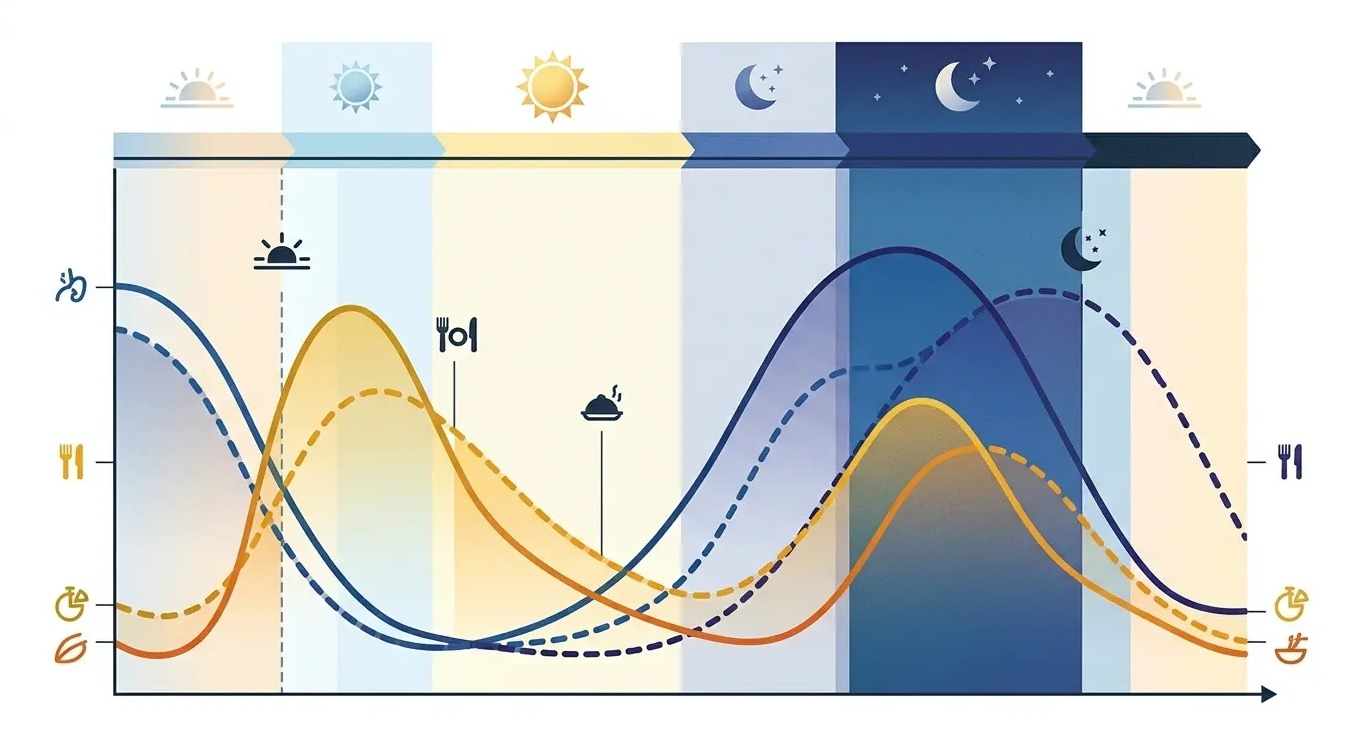
Melatonin and cortisol production graphs differ noticeably between early birds and night owls
How Chronotype Changes with Age
Interestingly, chronotype is not a fixed characteristic set once and for all. It shifts noticeably throughout life, and this is one of the reasons why the question “are you an owl or a lark?” doesn’t have a simple answer.
When we’re little, we wake up early. In adolescence, we turn into night owls. In middle age, the rhythm stabilizes, and in old age, we become early birds again because melatonin levels decrease.
Studies confirm this picture: the late chronotype peaks around age 20, while children and elderly people exhibit an earlier chronotype.
But here’s what’s important: despite these age-related shifts, the relative position on the “owl–lark” scale remains fairly stable. If at 20 you were a later chronotype than your peers, you will most likely remain a “night owl” compared to your social circle at 50 — just the overall framework will shift to an earlier time.
Why Night Owls Have It Harder: Social Jetlag
If chronotype is an innate trait, why do studies repeatedly show that night owls fare worse? The answer lies not in the chronotype itself, but in its conflict with society.
Social jetlag arises from the mismatch between a person’s internal biological clock and the external demands of society — primarily work and school schedules. Imagine that every Monday you fly two or three time zones east, and on Friday — back again. That’s exactly what happens to night owls who are sleep-deprived all week due to early work starts and then catch up on sleep over the weekend.
The term “social jetlag” describes the discrepancy between biological time (internal clocks) and social time (work obligations). In industrialized countries, two-thirds of the working population experience social jetlag, often for many years. And chronotype plays a central role in its development: evening types are particularly vulnerable because their internal clocks are by default “delayed” relative to social norms.
The consequences of this mismatch are more serious than just morning drowsiness. Systematic reviews have shown that social jetlag is associated with deteriorating psychological health and other risks — including a higher prevalence of obesity. However, it’s important to note that a direct causal link between social jetlag and disease development has not yet been proven — most data come from observational studies.

Night owls are often forced to work during hours of minimal productivity and “wake up” by evening
Who Lives Longer: Night Owls or Early Birds?
If we answer directly, statistically early birds look slightly more “advantageous”: in large studies, night owls had a higher risk of death from various causes. For example, in the UK Biobank database, where data from more than 433,000 people were analyzed, the evening chronotype showed approximately a 10% higher mortality rate compared to the morning type. Additionally, night owls were more frequently found to have associated health problems, including diabetes and mental disorders. But this doesn’t mean that the habit of going to bed late automatically shortens life.
More precise data show that it’s not only or even primarily about chronotype, but about lifestyle. In a Finnish observational study spanning 37 years, night owls also showed slightly higher mortality, but after adjusting for smoking and alcohol, a significant portion of this difference disappeared, and among non-smokers and light drinkers, there was no excess risk at all.
Simply put, what often harms night owls is not their biology per se, but the constant conflict between their internal clocks and the usual life schedule: early wake-ups, sleep deprivation, social jetlag, stress, and disrupted routines. Therefore, it’s more accurate to say not “early birds live longer,” but “night owls more frequently accumulate factors that can shorten life.”
Is It Better to Be a Night Owl or an Early Bird?
So who is “better” — an early bird or a night owl? The source in Popular Science puts the answer succinctly:
The key is not waking up early, but synchronizing your life with your natural rhythm.
If your chronotype matches your schedule — you get enough sleep, feel energized, and work productively.
Adapting to your natural chronotype can improve sleep quality, energy levels, and mood. Conversely, trying to “remake” yourself from a night owl into an early bird without considering biology is more likely to lead to chronic sleep deprivation.
What you can do right now:
- Try to go to bed and wake up at the same time every day, including weekends — this reduces social jetlag
- Get plenty of natural light in the morning — this helps set your internal clock
- Limit screens and bright light in the evening — blue light suppresses melatonin production and shifts your sleep time later
- If your chronotype doesn’t match your work schedule — try to negotiate flexible hours or adjust your routine where possible