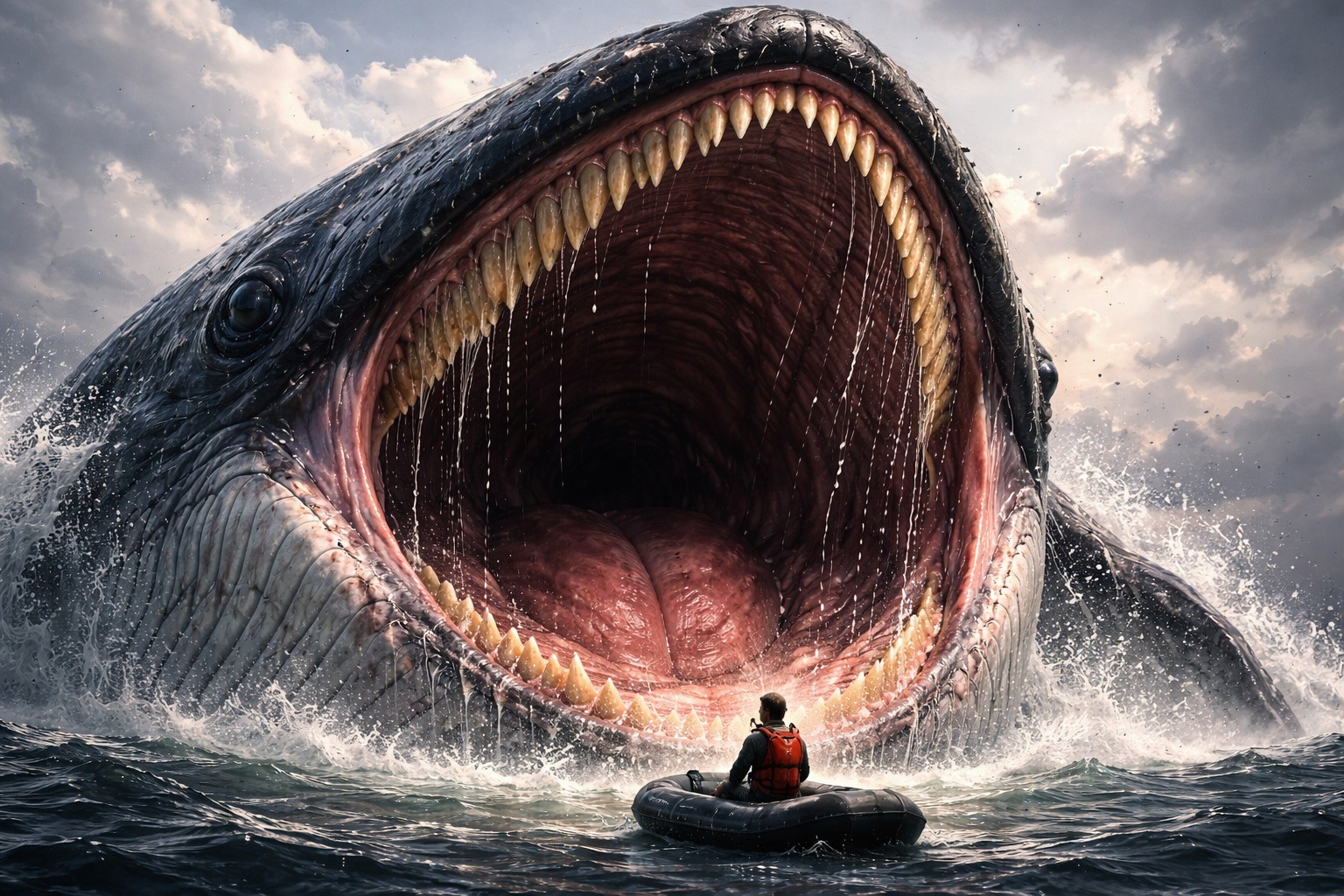
Not only the blue whale has an enormous mouth — there are other contenders too
Which animal can open its mouth wider than any other? In their search for the answer, scientists have measured the jaws of whales, sharks, and prehistoric predators, but the absolute record holder turned out to be a peaceful and even somewhat mysterious creature. We’re talking about an inhabitant of the ocean depths whose mouth opens so wide that a truck could fit inside it. Giant dimensions, unique anatomy, and an amazing way of life — all of this makes it the owner of the biggest mouth in the world.
The Animal with the Biggest Mouth
The biggest mouth among all living creatures on Earth belongs to the blue whale (Balaenoptera musculus) — the largest animal that has ever existed on our planet. Its mouth opens up to 4 meters high — roughly the height of a ceiling in a two-story building or a full-size SUV standing upright.
But why does a whale need such a big mouth? The answer lies in one of nature’s most elegant paradoxes: the animal with the biggest mouth feeds on some of the smallest organisms in the ocean — krill, tiny crustaceans just a few centimeters long.
This is not just a biological curiosity. It is the result of millions of years of evolution that created the perfect machine for filtering food from seawater. A single gulp of a blue whale holds up to 80,000 liters of water, which it then strains through special plates — baleen.
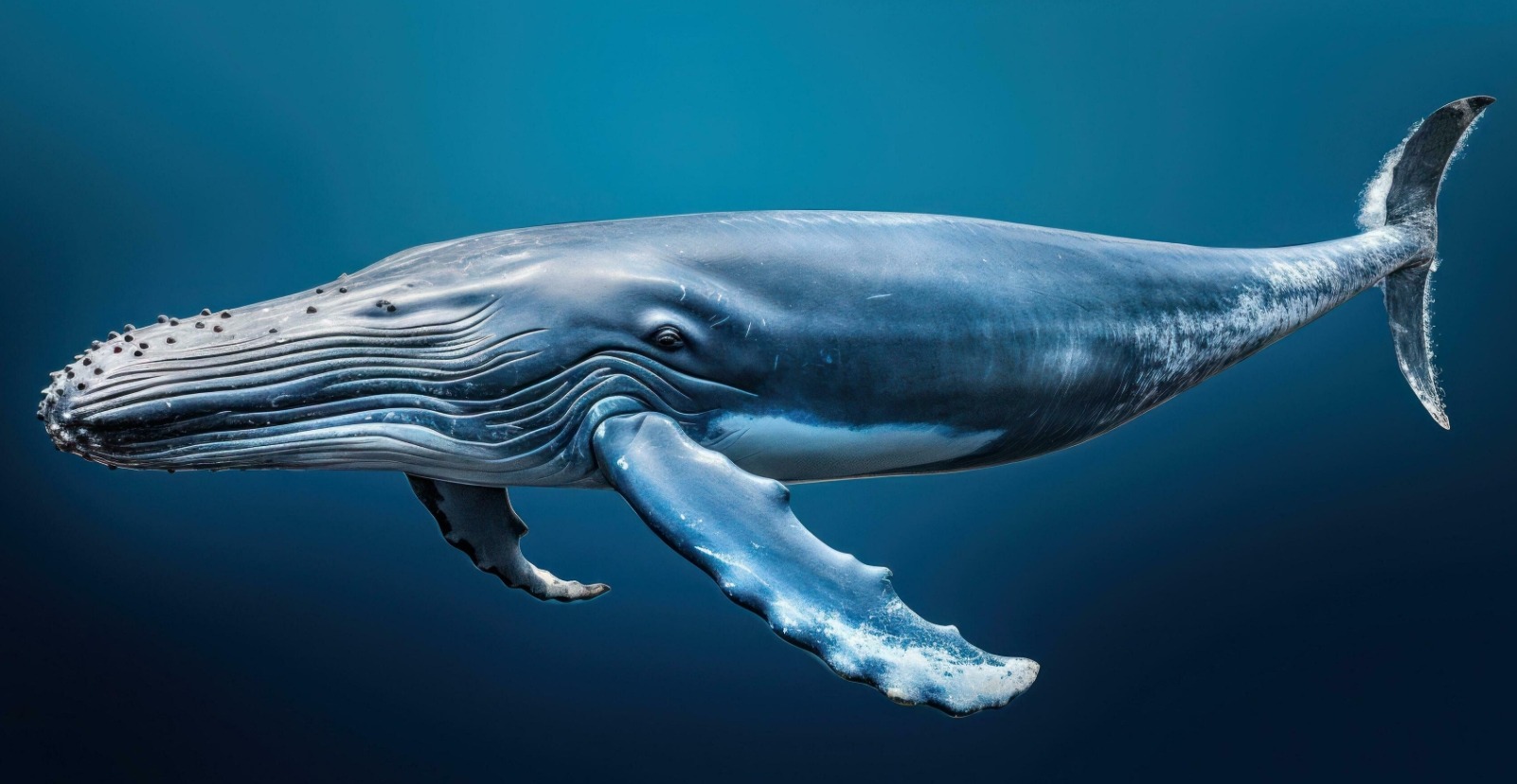
The blue whale feeds on very small food. Image source: vecteezy.com
How Blue Whales Feed
The blue whale belongs to the baleen whales (Mysticeti) — a suborder that evolved in a completely different way from toothed whales like sperm whales or dolphins. Instead of teeth, it has hundreds of keratin baleen plates hanging from the upper jaw like a giant sieve.
The whale’s hunting mechanism works like this:
- The whale accelerates and makes a powerful lunge into a swarm of krill;
- Its mouth opens nearly 90 degrees, with the jaw dropping those full 4 meters;
- An enormous volume of water rushes in along with thousands of crustaceans;
- The whale’s tongue weighs as much as an elephant — about 4 tons — and helps push the water back out through the baleen plates;
- The krill remains inside and is swallowed.
In a single day, an adult blue whale eats up to 4 tons of krill. That’s about 40 million individual crustaceans. Impressive, isn’t it?
Interestingly, the very act of opening its mouth requires colossal energy expenditure. Scientists have found that a single lunge with an open mouth consumes roughly the same amount of energy as the whale gains from the krill eaten in that gulp. In other words, hunting operates literally on the edge of profitability — and that’s precisely why whales try to attack only dense concentrations of food.
Other Animals with the Biggest Mouths
The blue whale is the absolute champion among currently living creatures. But in the animal kingdom, there are other impressive mouths worth mentioning:
- Bowhead whale (Balaena mysticetus) — the closest competitor to the blue whale. Its mouth is, by some measures, proportionally even larger: it makes up about one-third of the animal’s entire body length. With a body length of up to 18 meters, this gives a mouth up to 5 meters high when fully open according to some data, although its overall body mass is less than that of the blue whale.
- Whale shark (Rhincodon typus), the largest fish on the planet, is also a filter feeder with an enormous mouth up to 1.5 meters wide. It leisurely swims with its mouth open, straining plankton.
- Sperm whale (Physeter macrocephalus) — among toothed whales, it has the biggest mouth. The sperm whale’s lower jaw can reach 5 meters in length and is lined with teeth weighing up to 1 kg each. Sperm whales are the ones that hunt giant squid at depths of over a kilometer.
Speaking of historical record holders, among extinct creatures special attention goes to Livyatan melvillei — a prehistoric predatory whale with teeth up to 36 centimeters long. Its mouth was probably one of the most lethal weapons in the history of life on Earth.
Why Do Animals Need a Big Mouth
Mouth size is not a random characteristic. In the wild, the shape and size of the oral apparatus directly determine an animal’s ecological niche, the food available to it, and ultimately its evolutionary success.
The blue whale’s enormous mouth evolved not to eat large prey, but quite the opposite — to collect small prey as efficiently as possible. This is a strategy scientists call “low-cost, high-yield feeding”: invest minimal energy in a single capture, but capture the maximum volume.
Compare this with a crocodile, which also has an impressive mouth — the most bloodthirsty Nile crocodile has one up to 70 centimeters. But its mouth is a trap for large prey: a powerful grip, with jaw-clamping force of up to 16,000 newtons (the strongest bite among all living creatures). Two completely different evolutionary strategies — and both work flawlessly.
The pelican uses its famous pouch-mouth as a fishing net. The hippopotamus opens its mouth to 150 degrees — not for eating, but to display a threat to rivals: its canine teeth can reach 50 centimeters.