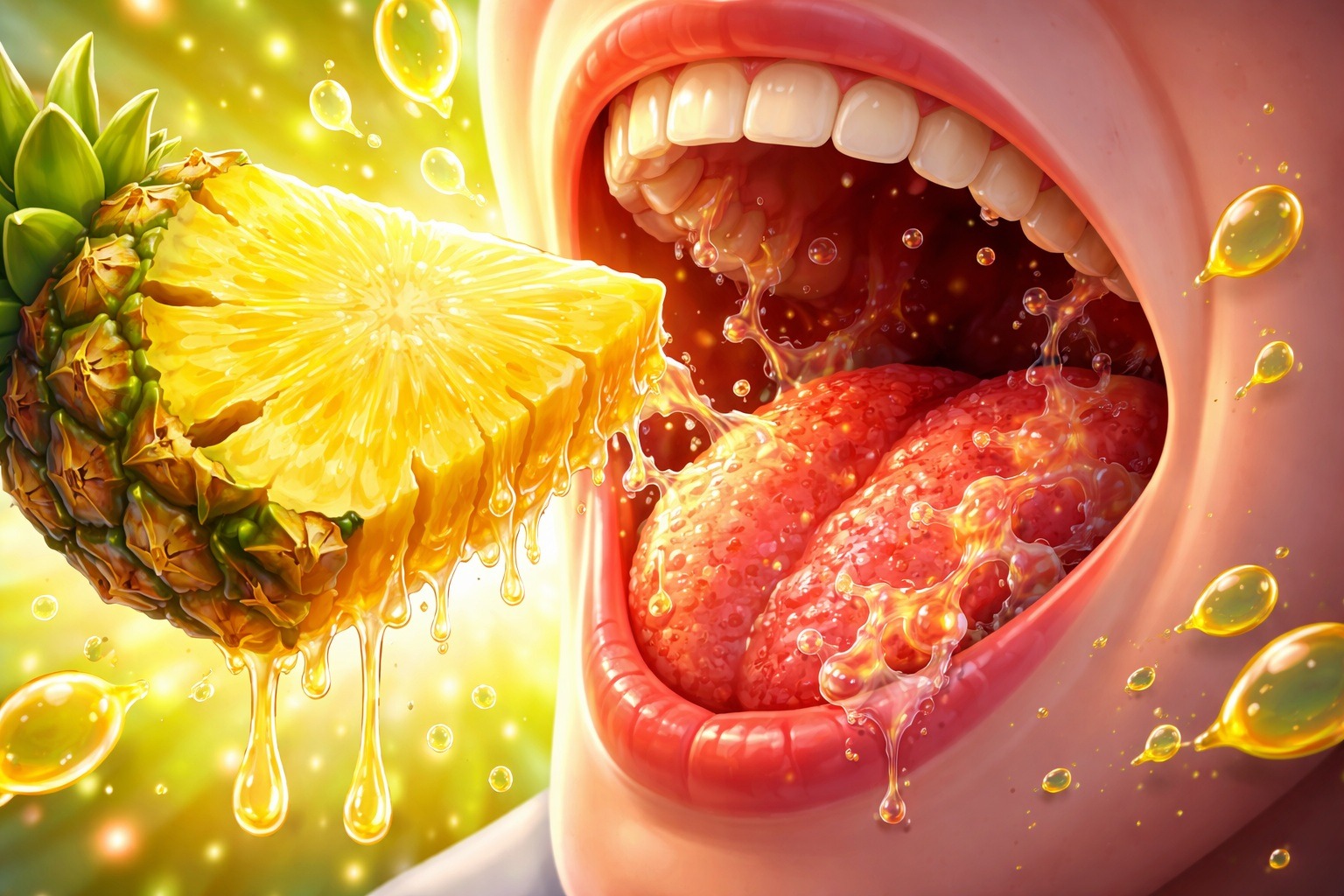
When you eat pineapple, it eats you back
You’ve probably noticed: after a few slices of fresh pineapple, your tongue starts tingling, your lips go slightly numb, and sometimes your mouth feels like you’ve been chewing sandpaper. Many people blame it on the acidity, an allergy, or just “that’s just how the fruit is.” But in reality, something far more interesting is happening — while you’re eating the pineapple, the pineapple is literally digesting you back. And this is not a metaphor — it’s pure biochemistry.
What Is Bromelain and Why Is It Found Only in Pineapple
The main culprit behind all the unpleasant sensations in your mouth is an enzyme called bromelain. It is a proteolytic enzyme (protease), meaning a substance capable of breaking down proteins into smaller fragments — peptides and amino acids. Bromelain is found in all parts of the pineapple, but it is especially concentrated in the tough core and fresh juice.
When a piece of pineapple enters your mouth, bromelain immediately gets to work. Its target is the proteins that make up the mucous membrane of the oral cavity. Simply put, the enzyme destroys the thin protective layer on the surface of the tongue, palate, and inner cheeks. That’s why the characteristic tingling, burning, or even mild pain occurs. It’s not an allergy or irritation from acid — it’s literally microscopic digestion of your own tissues.
Interestingly, bromelain is found almost exclusively in pineapples. Other tropical fruits have their own proteases — for example, papain in papaya and actinidin in kiwi. But bromelain stands out for its particularly aggressive action on the proteins of the mucous membrane.
Why Pineapple Causes Burning and Tingling in the Mouth
Let’s take a closer look at what exactly happens at the cellular level. The oral mucosa is covered with a thin layer of glycoproteins — proteins linked to carbohydrate chains. This layer acts as a protective barrier: it shields the delicate tissues from mechanical damage, bacteria, and aggressive substances in food.
Bromelain attacks precisely this barrier. It breaks peptide bonds in protein molecules, essentially “dissolving” the protective film. When the barrier thins out, nerve endings end up closer to the surface and start reacting to everything — the acidity of pineapple juice, the mechanical pressure of chewing, even saliva. Hence the bouquet of sensations: tingling, burning, numbness, and for particularly sensitive people — a feeling of “scraped” skin inside the mouth.
But there’s a nuance. Bromelain only works in fresh pineapple. When heated to 70–80 degrees Celsius, the enzyme denatures — its protein structure breaks down and it loses its activity. That’s exactly why canned pineapples, which have undergone heat treatment, don’t cause any discomfort. The same applies to pineapple jam, baked desserts, and pineapple pizza (yes, that one).

Pineapple pizza has almost no bromelain because it breaks down when heated
Is Bromelain Dangerous to Human Health
You might think that an enzyme that digests living tissue must be dangerous. But there’s no need to panic. The thing is, bromelain acts superficially and quite slowly compared to the digestive enzymes in your own stomach. The oral mucosa renews itself at an impressive rate — a full cell replacement cycle takes only 3 to 7 days. And the damaged protective glycoprotein layer regenerates even faster, literally within a few hours.
Moreover, once the pineapple reaches the stomach, bromelain finds itself in an extremely acidic environment, where its activity drops sharply. Some of the enzyme does retain its function and even helps digest protein-based food — which is exactly why some cuisines traditionally serve pineapple with meat. Bromelain is used as a natural meat tenderizer — a pineapple juice marinade can turn even tough beef into a tender dish in just a couple of hours.
However, if you overdo it with fresh pineapple, the consequences can be unpleasant. When consuming a large amount of the fruit at once, the mucosa doesn’t have time to recover, and the discomfort intensifies. Some people develop micro-cracks on the tongue and lips, and in rare cases — temporary loss of taste sensitivity. Usually everything resolves within a day, but the sensations are far from pleasant.
How to Eat Pineapple Without Pain and Discomfort
If you love pineapple but hate the “chemical burn” sensation in your mouth, there are a few simple tricks. First, eat pineapple together with dairy products — yogurt, ice cream, or cottage cheese. Casein and other milk proteins “distract” the bromelain, and the enzyme breaks them down instead of your mucous membrane.
Second, you can lightly salt the pineapple slices. It sounds strange, but salt partially suppresses the enzyme’s activity while simultaneously enhancing the sweetness of the fruit. This technique has long been known in Asian countries, where pineapple is often served with a pinch of salt or chili pepper.
Third, don’t eat the core — that’s where the bromelain concentration is highest. And finally, the most reliable method is heat treatment. Even brief heating on a pan or grill completely “switches off” the enzyme while preserving the taste and aroma.
So pineapple is one of those rare foods that reminds us: nature is full of surprises, and even an ordinary fruit from the supermarket can stage a little chemical attack. An entirely harmless attack, of course — as long as you don’t try to eat a whole pineapple in one sitting.