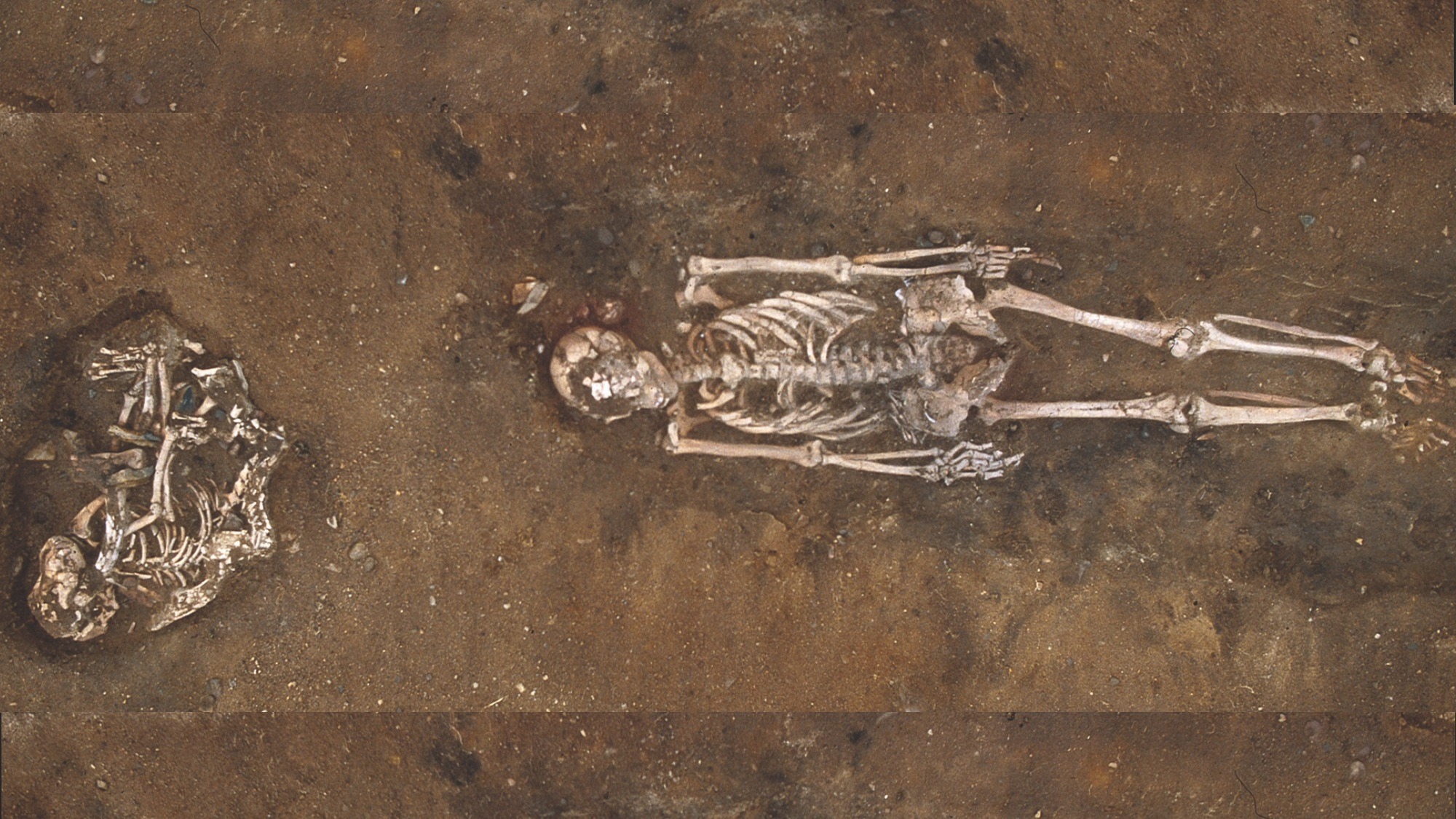
One of the dogs whose remains were found at the Skateholm site in Sweden, buried next to a human. Image source: popsci.com
Geneticists have discovered that dogs in Europe were domesticated more than 14,000 years ago — 3,000 years earlier than previous genetic data indicated. A DNA study of hundreds of ancient bones has for the first time made it possible to clearly distinguish ancient dogs from wolves and trace how our four-legged friends accompanied us on the journey from hunting and gathering to agriculture.
How Long Ago Did Humans Domesticate Dogs — and Why Were Previous Estimates Wrong
Dogs were domesticated from gray wolves near the end of the last Ice Age and became the first animal to enter a “domestic relationship” with humans — long before the emergence of herding and agriculture. The genetic divergence of the dog ancestor from modern wolves occurred 20,000–40,000 years ago, but that was not the moment of domestication — it happened later, possibly more than 17,500 years ago.
The problem was that direct genetic evidence was extremely scarce. Until now, the oldest genetic confirmation of the existence of dogs dated back only 10,900 years. Analyzing DNA from old canid remains is extremely difficult, and the external appearance of bones does not always allow one to confidently distinguish a dog from a wolf. This once again shows how thin the boundary between an early dog and a wolf can be, especially since modern breeds still retain traces of wolf ancestry.
That is precisely why the new study, conducted by an international team from the Francis Crick Institute, the University of East Anglia, and the Max Planck Institute for Evolutionary Anthropology, became such an important step: for the first time, scientists applied large-scale genetic analysis to hundreds of ancient samples.
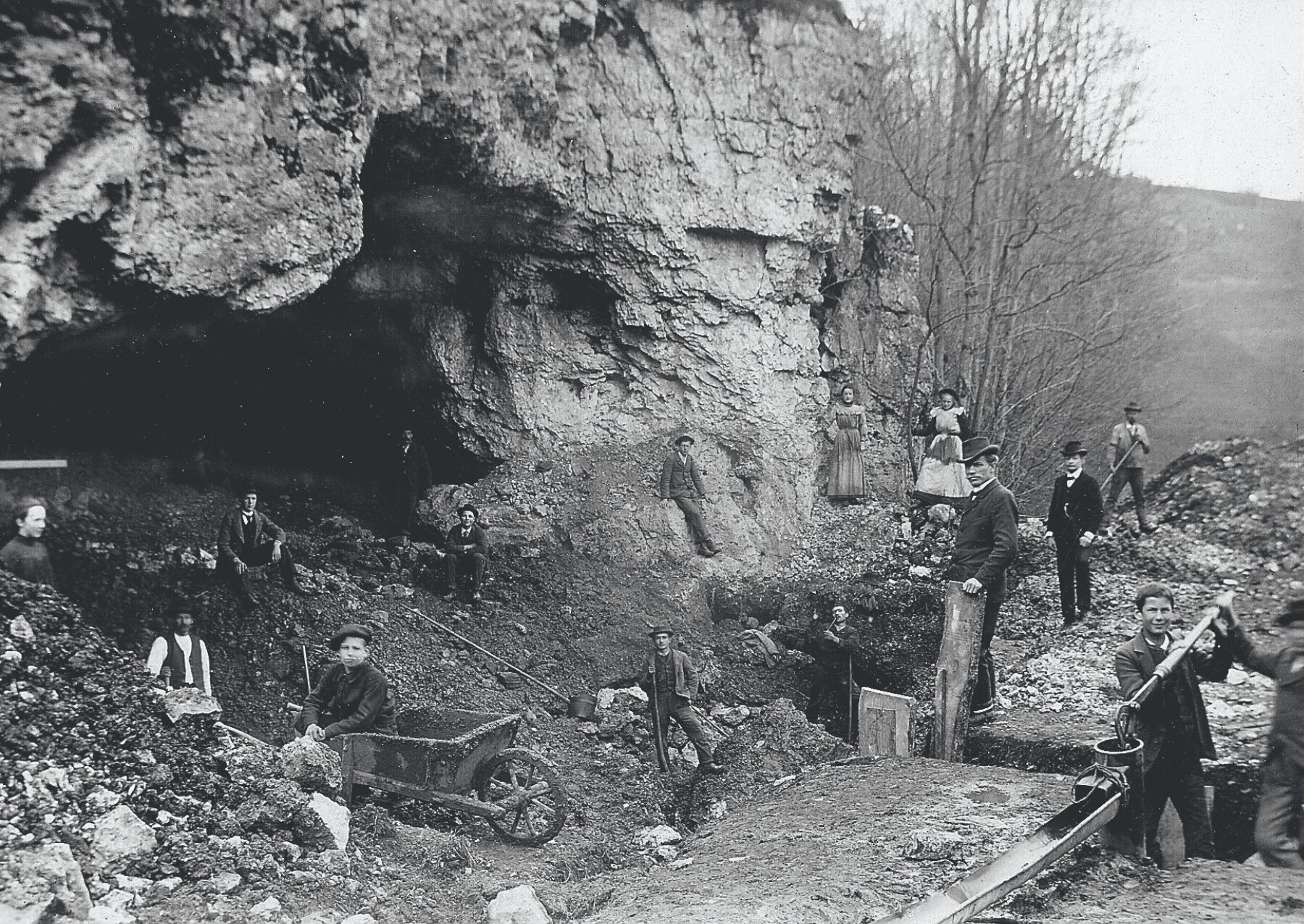
Excavations at Kesslerloch cave led by Jakob Heierli in 1903. Image source: popsci.com
What DNA Analysis of 216 Ancient Remains Revealed
The researchers studied 216 remains of canid family members, of which 181 samples date to the Paleolithic and Mesolithic — that is, to the time before the onset of agriculture, approximately 10,000 years ago. Samples were collected from archaeological sites across Europe and Western Asia: from Switzerland, Germany, France, Belgium, the Netherlands, Turkey, Sweden, Denmark, and Scotland.
To extract the maximum useful DNA from ancient bones, the team used a hybridization capture method. The concept is simple: special genetic “probes” are created that specifically target dog and wolf DNA among the enormous amount of microbial DNA that has accumulated in the remains over thousands of years. This approach made it possible to increase the volume of useful DNA by 10–100 times and determine whether the specimen was a dog or a wolf for 141 of the 216 samples.
There were also surprises: for example, 13,700-year-old remains from Belgium, previously considered a dog due to their small size and traces of human processing, turned out to be genetically a wolf. This once again demonstrates that the external appearance of bones cannot reliably distinguish an early dog from a wolf.
Ancient Dogs from Kesslerloch Cave: The Oldest in Europe
The oldest dog data in this study came from Kesslerloch cave in Switzerland — this animal is 14,200 years old. A fragment of the upper jaw, nicknamed “Maxilla,” was discovered back in 1903, but now for the first time its status has been genetically confirmed.
The Kesslerloch dog turned out to be genetically closer to European dogs than to Asian ones. This means that by the time this particular dog was alive, European and Asian dog populations had already genetically diverged. And for that to happen, domestication must have occurred significantly earlier than 14,200 years ago — otherwise there would not have been enough time for such divergence.
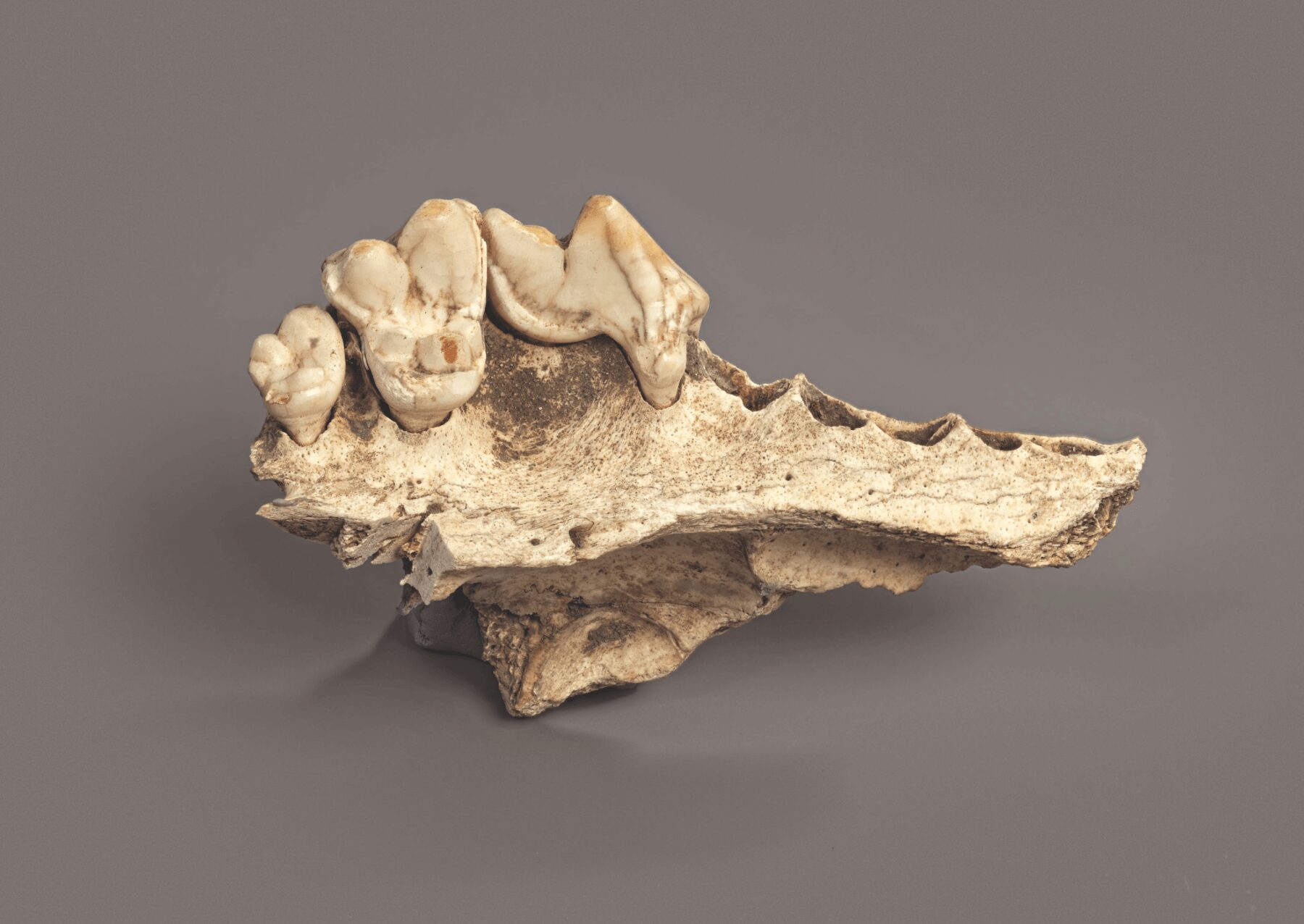
Fragment of an ancient dog’s jaw from Kesslerloch cave, Switzerland. Image source: popsci.com
The new data also show that European wolves did not make a significant genetic contribution to dog evolution, and that early European dogs were not domesticated independently from Asian ones — they share the same lineage. In parallel with this study, another group of scientists identified an even older dog — from the Turkish rock shelter of Pınarbaşı, approximately 15,800 years old.
How Ancient Dogs Survived Humanity’s Transition from Hunting to Farming
One of the key questions in the history of domestication is what happened to dogs when humanity transitioned from hunting and gathering to farming. The spread of agriculture in Europe was accompanied by large-scale migration of people from Southwest Asia. It would be logical to assume that farmers brought their dogs with them, and the “local” European dogs simply disappeared. But it turned out to be more complicated than that.
Scientists discovered that the influx of Southwest Asian genetics in European dogs was smaller than in the humans themselves. This means that the dogs of local hunter-gatherers made a significant contribution to the genetics of later and, likely, even modern European dogs.
Simply put, when the first farmers came to Europe, they did not simply replace local dogs with their own but “adopted” the four-legged residents already living there into their communities. Genetic changes in dogs generally mirrored changes in humans, but were less pronounced — dogs turned out to be a kind of “bridge” between the old and new ways of life.

Reconstruction of a scene in front of Kesslerloch cave in Thayngen, Switzerland. Image source: popsci.com
Why the Exact Date of Dog Domestication Remains a Scientific Mystery
Where exactly dog domestication occurred still remains a subject of debate: the most likely regions mentioned are Central Asia, East Asia, and Western Europe. The new study does not put this question to rest, but it provides important clues.
The oldest European dogs in this study are genetically linked to dogs in Asia and the rest of the world, suggesting a single domestication event rather than several independent ones. Geneticist Anders Bergström notes that, unlike most other domestic animals, dogs did not always have a clearly defined “working” role — perhaps their main function was always simply to be nearby.
The dog is the only domestic animal domesticated before the advent of agriculture. This makes its history a unique tool for studying how humans themselves changed.