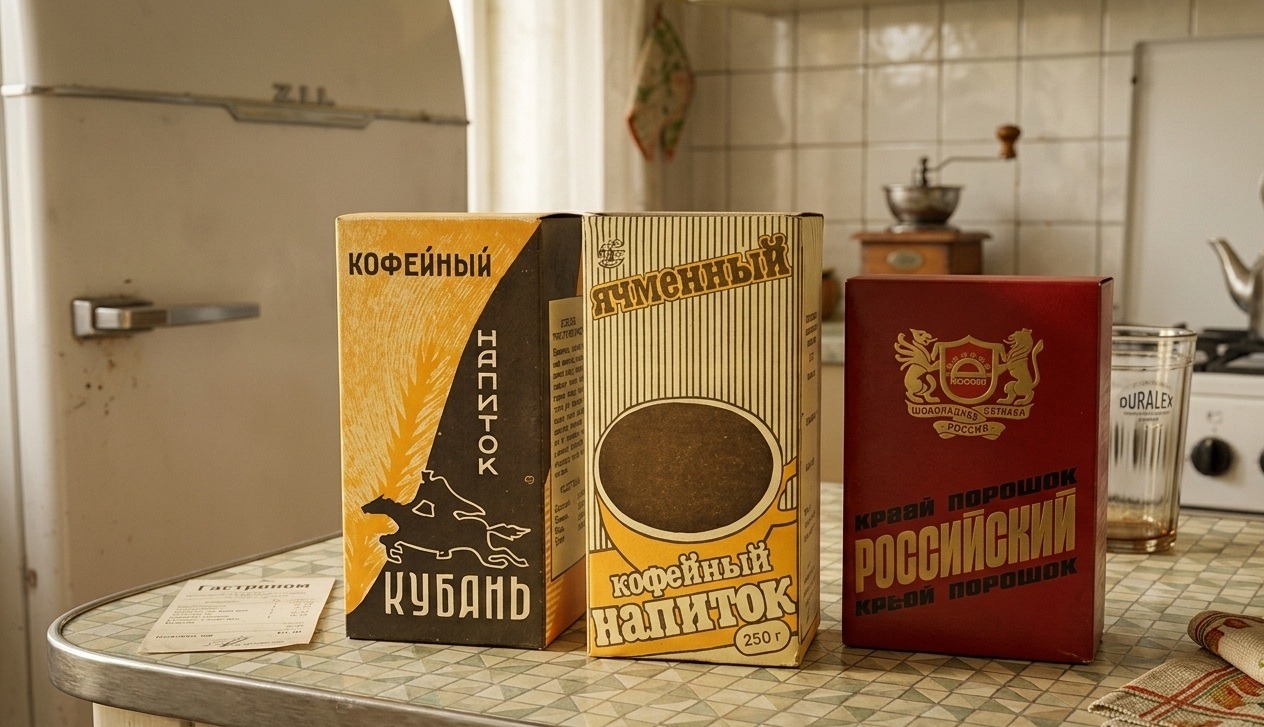
This is what coffee packages looked like in the USSR era
Coffee in the USSR was not just a story about shortages. It was an entire world of beverages in which actual coffee might not be present at all. Store shelves featured tin cans labeled “coffee drink,” but what was inside was anything but coffee. Real instant coffee was obtained “through connections,” and beans cost half a day’s wages. What made up the coffee culture of the Soviet Union, and why was it the way it was?
The Appearance of Coffee in the Russian Empire
Before the revolution, coffee was mainly consumed by aristocrats and wealthy merchants. According to history.ru, in the late 19th century, the most expensive beans were Arabian — about two rubles per kilogram, while Brazilian ones were cheaper, around one ruble. Meanwhile, an ordinary worker’s salary in the Moscow Governorate barely reached 12 rubles a month, so daily coffee for a common person was an unaffordable luxury.
By 1913, the situation began to change: imports grew to 12 tons per year, and a cup of coffee in a café cost just two kopecks. But World War I and the subsequent revolution disrupted foreign supplies, and coffee once again became a rarity.
Interestingly, in the early years of Soviet power, there was an attempt to turn coffee into a symbol of the new world. It was called the drink of bold and independent people, contrasted with traditional tea — an attribute of “old way of life” family gatherings.
The Appearance of Coffee in the USSR
Thanks to the NEP (New Economic Policy) and diplomatic ties with Africa, Asia, and Latin America, purchases grew rapidly: 46 tons in 1921, and by 1925 — already 1,400 tons, costing over six million rubles. Beans were shipped from Ethiopia, Yemen, and other countries of the Arabian Peninsula.
However, the Great Patriotic War and the postwar rationing system set coffee imports far back. Only by 1950 did they return to pre-revolutionary levels — those same 12 tons per year. The real flourishing began in the 1960s, on the wave of the Khrushchev Thaw, and peaked during the Brezhnev era of the 70s–80s. The Soviet Union purchased large volumes from Brazil and India, and from 1972, domestic production of instant coffee began.
According to the Soviet GOST 6805-88 standard, the highest grade coffee was made from Arabica imported from Colombia, Mexico, Nicaragua, Peru, Ethiopia, and India. The first grade was Arabica or Robusta from Brazil, Vietnam, and India. The second grade consisted entirely of Robusta — Angolan, Malagasy, Indonesian, and others.
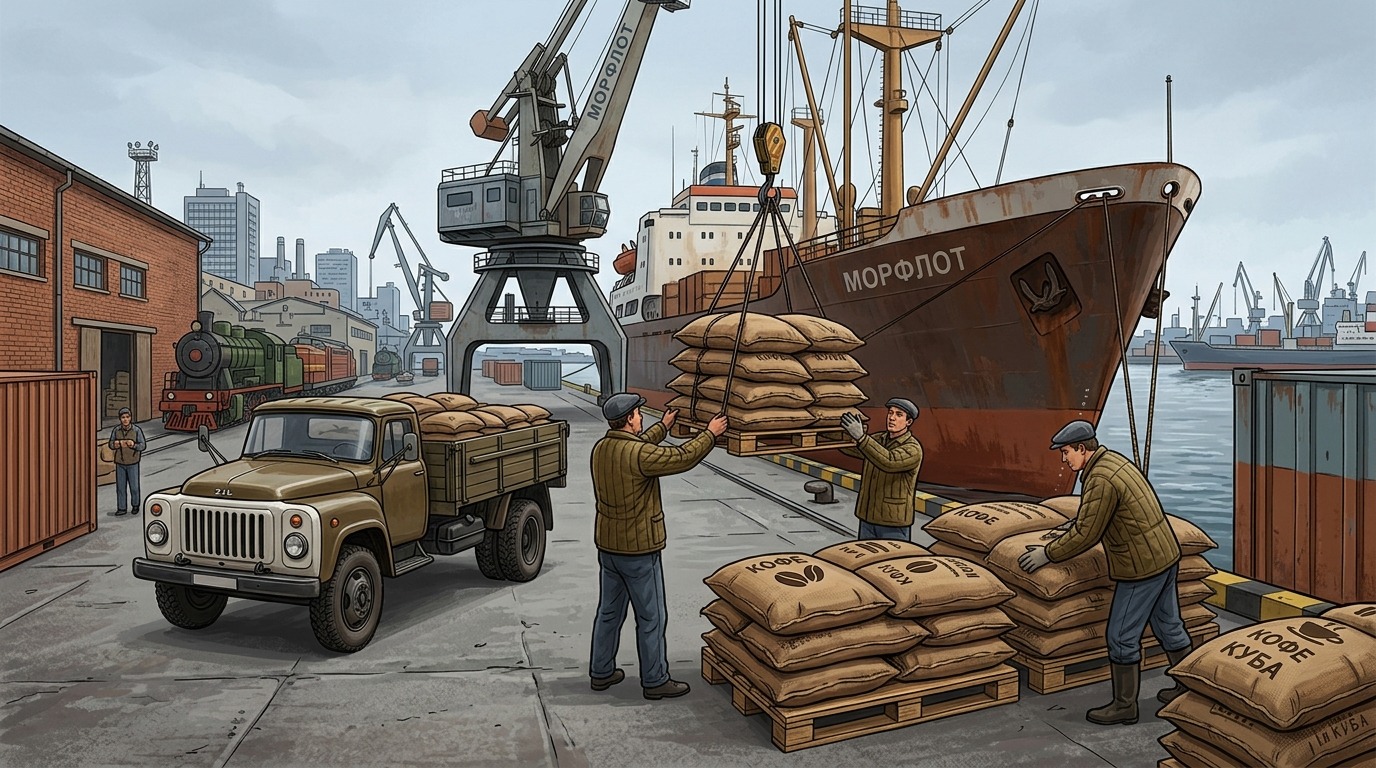
Unloading imported goods at a Soviet port
Indian Coffee in a Tin Can in the USSR
If you ask people who grew up in the USSR what coffee they remember, most will name Indian instant coffee in a characteristic brown tin can. These little cans became a symbol of the era — after use, they stored nails, buttons, and spices for decades.
Instant coffee in the USSR was sold in several types of tin cans: Moscow-produced (in a wide brown can), Indian (featuring images of Indian women), and “natural instant” with black print and palm trees. Among imported brands of the late USSR, the undisputed leaders were Brazilian Cacique and Café Pelé.
But buying such a can in a regular store was no easy task. Imported instant coffee was a classic “deficit item” — it was included in workplace food “orders” or “thrown out for the plan” in stores at the end of the quarter, and mainly in Moscow and Leningrad at that. In the provinces, one had to stand in hours-long lines or buy from resellers.
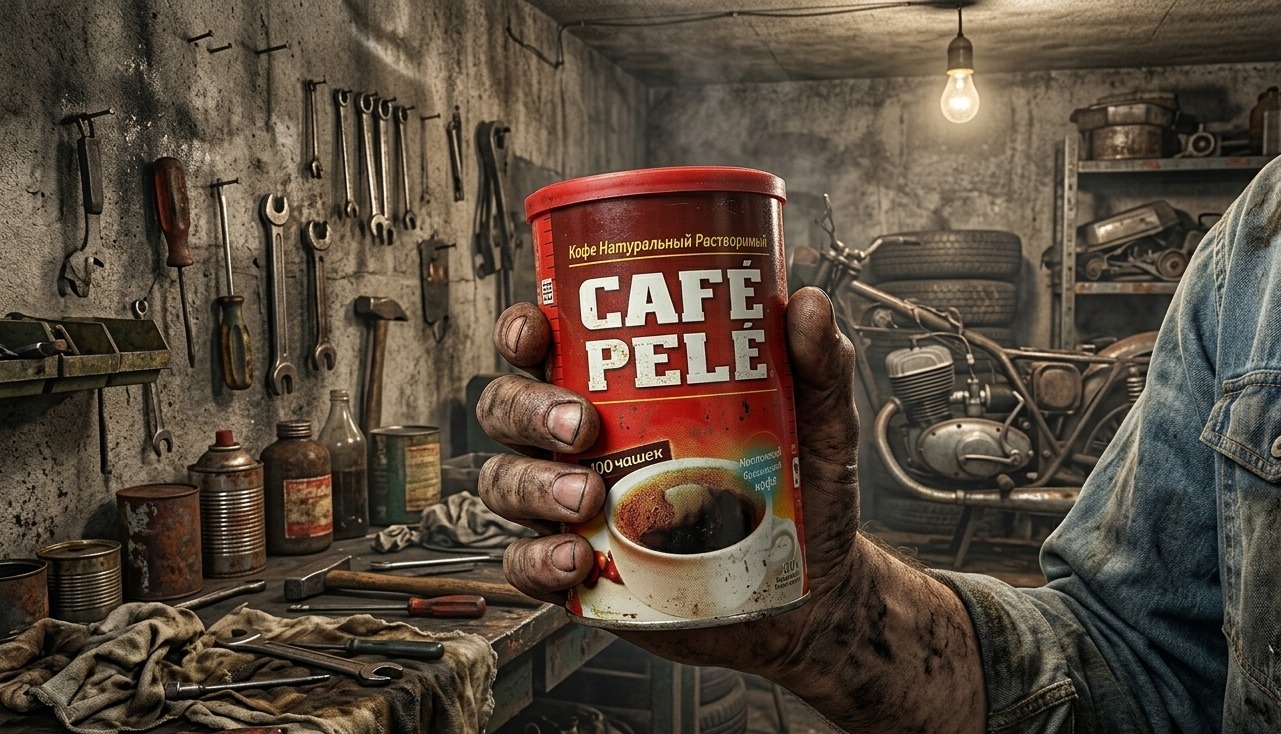
These cans later stored nails
The Cost of Coffee in the USSR
Coffee prices in the USSR changed over time but always remained high relative to wages. Here are the main benchmarks:
- Coffee beans in the mid-1980s cost 10–20 rubles per kilogram, and according to some sources, roasted whole beans could reach 35–45 rubles per kilogram;
- A can of imported instant coffee (100 g) cost 6 rubles — more than a day’s earnings with an average salary of about 120–180 rubles per month;
- For comparison: for the same 6 rubles, you could buy two “Kyiv” cakes or drink more than 20 cups of freshly brewed coffee at a street café at 28 kopecks per cup;
- Coffee substitute drinks were many times cheaper: “Yachmennyy” (Barley) cost 25 kopecks, “Baltika” — 40 kopecks, and “Letny” (Summer) in a tin can — about 2 rubles.
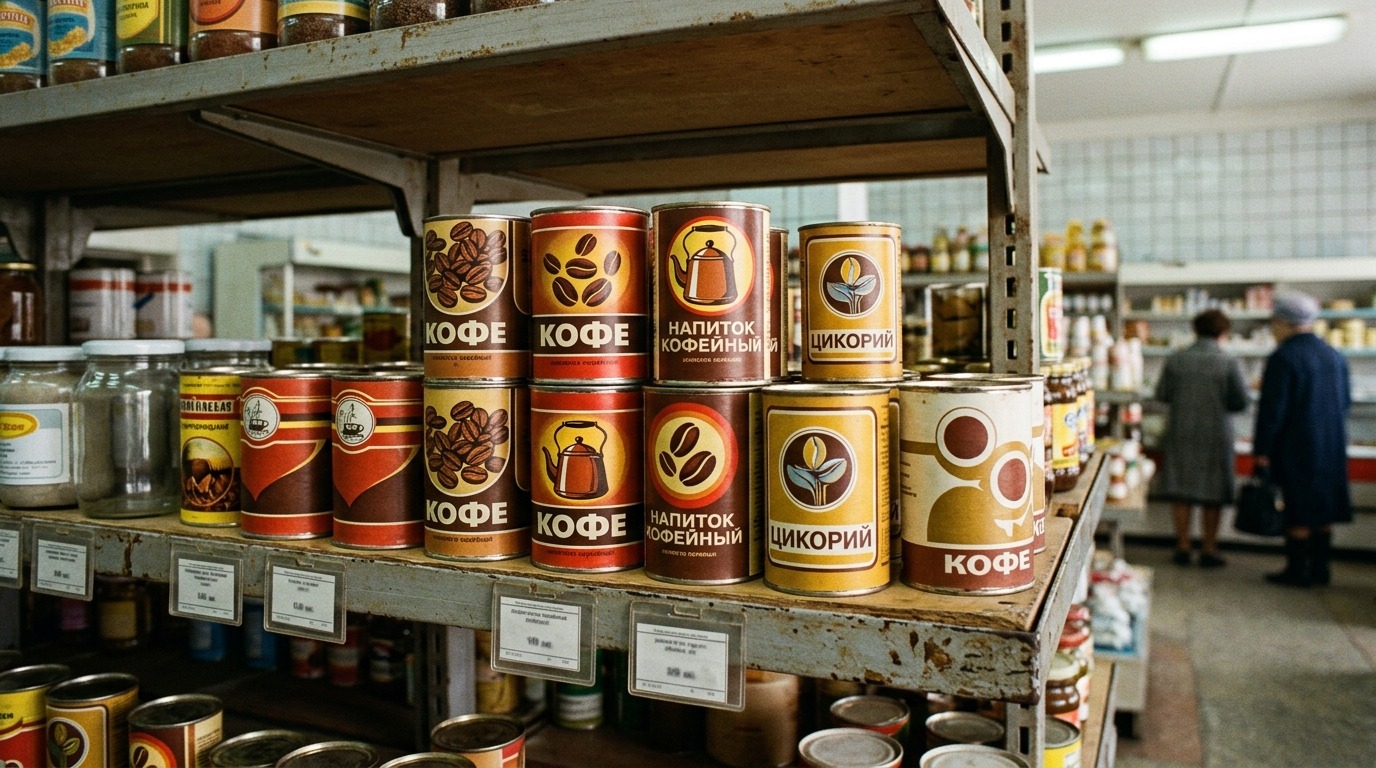
A shelf in a Soviet grocery store with coffee drinks
With an average salary of 150 rubles, a kilogram of good coffee beans could cost a quarter of a monthly wage. It’s no surprise that most Soviet citizens drank entirely different beverages.
Soviet Coffee Drinks Made from Barley, Chicory, and Acorns
This is where the most colorful part of the story begins. Since real coffee was expensive and in short supply, the Soviet food industry produced dozens of so-called “coffee drinks.” Essentially, these were blends of roasted and ground plant materials: barley, rye, chicory, acorns, chestnuts, soybeans, fruit pits, rosehips, and even pine nuts.
The composition of the most famous brands speaks for itself:
- “Baltika” — 35% chicory, 35% barley, 20% soy, 10% chestnuts. Coffee — zero percent;
- “Yachmennyy” (Barley) — 80% barley and 20% chicory. Also without coffee;
- “Letny” (Summer, Latvian production) — 20% natural coffee, the rest barley;
- “Nasha Marka” (Our Brand) — 35% coffee, 25% ground acorns, 10% chestnuts, 30% chicory.
These drinks were sold in cardboard boxes, and from the 1970s onward, also in small tin cans with colorful labels. Their taste was distinctive: dark, slightly bitter, with a bread-like, burnt note, far removed from real coffee. However, many remember it with nostalgia, and some of these recipes are sold today in health food sections as a healthy alternative to caffeine.
Depending on their caffeine content, such drinks could even be served in school cafeterias and kindergartens, as they were considered safe for children.
Coffee in Briquettes: A Forgotten Soviet Format
Another format that is often fondly remembered is coffee and cocoa in briquettes. Small pressed cubes that already contained coffee powder (or its substitute), powdered milk, and sugar. All you had to do was drop a briquette into boiling water — and the drink was ready.
The recipe for one such briquette appeared as early as the late 1950s. Children often just chewed on them like candy without even dissolving them in water. These little briquettes cost mere kopecks — from 8 to 20 kopecks each. Today, this format has virtually disappeared from sale.
What Happened to Coffee Culture After the Collapse of the USSR
By the late 1980s, the Soviet Union was importing about 113 thousand tons of coffee per year, but the country’s collapse and the economic crisis cut that figure in half within just one year. However, borders opened for private shipments: Nescafé, Jacobs, Maxwell House, and dozens of other brands that the Soviet consumer had never heard of appeared on store shelves.
Barley and chicory drinks left everyday life but didn’t disappear. Today they are experiencing something of a renaissance — in health food stores, chicory and barley coffee substitutes are sold as caffeine-free products beneficial for digestion. Ironically, what was once a forced substitute has become a conscious choice.
The history of coffee in the USSR is a vivid example of how shortages shape an entire gastronomic culture. Millions of people grew up on the taste of barley “coffee” and genuinely loved it. And those who managed to get a real can of Indian instant coffee treasured it — first the contents, and then the tin itself. For us, this is a story not just about a beverage, but about how a planned economy determines the tastes of an entire generation.