People on the Moon feel completely different than on Earth
For the first time since the Apollo space program, humans are preparing not just to fly to the Moon, but to live and work there — for weeks, months, and eventually years. In early April 2026, NASA launched the Artemis 2 mission, carrying four astronauts around the Moon. This is just a warm-up: the agency has already announced plans to spend 20 billion dollars on building a lunar base. But before moving in, it’s worth understanding what exactly will happen to the human body on another celestial body.
The US Wants to Build a Base on the Moon
The Artemis program is unfolding in stages. In 2022, the unmanned Artemis mission successfully orbited the Moon. And on April 1, 2026, Artemis launched from Cape Canaveral — the first crewed flight of the Orion spacecraft. On board, in orange spacesuits, were NASA astronauts Reid Wiseman, Victor Glover, and Christina Koch, as well as Canadian Jeremy Hansen. The ten-day mission is not a landing but a test of life support systems, navigation, and thermal protection in deep space conditions with real people.
On April 6, the crew broke the distance record for a crewed flight, surpassing the achievement of Apollo 13. But the essence of the mission isn’t about records: before people can live on the Moon, it must be confirmed that the journey there is safe.
Then — more to come. In March 2026, NASA presented an updated strategy: instead of the orbital Gateway station, the agency will focus on a surface base at the Moon’s south pole. The first human landings are planned for 2028 as part of the Artemis 4 and 5 missions, followed by landings every six months. The ultimate goal is a permanent human presence on the lunar surface and preparation for flights to Mars.
Effects of Space on the Human Body
The lunar environment is a set of stressors that hit every body system simultaneously. Scientists call it a combination of physical, chemical, biological, and psychological factors that a person faces beyond Earth.
How the Moon differs from Earth:
- Gravity is six times weaker than Earth’s;
- Constant exposure to cosmic radiation;
- Temperature swings from +127 degrees in sunlight to −173 degrees in shade;
- Toxic lunar dust;
- Isolation and disrupted sleep patterns;
- Confined spaces.
Critically, on the Moon’s surface, unlike the ISS, crews work almost entirely beyond Earth’s magnetic field. This invisible shield protects us from cosmic rays: protons and heavy nuclei traveling at nearly the speed of light. Without it, radiation damages DNA, suppresses the immune system, and can disrupt brain and cardiovascular function.
Reduced gravity changes how blood, oxygen, and fluids move through the body. Blood rushes to the head, muscles and bones begin to degrade, and the cardiovascular system reconfigures in ways it shouldn’t operate on Earth. And yet many changes develop silently: an astronaut may feel fine until problems manifest months or even years later.
Cosmic Radiation on the Moon
Radiation is perhaps the most insidious factor of lunar life. On Earth, we are protected by the atmosphere and magnetosphere. On the ISS, astronauts are still within our planet’s magnetic bubble. But on the Moon — neither of those protections exists.
The first precise measurements of radiation levels on the Moon’s surface were made only in 2019 by the Chinese Chang’e-4 lander. The results showed that the radiation dose is approximately 1,369 microsieverts per day — roughly 2.6 times higher than on the ISS, and about 200 times higher than on Earth’s surface. According to scientists’ estimates, without additional protection, an astronaut can safely stay on the Moon for about two months, including travel time to and from.
Cosmic rays, born in supernova explosions, pass through body tissues and tear apart DNA molecules. Damaged cells can mutate, and the accumulation of mutations over time increases the risk of cancer. Animal studies show that radiation can cause arterial hardening, structural heart damage, and cardiac rhythm disturbances. However, human data remains limited: the twenty-four Apollo astronauts who flew beyond the magnetosphere spent a maximum of 13 days in deep space. Many of them subsequently developed cataracts, but most lived to 80–90 years without obvious signs of cancer.
For long-duration missions, this experience is insufficient. As researchers note, laboratory cell irradiation takes seconds, whereas in deep space the exposure will be chronic. Experimental platforms are needed that can simulate constant low-dose irradiation over extended periods.
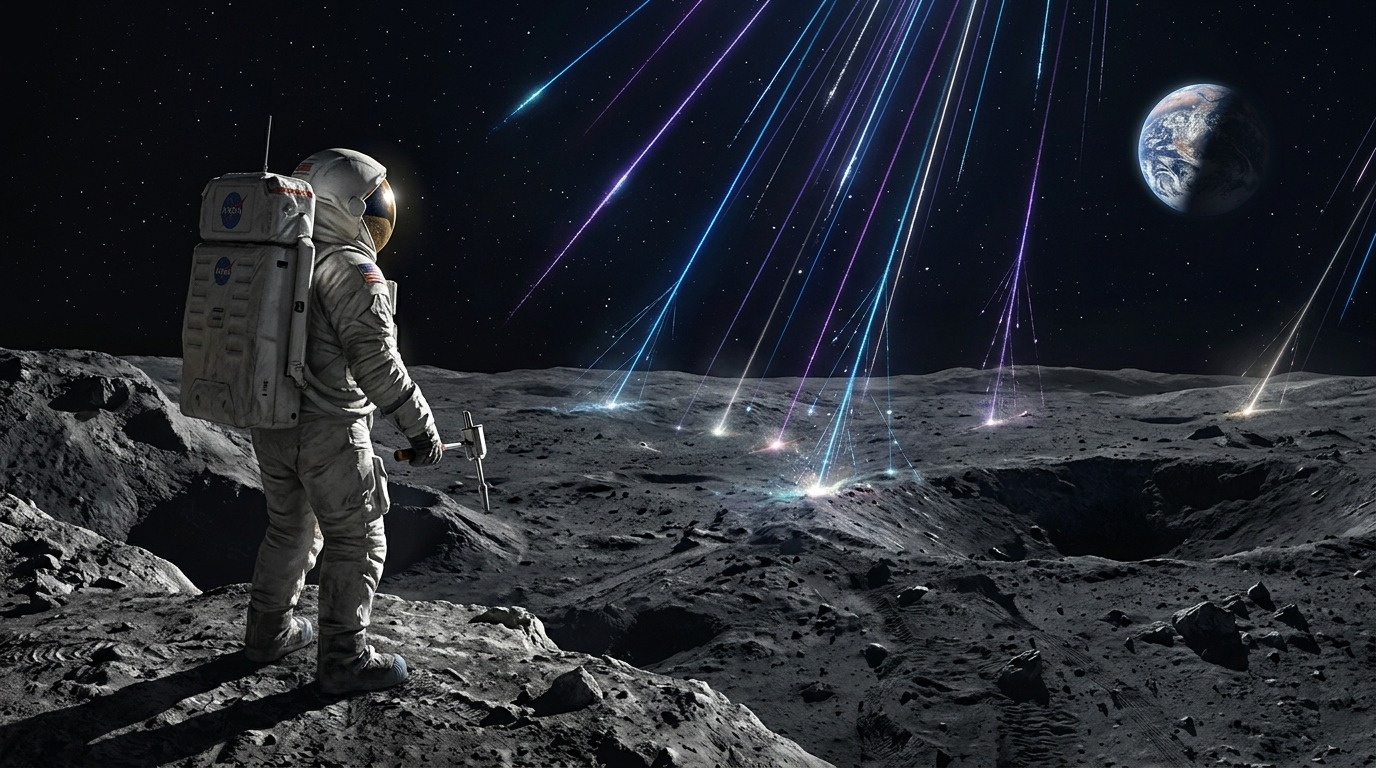
Cosmic rays reach the lunar surface unimpeded
Why Lunar Dust Is Dangerous for Lungs and Skin
Radiation isn’t the only hidden threat. Lunar dust (regolith) is another serious factor that few people think about.
Lunar soil has been forming for billions of years under micrometeorite impacts. Unlike Earth dust, rounded by wind and water, lunar particles are sharp as glass shards and incredibly fine. They contain silicates, and their surface is chemically activated by solar wind. In reduced gravity, such particles hang in the air longer and penetrate deeper into the lungs.
Apollo 17 astronaut Harrison Schmitt described his reaction as “lunar hay fever”: sneezing, red eyes, sore throat, and nasal congestion. Other program participants also reported allergy symptoms. Their symptoms resolved quickly, but they only spent a couple of days on the Moon.
Laboratory studies have shown that lunar soil analogs, ground to inhalable sizes, killed up to 90% of human lung cells and mouse neurons. Scientists don’t yet know for certain how dangerous real lunar dust is with chronic exposure, because there is too little data. But NASA has already established preliminary permissible concentration limits and is developing new materials for spacesuits and air filtration systems.
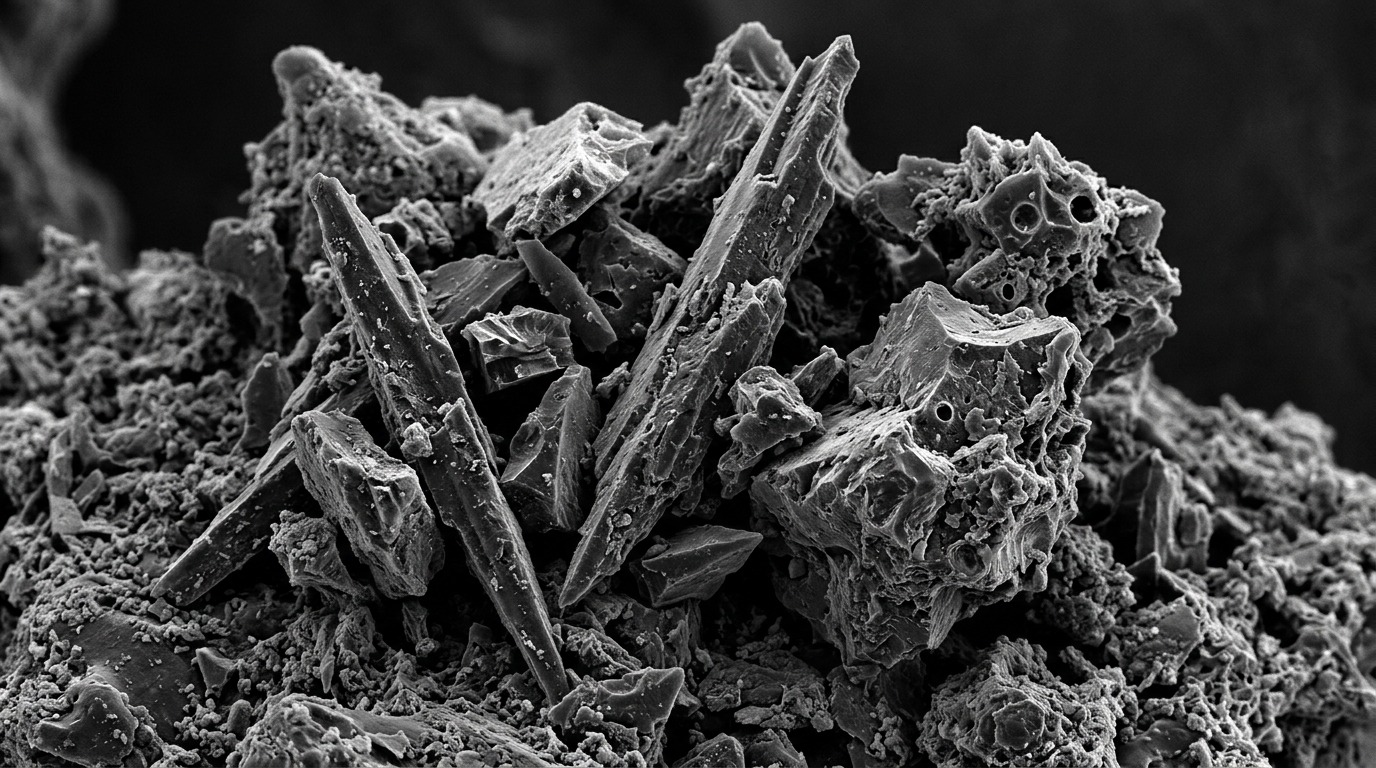
Lunar dust particles under an electron microscope — sharp and abrasive
How to Protect Health on the Moon
The good news is that the human body is remarkably adaptive. The challenge is to steer that adaptation in a safe direction. Scientists and engineers are already working on an entire arsenal of countermeasures.
Physical exercise remains the foundation. On the ISS, astronauts exercise about two hours a day — this helps maintain muscle mass, bone density, and heart function. But on the Moon, familiar exercise equipment will need to be redesigned: at one-sixth of Earth’s gravity, workloads function quite differently.
Nutrition is another powerful tool. Diet affects bone health, muscles, immunity, and even how the body responds to radiation. For long-duration lunar missions, scientists are considering personalized diets tailored to each astronaut’s physiology. Moreover, the lunar base plans include growing vegetables in greenhouses — fresh greens not only improve nutrition but also positively affect crew morale.
Among promising directions is artificial gravity. Short-radius centrifuges could give astronauts sessions of increased gravitational load, stabilizing heart and vascular function. The technology is still experimental, but for long-duration lunar expeditions it could prove extremely useful.
Radiation protection is built in multiple layers:
- Walls of habitation modules made from lunar soil (regolith) — calculations show that a 50 cm layer is sufficient to protect against background cosmic radiation;
- Early warning systems for solar flares — a 30-minute warning allows time to take shelter;
- Operational protocols limiting surface work time during periods of elevated solar activity;
- Wearable sensors and continuous monitoring — to detect a problem before it becomes critical.
The key principle of lunar medicine: act preemptively. As specialists emphasize, countermeasures must be proactive — not treating consequences, but preventing them.
Is Life on the Moon Possible for Ordinary People
It’s worth being honest: life on the Moon is not yet for “ordinary people.” It’s an environment for trained specialists with serious medical support. But that’s exactly why the lunar base is being created.