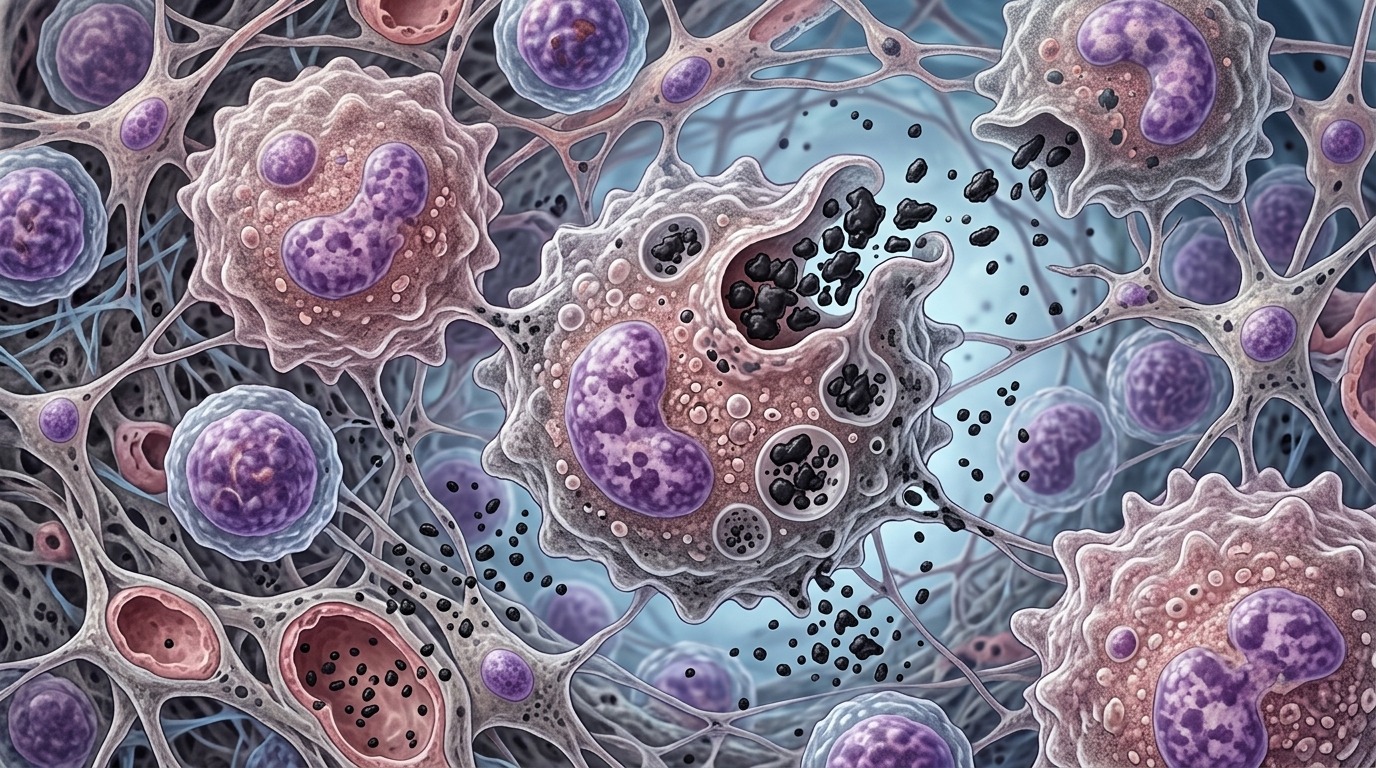
Macrophages attempting to engulf tattoo pigment particles in a lymph node
Tattoos have long ceased to be something unusual. According to a 2023 survey, approximately 11% of Russians have permanent tattoos. But while for some it’s simply a form of self-expression, scientists are asking an entirely different question: what happens to the ink after it ends up under the skin — and how does it affect the immune system? The answer provided by a new large-scale study turned out to be more alarming than many had assumed.
How Tattoos Affect the Immune System
Despite long-standing concerns about ink toxicity, until recently no study had examined the direct consequences of getting a tattoo on the immune system. This changed with the work of Swiss scientists, published in late 2025 in the journal PNAS.
The scientists discovered that ink is captured by immune cells — macrophages — which then die and release signals that sustain inflammation in lymph nodes for at least two months. Simply put, the body perceives tattoo pigment as a foreign body and tries to deal with it. But the particles are too large to be digested, and instead of defeating the “invader,” the immune system gets stuck in a state of chronic tension.
Furthermore, the researchers found that ink accumulated at the vaccination site reduced the immune response to an mRNA COVID-19 vaccine, but enhanced the response to an inactivated influenza vaccine. This doesn’t mean tattoos make vaccinations dangerous. But it indicates that pigments can interfere with the finely tuned work of immune cells, depending on the type of vaccine and the conditions of administration.
An important clarification: it’s still unclear whether these effects are reproduced in humans, since the vaccine experiments were conducted on mice. This is both a strength and a limitation of the study, and the authors emphasize the need for clinical research, although available data from human cells in vitro support the observations.
What Happens to Tattoo Ink Inside the Body
Many people think that tattoo ink simply “sits” under the skin. In reality, it’s more complicated. When an artist injects pigment into the dermis (the deep layer of skin), the body recognizes the particles as foreign material. Macrophages try to engulf them. But the pigment particles are too large to be fully digested and remain inside the cells. This is exactly why tattoos don’t disappear.
But the ink doesn’t stay in place. The study showed that tattoo pigment not only remains in the skin but also travels through the body, accumulating in the lymphatic system, where it can remain for years. Lymph nodes are the “command centers” of immunity — they filter and coordinate the work of immune cells. When foreign chemical substances accumulate in them, it raises legitimate concern.
After tattooing, the pigment quickly enters the lymph nodes through the lymphatic system, where macrophages capture it. But they cannot break it down, and this leads to chronic inflammation that can persist for months and even years, constantly burdening the immune system.
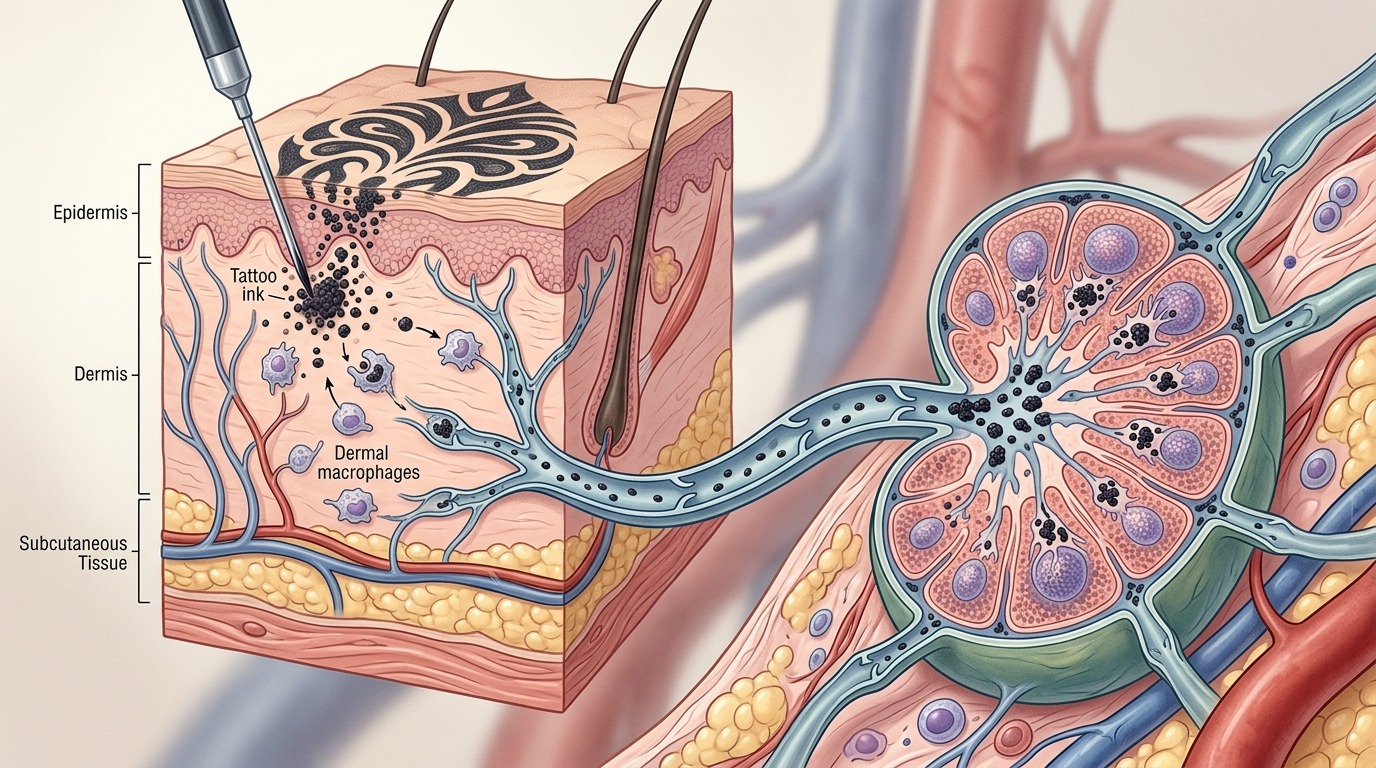
The path of pigment from the skin to the lymph nodes through the lymphatic system
Tattoo Ink Composition
Tattoo ink is a very complex chemical mixture. It includes pigments for color, liquid carriers for distributing the ink, preservatives, and other additives. And the composition of these mixtures is far from harmless.
Many pigments used in the tattoo industry today were originally developed for entirely different purposes — for automotive paints, plastics, and printer toners. They were never designed for injection into living tissue.
Some inks contain traces of heavy metals — nickel, chromium, cobalt, and sometimes lead. These substances can provoke allergic reactions and increase immune system sensitivity. In addition to metals, inks may contain:
- Azo dyes — synthetic colorants that under the influence of sunlight or during laser tattoo removal can break down into aromatic amines — substances linked to DNA damage and cancer risk in laboratory conditions;
- Polycyclic aromatic hydrocarbons (PAHs) — compounds formed during incomplete combustion of organic materials. They are found in soot, exhaust fumes, and charred food. Black tattoo inks based on carbon black may contain PAHs, some of which are classified as carcinogenic.
Colored inks, especially red, yellow, and orange, are more likely than others to cause allergic reactions and chronic inflammation. This is due to metal salts and azo pigments in their composition. The Swiss study also confirmed that the reaction was stronger when red and black inks were used.
Allergies and Inflammation from Tattoos
The most studied and documented risks of tattoos are allergic and inflammatory reactions. Red inks are particularly often associated with prolonged itching, swelling, and the formation of granulomas — small inflammatory nodules that form when the immune system tries to isolate a substance it cannot remove.
Such reactions can appear months and even years after getting a tattoo. They can be triggered by sun exposure or changes in immune system function. For people with autoimmune diseases or weakened immunity, tattoos may carry additional risks.
Like any procedure involving skin punctures, tattooing carries a risk of infections. If hygiene is not maintained, infections with staphylococcus, hepatitis B and C, and in rare cases, atypical mycobacterial infections are possible.
What about cancer? To date, there is no convincing epidemiological data linking tattoos to cancer in humans. However, laboratory studies show that certain pigments, when broken down (by ultraviolet light or laser), can form toxic and potentially carcinogenic compounds.
The International Agency for Research on Cancer (IARC) is also studying the possible long-term consequences of tattoos — their connection to immune response, lymphomas, and other types of cancer. Given that many types of cancer develop over decades, and the mass adoption of tattoos began relatively recently, it’s too early to draw definitive conclusions.

Inflammatory skin reaction in the area of a red tattoo
Do Tattoos Weaken the Immune System?
The question “do tattoos weaken the immune system” does not yet have a definitive answer, and this in itself is an important fact. For most people, tattoos don’t cause serious health problems. But calling them completely harmless isn’t accurate either.
The new Swiss study revealed a specific mechanism: pigments penetrate lymph nodes, kill macrophages, and sustain inflammation that can affect immune responses, including the body’s response to vaccines. The authors themselves call their work “the most comprehensive study to date on the impact of tattoo inks on the immune response” and emphasize the need for further research to inform public health policies and regulatory measures.
The main concern is the cumulative effect. The more tattoos you have, the larger and more colorful they are, the greater the total chemical load on the body. Combined with sun exposure, aging, immune changes, or laser removal, this load may have consequences that science has not yet fully uncovered.
There’s no need to panic, but it’s important to be informed. If you’re planning a tattoo or already have several, it’s wise to choose artists who work with certified inks and to monitor the condition of your skin.
Science, meanwhile, has yet to answer the main question: what happens to people whose lymph nodes have stored particles of industrial pigment for decades? We will most likely get an answer to this in the coming years — and it could seriously change attitudes toward the tattoo industry worldwide.