Berries, greens, nuts, and olive oil — the foundation of a diet to slow brain aging
The brain’s gray matter, responsible for memory, thinking, and decision-making, inevitably shrinks with age. But the speed of this process, as it turns out, largely depends on what’s on your plate. A new large-scale study has shown that people who followed the so-called MIND diet lost gray matter significantly more slowly than others. The difference amounted to approximately 2.5 years of slower brain aging.
What Is the MIND Diet
MIND stands for Mediterranean-DASH Intervention for Neurodegenerative Delay. Essentially, it’s a hybrid of two well-studied dietary systems. The first is the famous Mediterranean diet, rich in vegetables, nuts, fish, and olive oil with minimal red meat. The second is the DASH diet, originally developed to lower blood pressure, built on fruits, vegetables, whole grains, and low-fat dairy products.
The MIND diet takes the foundation of both systems but places special emphasis on foods that, according to research, best protect the brain specifically. The main idea is more plant-based foods, fish, and healthy fats, and less fried food, fast food, and sweets. Berries (blueberries, strawberries, raspberries) and leafy greens (spinach, kale, arugula) hold a special place in the diet — they are considered the most valuable categories. The brain diet was developed by Martha Clare Morris, a nutritional epidemiologist at Rush University Medical Center.
The first study, published in 2015, showed that people whose diet most closely matched the MIND diet had a 53% lower risk of developing Alzheimer’s disease. Since then, numerous confirmations of this approach’s benefits for cognitive health have emerged. But this new study was the first to show in such detail what happens to the brain’s structure.
Studying the Effect of Diet on Brain Aging
An international team of researchers led by Chinese scientists studied the effect of the MIND diet on brain aging. To do this, they used data from the Framingham Heart Study — one of the most famous and longest-running medical projects in the world. This large-scale cohort study of residents of Framingham, Massachusetts, was launched in 1948 and has been running for over 75 years, covering three generations of participants.
The new study included 1,647 middle-aged and older adults. Participants were not asked to follow any specific diet — instead, scientists assessed how closely their eating habits aligned with the principles of the MIND diet. Participants were followed for an average of about 12 years, with their diet recorded through questionnaires and brain changes tracked using MRI.
2.5 Years Younger: What Brain Scans Showed
The results were impressive. Each three-point increase in adherence to the MIND diet was associated with a 20% slowdown in gray matter loss, equivalent to 2.5 years of slower brain aging. Additionally, diet adherents less frequently showed enlargement of brain ventricles — cavities filled with cerebrospinal fluid. When brain tissue shrinks, these cavities expand to fill the freed space. This is one of the classic markers of brain aging.
Gray matter, rich in neurons, dendrites, and synapses, plays a key role in memory, learning, and decision-making. Ventricular enlargement, in turn, reflects brain atrophy, where tissue loss is accompanied by an increase in spaces filled with cerebrospinal fluid.
Simply put, the brains of those who ate closer to the MIND diet physically remained “fuller” and denser — neural tissue was better preserved, and the voids inside the skull grew more slowly.
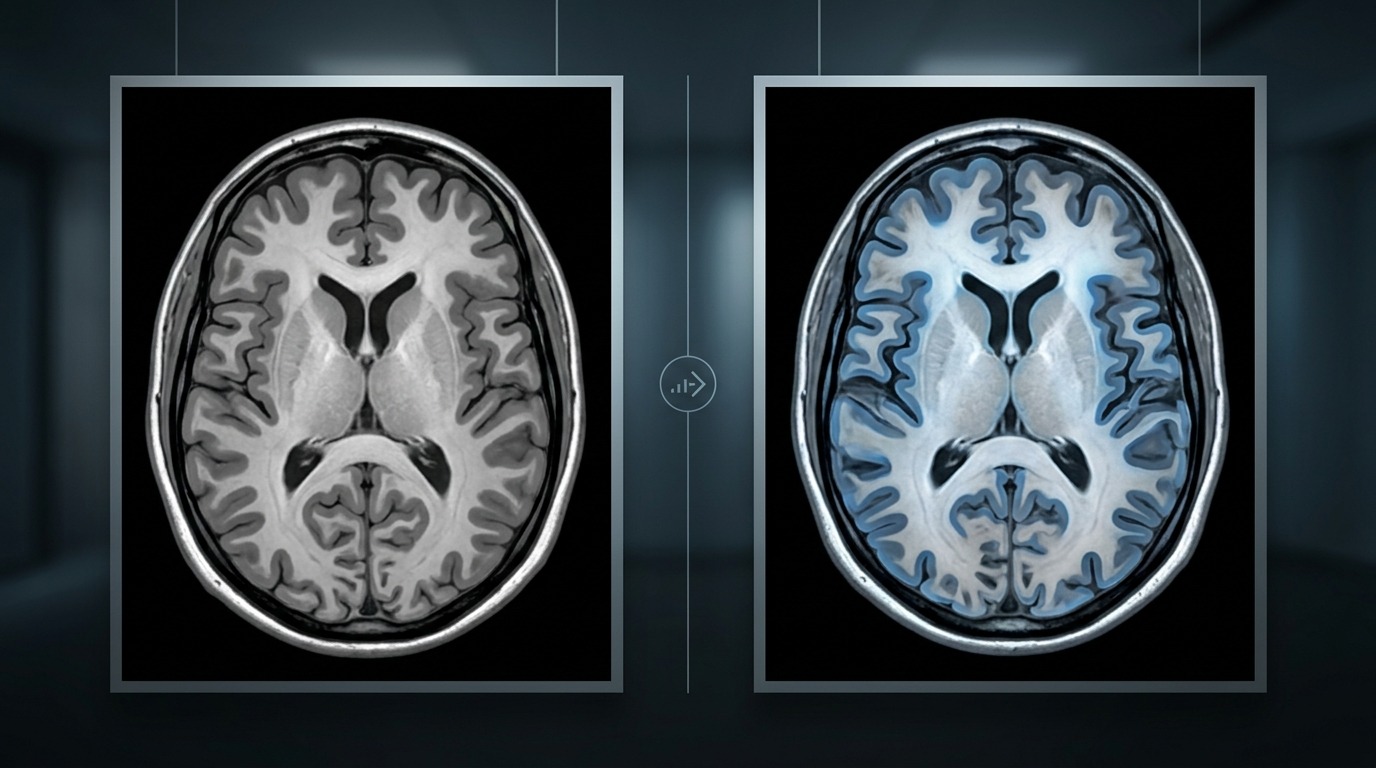
MRI scans allow tracking changes in gray matter volume over the years
Which Foods Protect the Brain and Which Accelerate Its Aging
Researchers analyzed the impact of individual food categories. MIND diet foods rich in antioxidants, such as berries, and quality protein sources like poultry can reduce oxidative stress and decrease neuronal damage. At the same time, fried fast food high in harmful fats, trans fats, and advanced glycation end products can contribute to inflammation and vascular damage.
Increased consumption of sweets and fried foods was associated with faster ventricular enlargement, while sweets alone were linked to accelerated degradation of the hippocampus — the brain region most closely associated with memory.
Foods that improve brain function:
- Leafy greens (spinach, kale, arugula) — at least 6 times per week;
- Berries (blueberries, strawberries, raspberries) — at least 2 times per week;
- Nuts — at least 5 servings per week;
- Fish;
- Poultry;
- Legumes;
- Whole grain products;
- Olive oil as the primary fat.
Foods that harm the brain:
- Fast food and fried foods;
- Sweets and pastries;
- Red meat (no more than 3 times per week);
- Butter and margarine;
- Cheese (no more than 1 serving per week).
Interestingly, the study also found unexpected results. Cheese consumption appeared to protect the brain, while whole grain products were associated with faster gray matter loss. However, lead author Hui Chen urged caution: cheese is so restricted in the MIND diet that these results should not be interpreted as evidence of its protective properties for the brain.
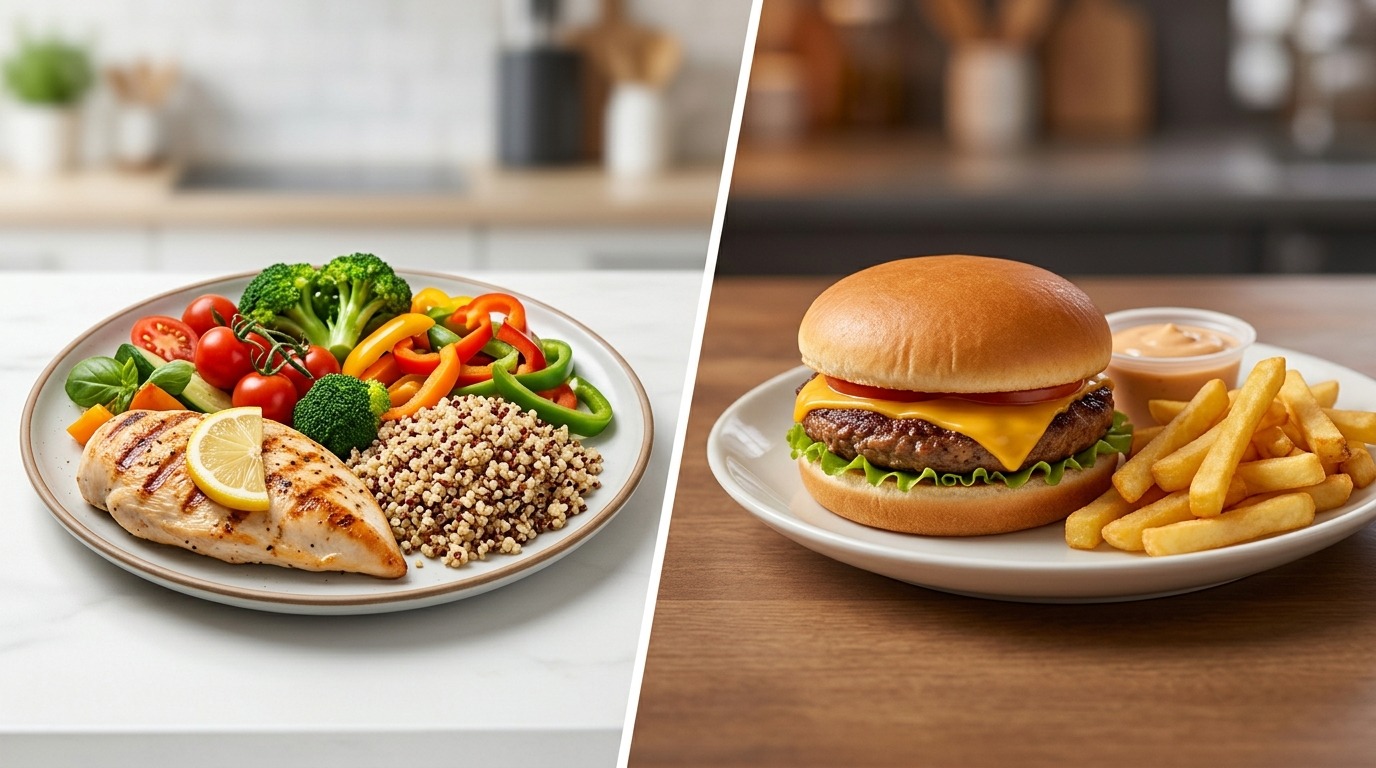
The choice between a healthy diet and fast food directly affects brain health
Why It’s Too Early to Fully Trust the Results
Like any observational study, this work has limitations. The main one is that the data shows correlation, not direct causation. Scientists accounted for many factors such as age, education, and sex, but couldn’t control for everything. Sleep quality, genetic predisposition, stress levels, and physical activity also affect brain aging, and these factors were not fully tracked.
Additionally, dietary data was based on participants’ self-reports: people recalled what they ate themselves. This method is not ideal — people tend to embellish their diet or simply forget details. Nevertheless, the large sample size (1,647 people) and the long observation period (about 12 years) make the results convincing enough to continue studying.
It’s also worth noting that the study participants came from a single geographic and ethnic group — the data was taken from the Framingham Heart Study offspring cohort, and the research involved scientists from Zhejiang University, Harvard T.H. Chan School of Public Health, Boston University, and the University of Edinburgh. More diverse participant groups are needed to confirm the findings.
Should You Change Your Diet for Brain Health
This study does not claim that the MIND diet will definitely prevent dementia or Alzheimer’s disease. But it adds growing evidence that diet is one of the real levers of influence on the rate of brain aging. And unlike genetics, nutrition is something we can actually control.
The MIND diet is also attractive because it doesn’t require radical changes. It’s not a strict system with calorie counting, but rather a set of guidelines: more greens and berries, fewer sweets and fried foods, olive oil instead of butter. The more closely a person’s diet matched the MIND diet recommendations, the more noticeable the benefits for the brain — meaning that even partial adherence to these principles can make a difference.