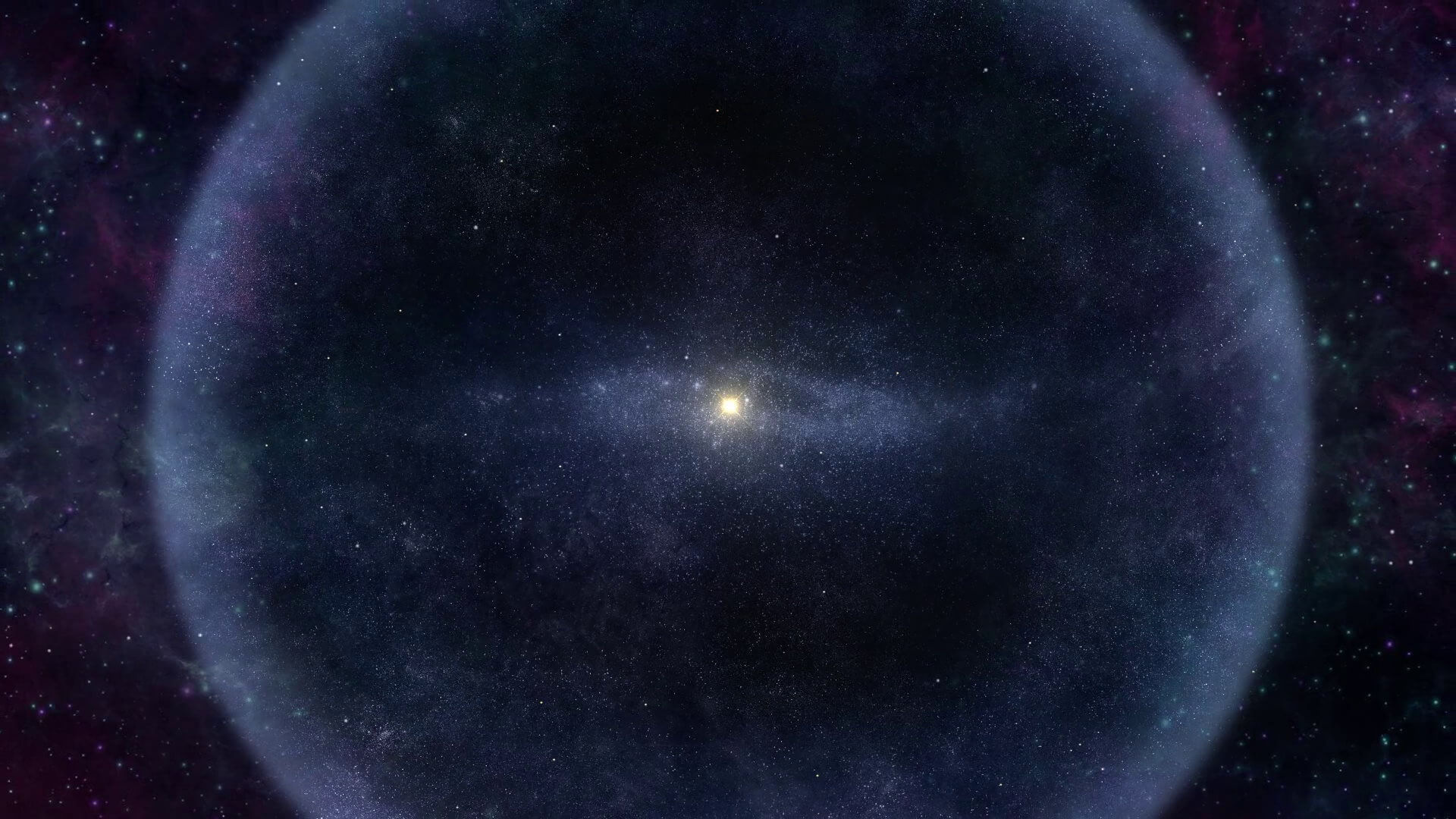
The Oort Cloud is the boundary of the Solar System and the reservoir from which the rarest comets come.
At the very edge of our Solar System lies a giant sphere of ice and dust. It cannot be seen even with the most powerful telescopes, but its “guests” regularly appear in the sky — in the form of bright comets. This region is called the Oort Cloud. It is there, according to astronomers, that long-period comets are born. And perhaps it holds the frozen history of the formation of the Sun and planets.
What is the Oort Cloud and what is it made of
The Oort Cloud is a hypothetical spherical collection of icy bodies surrounding the Solar System. Its existence has not been confirmed by direct observations, but most scientists consider it real. The idea was proposed in 1950 by Dutch astronomer Jan Hendrik Oort.
According to estimates, the cloud contains trillions of objects, most smaller than 100 km. They consist of frozen water, methane, ammonia, ethane, carbon monoxide, and even hydrogen cyanide.
It is from here that long-period comets arrive, which take from 200 to tens of thousands of years to make one orbit around the Sun.
Without such a distant “reservoir,” comets would have long ago been destroyed or collided with planets.
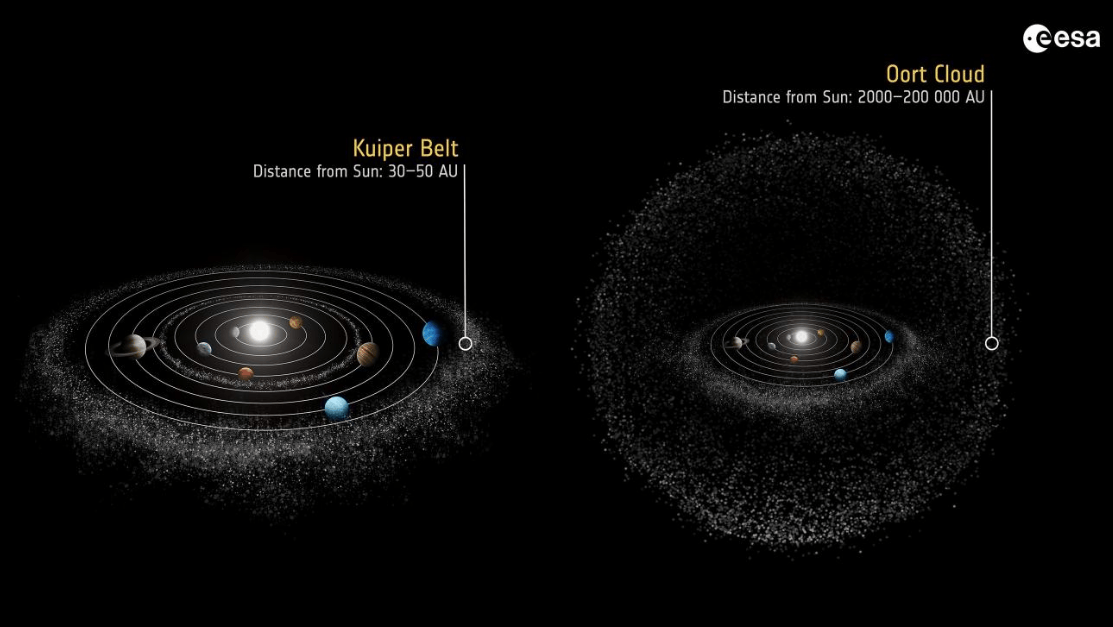
The Oort Cloud consists of trillions of small icy objects moving in various orbits.
Where is the Oort Cloud located in the Solar System and what are its dimensions
The inner edge of the cloud begins at approximately 2,000-5,000 AU from the Sun. For comparison: Neptune is only 30 AU away. One AU is the distance from Earth to the Sun.
The outer boundary can reach from 10,000 to 100,000-200,000 AU — that’s somewhere around half or a quarter of the way to the nearest star, Proxima Centauri. If a spacecraft were sent there, it would take tens of thousands of years to cross this region.
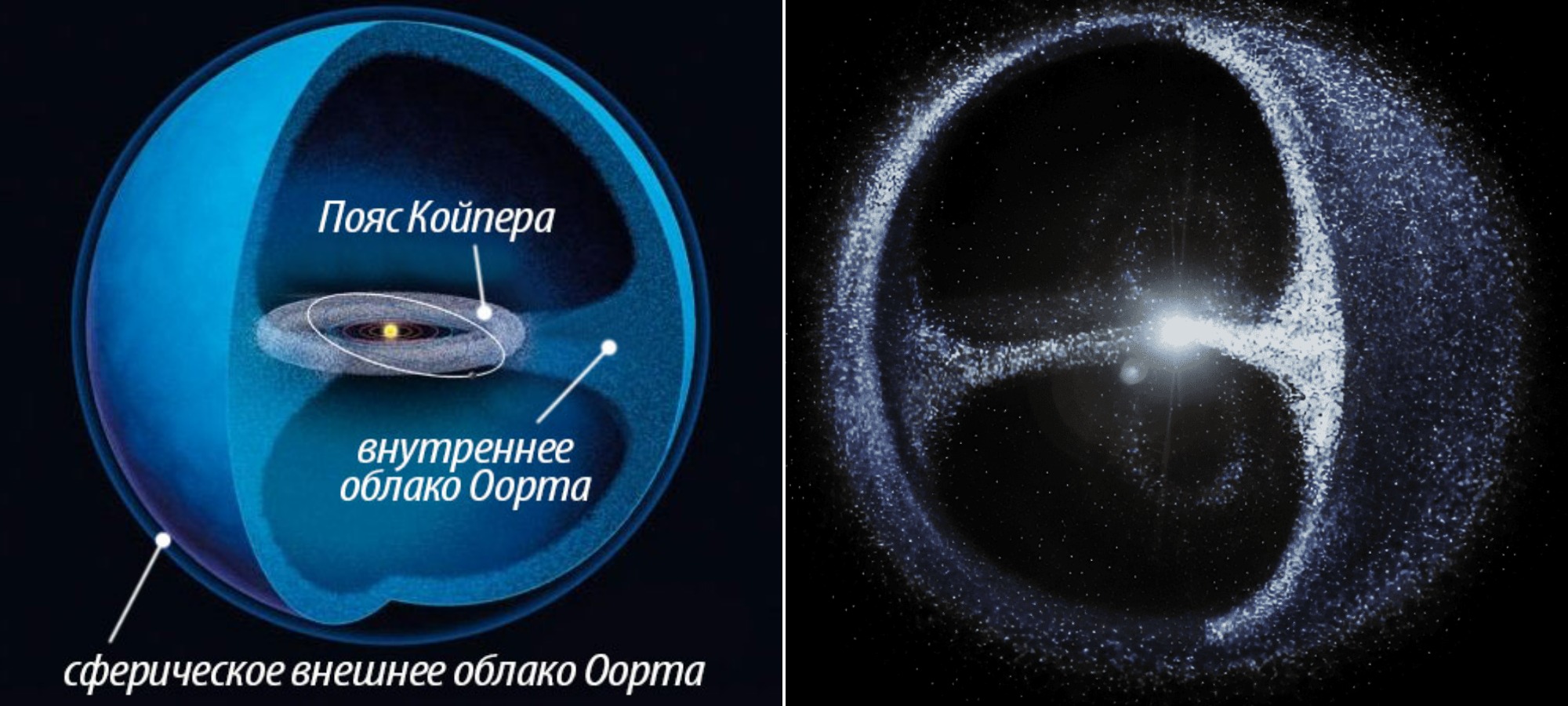
The inner Oort Cloud (also known as the Hills Cloud) is a hypothetical disk-shaped region that is considered the main reservoir of comets, as it is gravitationally more stable than the outer shell.
Despite its enormous distance, the cloud remains gravitationally bound to the Sun, although it is already on the boundary of interstellar space.
How did the Oort Cloud form and where do comets come from
The Oort Cloud is a frozen archive of the early Solar System. It formed about 4.6 billion years ago, when young giant planets ejected planetesimals into distant orbits. Later, the gravity of the Galaxy gave this structure a spherical shape.
The Oort Cloud is connected to the Kuiper Belt — a disk-shaped region beyond Neptune’s orbit. It is believed that some objects ejected by the gravity of giant planets from the Kuiper Belt eventually entered distant orbits and formed the Oort Cloud.
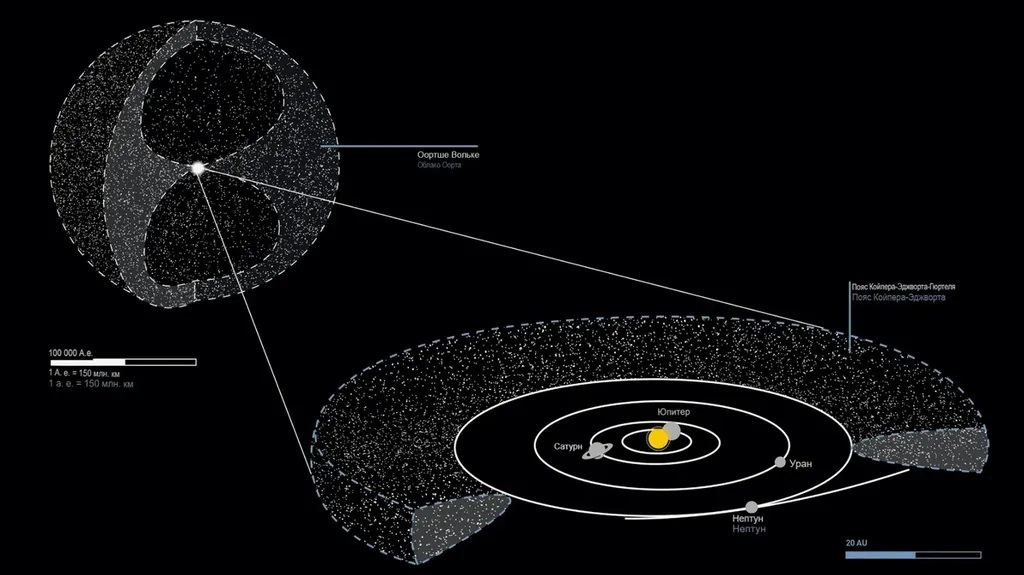
Astronomers believe that the objects making up the Oort Cloud formed near the Sun and were scattered far into space by the gravitational effects of giant planets in the early stages of the Solar System’s development.
When the gravity of neighboring stars, molecular clouds, or tidal forces of the Milky Way disturb the equilibrium, some objects from the Oort Cloud rush into the inner Solar System. This is how comets like C/2025 R2 (SWAN) or C/2025 A6 (Lemmon) appear.
By studying their composition, astronomers gain a rare opportunity to look into the past — to the material from which planets were born.