
A water flosser directs a thin stream of water into interdental spaces and is believed to protect against cavities
A water flosser — a device that shoots a pulsating stream of water between teeth — is already owned by millions of people, but debates about its usefulness continue. Some dentists call it the best supplement to a toothbrush, while others remind us that it doesn’t replace traditional floss. Let’s look at what research and practicing dentists say — honestly, without advertising.
What Is a Water Flosser
A water flosser is a home device for removing dental plaque, food debris from interdental spaces, and massaging gums through water jet pulsations. The principle is simple: the device draws water from a built-in reservoir, a motor builds up pressure, and a thin stream bursts from the nozzle at a frequency of about 1,000–1,200 pulsations per minute. These microscopic hydraulic impacts effectively wash away soft dental plaque and food residue.
If we draw an analogy, it’s like a pressure washer for a car, only miniature and safe for gums. The water reaches places where brush bristles physically can’t: narrow spaces between teeth, under braces components, around implants and bridges.
According to Popular Science, the history of the device goes back to the late 1950s. The water flosser was invented by dentist Gerald Moyer and engineer John Mattingly in Fort Collins, Colorado, and presented to the dental community at a convention in Dallas in 1962. Interestingly, the prototype didn’t work as intended: instead of a steady stream, the motor produced a pulsating flow.
Does a Water Flosser Actually Help Clean Teeth
The question “what are the benefits of a water flosser?” is one of the most common in a dentist’s office. Science’s answer: yes, it helps, but with caveats.
Dr. Diana Nguyen says it directly: water flossers can be a very useful tool, especially for certain patients, but they are not intended to completely replace regular dental floss. A number of studies confirm that water flossers are an excellent supplementary tool for those who want to maintain oral health.
A systematic review covering seven randomized controlled trials showed that most studies favor water flossers over dental floss in reducing plaque. However, when compared with previous reviews, it turned out that water flossers are better at reducing signs of gingivitis and gum bleeding but have minimal impact on visible plaque. In other words, the strength of a water flosser lies more in gum health than in mechanically removing the film from teeth.
One study found that a three-second treatment with pulsating water at 1,200 pulsations per minute removed 99.9% of biofilm plaque from treated areas. That sounds impressive, but it’s important to understand that this is a laboratory result on specific areas, not a guarantee that your entire mouth will become perfectly clean in three seconds.
Which Is Better: a Water Flosser or Dental Floss
This is the main question buyers ask themselves. And dentists’ answer is surprisingly diplomatic: both tools do different things.
When you use regular floss, you mechanically remove biofilm, food debris, and plaque by wrapping the floss around the tooth and moving it like a scraper. Floss can cover a larger surface area. A water flosser, on the other hand, is less precise — the water stream has limited force and cannot “wrap around” a tooth.
A clinical study of 83 participants showed that plaque reduction was 89% for regular floss and 87% for a water flosser — the difference is statistically insignificant. Simply put, with single use, both techniques work roughly the same. However, when it comes to gum bleeding, the water flosser performed better: in one study, water flosser users showed a 51% reduction in gingivitis, while the floss group showed 30%.
Dentists' conclusion is quite clear: the ideal strategy is to use both tools rather than choosing one over the other. Floss removes what water can't wash away, and a water flosser rinses places where floss can't always easily reach.
Who Definitely Needs to Buy a Water Flosser
While anyone can use a water flosser, there are groups of people for whom it is especially valuable. These are primarily:
- People with limited hand mobility — those with tremors, Parkinson’s disease, or rheumatoid arthritis. Using floss is difficult and sometimes painful for them, while a water flosser requires minimal hand movements;
- Wearers of braces and orthodontic appliances — when brackets and wires are on the teeth, floss simply can’t pass between teeth as usual. Studies confirm that water flossers are more convenient and easier to use for people with orthodontic appliances;
- Patients with implants and bridges — a water flosser helps wash out food stuck under bridge structures, where floss can’t reach without special accessories;
- Caregivers — nurses and home aides find it easier to clean their patients’ teeth with a water flosser than with floss.
There is another important argument: the best tooth-cleaning tool is the one a person actually uses. Studies show that only about 30% of adults floss daily, and roughly a third never floss at all. A water flosser is simpler, faster, and more pleasant — meaning the chances of regular use are higher.

A water flosser is especially convenient for elderly people and those who find it difficult to use dental floss
Can a Water Flosser Damage Teeth and Gums
One of the most common fears: “Won’t the water pressure destroy my enamel?” The short answer is no.
Water flossers are extremely unlikely to damage any oral structures, even with frequent use. Water itself is virtually incapable of causing irreversible damage.
The only real precaution is not to press a hard nozzle against the gums and not to try to force the tip between teeth. Damage can be caused by the mechanical pressure of the plastic tip, not by the water stream.
Scientific data confirms this: no study has found that water irrigation damages tissue attachment or widens the gingival sulcus — these are concerns not supported by evidence. On the contrary, studies show a reduction in tissue inflammation with regular water flosser use.
Types of Water Flossers
If you’ve decided to purchase a water flosser, it’s useful to know that they come in two main types:
- Countertop models — plug into an outlet, have a large water reservoir (usually 600–1,000 ml), several nozzles included, and a wide pressure range. Suitable for the whole family but take up space in the bathroom.
- Portable models — compact, battery-powered, with a small reservoir (130–300 ml). Convenient for travel, but they have a smaller reservoir that requires refilling and a limited number of nozzles and modes.
Besides the housing type, water flossers differ in water delivery technology. Classic models use a pulsating stream. Some devices mix water with air: when the bubbles contact the teeth, they burst and create micro-impacts, and the oxygen provides an additional antimicrobial effect.
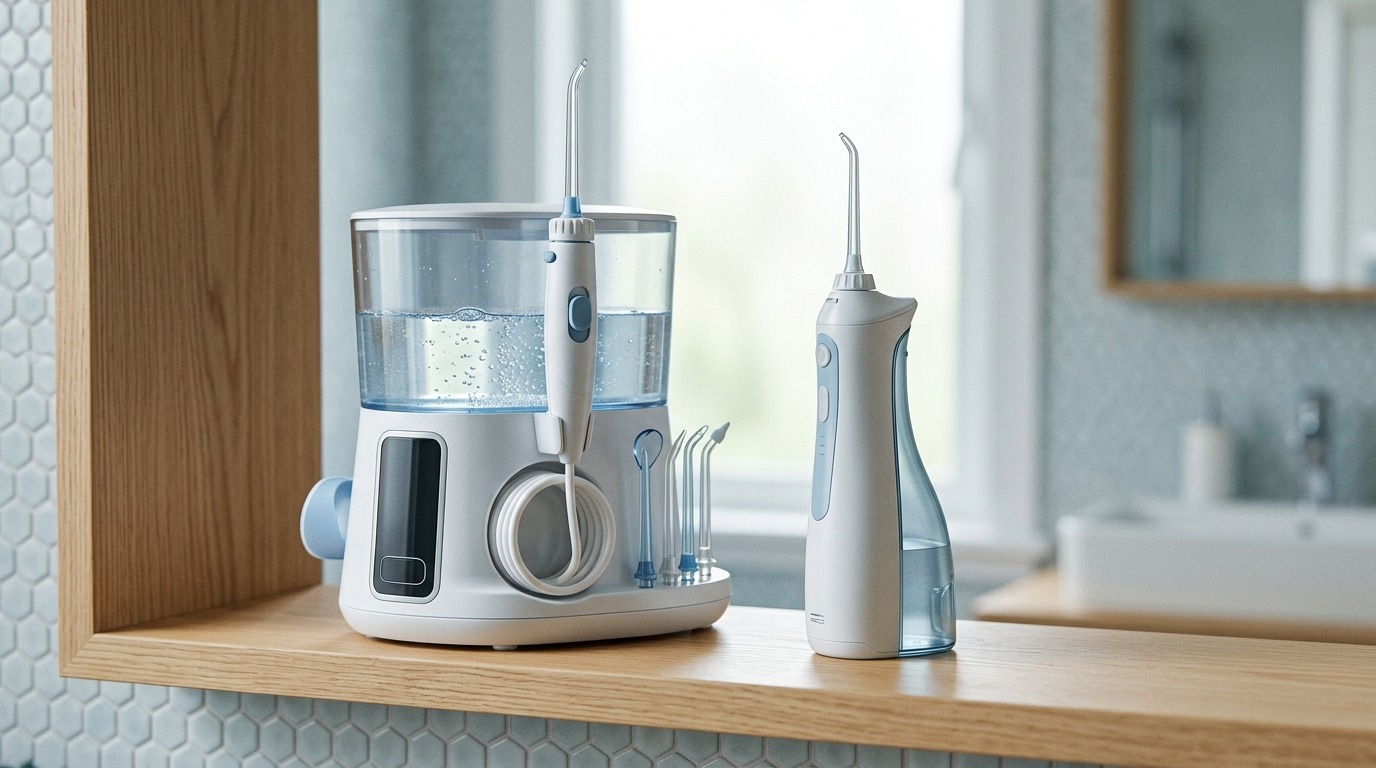
Countertop and portable water flossers: the choice depends on your lifestyle
It’s important to remember that a water flosser is a supplementary hygiene tool — it cannot replace a toothbrush with toothpaste, dental floss, and interdental brushes for braces. Dentists recommend using a water flosser 1–2 times a day after brushing — specifically after, not instead of.