
Thousands of cigarette butts on a wet city sidewalk — a familiar sight after rain. Image source: zmescience.com
A cigarette butt tossed on the sidewalk seems like a trifle — trash that will disappear after the first rain. But a ten-year experiment has proven that the filter doesn’t decompose — it turns into microplastic that remains in the soil for years. Italian scientists tracked the fate of 12,000 cigarette butts under real-world conditions over an entire decade for the first time, and the results force us to reconsider our attitude toward the most common type of litter on the planet.
The Most Common Type of Litter
The scale of the problem is impressive even at the numbers level. Approximately 6 trillion cigarettes are smoked worldwide each year, and by various estimates, 4.5 trillion cigarette butts are discarded into the environment annually, making them the most common type of litter on the planet. They can be found everywhere: on sidewalks, beaches, roadsides, in parks, and along railway tracks.
The problem is that most smokers genuinely believe butts are harmless. Many smokers admit they consider cigarette filters to be biodegradable. But this is a misconception: a cigarette filter is not paper or cotton. It is plastic.
Filters are made predominantly from cellulose acetate — a plastic polymer derived from natural cellulose that is highly resistant to environmental degradation and consists of tightly packed microscopic fibers. The word “cellulose” in the name creates an illusion of naturalness, but in essence it is a synthetic material that nature cannot process as easily as, say, a fallen leaf.
How Cigarette Butts Decompose
This was precisely the question posed by scientists led by Professor Giuliano Bonanomi. For the experiment, they placed 12,000 cigarette butts in mesh bags and put them in different conditions: in nutrient-rich meadow soil, in poor sandy soil, in open field plots, and in controlled laboratory setups simulating natural conditions.
Samples were regularly extracted and analyzed over 3,600 days — nearly ten years. They measured mass loss, chemical composition, microbial activity, and toxicity.
The decomposition pattern turned out to be unexpected. In the first month, butts quickly lost 15–20% of their mass — soluble chemicals were washed from the surface. But then the process slowed dramatically. Over two years, total mass loss reached only 30–35% under most conditions.
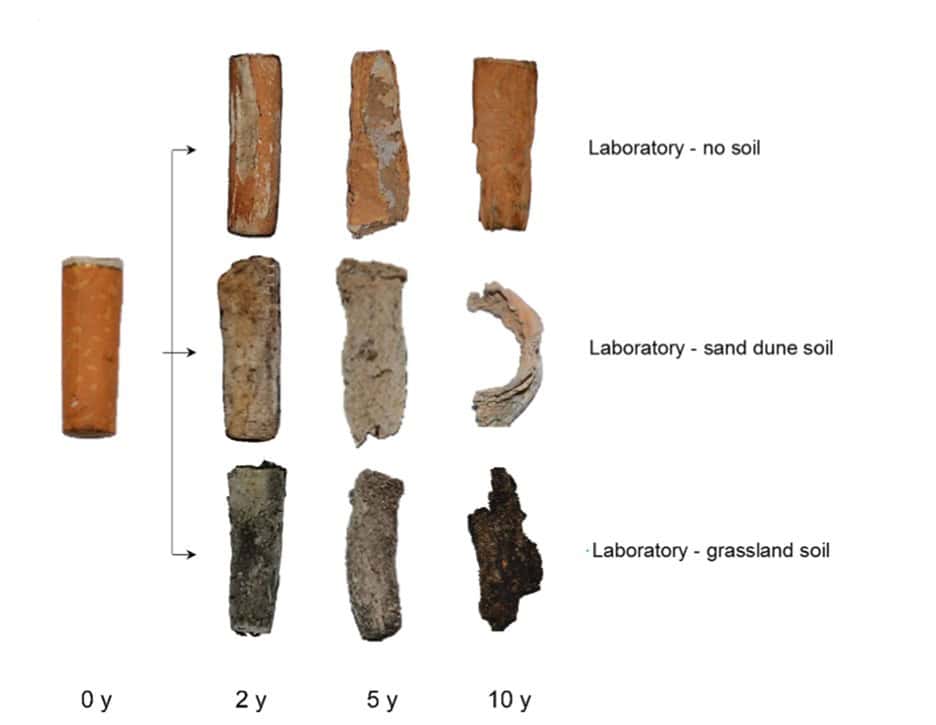
Stages of cigarette filter decomposition over 10 years: the rate of decay strongly depends on soil type
Beyond that, the environment began playing a decisive role. In nutrient-rich meadow soil, butts broke down significantly more, but even there the material did not disappear completely. After 10 years, the maximum mass loss reached 84%. And in samples without soil, filters lost only about 52% of their original mass over a decade. In other words, even after 10 years, up to 48% of the filter material remains in urban soils, and even more in nutrient-poor soils.
Why Cigarettes Don’t Decompose
The main reason for this persistence is cellulose acetate (essentially, a plastic based on wood cellulose treated with acetic acid). This durable plastic polymer makes cigarette filters effective, but it is also resistant to microbial breakdown.
For microbes to “digest” cellulose acetate, they first need to cleave the acetyl groups from the polymer chain (a process called deacetylation), and only then can cellulase enzymes break down the cellulose backbone itself. In poor soils, there simply aren’t enough of the necessary enzymes and microorganisms. Nitrogen-rich soils and active microbial communities accelerated decomposition, while dry, nutrient-poor environments preserved significantly more material.
Imagine a multi-layered plastic castle that needs to be disassembled brick by brick. Microbes are the workers, and nitrogen and moisture are their tools. In rich soil, there are many workers and good tools, but even they can’t disassemble the entire castle in ten years. And on dry asphalt, there are almost no workers at all.
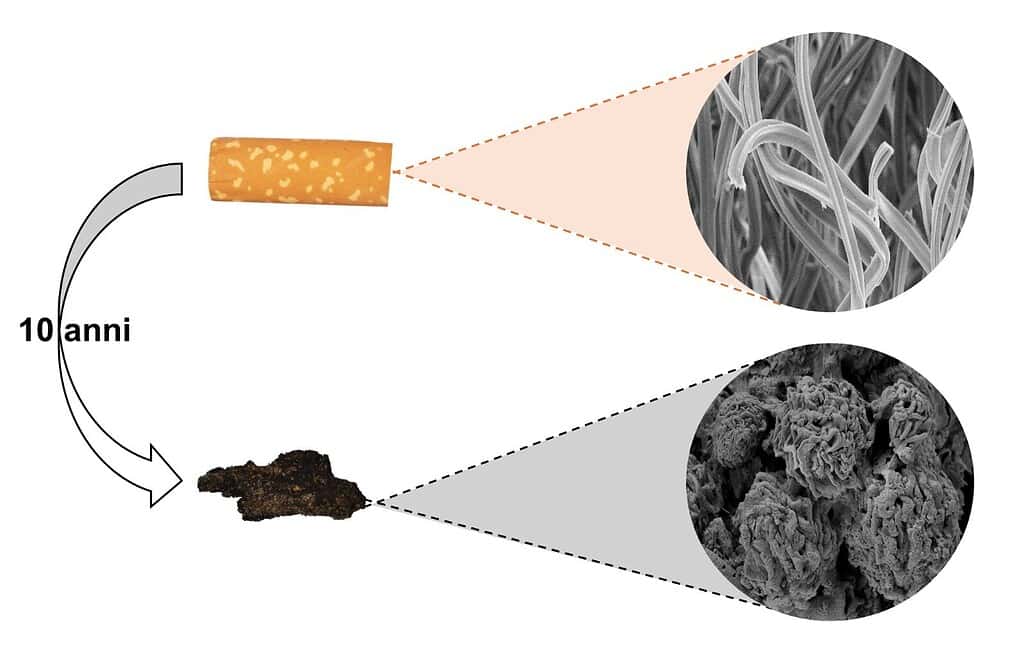
Cellulose acetate fibers from a cigarette filter under a microscope — a dense bundle of plastic threads
How Cigarette Butts Turn Into Microplastic
Perhaps the most alarming finding of the study is not that cigarette butts decompose slowly. It’s what they turn into.
Fresh filters under a microscope look like dense bundles of plastic fibers. But after years in rich soils, these fibers no longer resembled a recognizable butt. They curled, settled, and mixed with minerals and microbial residues. In some cases, tiny rounded structures about 6 micrometers in diameter formed — significantly smaller than the original fibers.
This means a cigarette butt can become invisible — but not disappear. Cigarette butts can become less noticeable without actually disappearing. Weathering doesn’t destroy them completely but breaks them into smaller, altered particles that persist in soils for years. In essence, cigarette butts become a source of secondary microplastic — the very kind that is now found everywhere: in water, in food, and even in the human body.
How Cigarette Butts Are Dangerous for Humans
The toxicity of cigarette butts also turned out to be less straightforward than one might expect. Fresh butts are the most dangerous: they quickly release nicotine, heavy metals, and carcinogenic substances. But even decade-old samples still showed measurable biological effects.
The question of impact on human health has not yet been fully studied, but the initial data is already concerning. A separate laboratory study from 2025 showed that human immune system cells (peripheral blood mononuclear cells) demonstrated an inflammatory immune response upon contact with cellulose acetate from cigarette filters and produced inflammatory cytokines at levels significantly exceeding control samples.
An important caveat: these are results from laboratory experiments, not observations of real people. Scientists concluded that cellulose acetate fibers stimulate cells upon contact and trigger an inflammatory response, but this does not mean the same effect occurs during ordinary everyday exposure. Nevertheless, the data suggests that particles from cigarette filters may be biologically more active than previously thought.
Why There Are So Many Cigarette Butts
It might seem like the solution is obvious — don’t throw butts on the ground. But reality is more complicated. Since the 1980s, cigarette butts have accounted for 30–40% of all litter found during cleanups in urban and coastal areas worldwide. This is not a problem of individual careless people — it is systemic in scale.
There are several approaches that could reduce the damage:
- Development of biodegradable filters — tobacco companies have been researching such options since the 1990s, but none of the proposed materials have yet met the requirements for taste and safety
- Extended producer responsibility — similar to packaging, tobacco companies could bear financial responsibility for disposal
- Infrastructure for disposal — special bins and containers for cigarette butts in public places
- Awareness campaigns — many smokers simply don’t know that the filter is plastic
The main conclusion of the study is not that cigarette butts are “bad” (that’s obvious), but that their actual environmental fate turned out to be far more complex and dangerous than assumed. They don’t just slowly decompose — they transform into a new form of pollution that integrates into the soil and continues to affect ecosystems.
The study was published in the journal Environmental Pollution and is currently one of the longest observations of cigarette filter decomposition under real-world conditions. Given that trillions of cigarette butts continue to enter the environment annually, understanding their long-term fate is not an academic curiosity but a matter of environmental safety that concerns everyone.