
The habit of listening to music with one earbud seems harmless, but it creates an uneven strain on your hearing. Still from the movie “Baby Driver”
Many of us are used to putting in just one earbud: it’s more convenient for hearing those around us, answering colleagues’ questions, and staying connected to reality. It seems like it’s even safer than listening to music with both ears at once. But doctors warn that constantly listening to music through one earbud can lead to unilateral hearing loss, a feeling of stuffiness, and chronic hearing fatigue.
Why You Shouldn’t Listen to Music with One Earbud
At first glance, the logic is simple: one ear listens to music, the other one “rests.” But in reality, it works the exact opposite way. Otorhinolaryngologist Bakhtier Rakhimov of the Krasnogorsk Clinical Hospital explained to RIA Novosti that constant use of one earbud leads to uneven strain on the auditory pathways and an increased risk of hearing loss on one side.
The thing is, our auditory system is originally designed to perceive stereo sound. Each ear picks up its own spectrum of frequencies, and the brain combines the signals into a unified picture. When sound comes from only one side, one auditory analyzer works at its limit while the other is essentially idle. The body is simply not adapted to such asymmetry.
But there’s another non-obvious nuance. When listening to music with one earbud, people usually turn up the volume to drown out external noise. And all that increased load falls on a single ear. At high volumes, the likelihood of developing sensorineural hearing loss increases — a condition in which the sensitive cells of the inner ear and the auditory nerve are damaged.
What Is Sensorineural Hearing Loss
Sensorineural hearing loss is not just “hearing got worse.” It’s damage to the sound-perceiving structures: the hair cells of the inner ear, the auditory nerve, or even the processing centers of the brain. Simply put, sound reaches the ear, but the system that’s supposed to “decode” it malfunctions. To put it plainly, it’s deafness.
The most unpleasant thing about this diagnosis is its irreversibility. Hair cells, once damaged by loud sound, do not regenerate. First, a person stops distinguishing quiet sounds, then begins to hear speech worse in noisy environments, and a constant ringing or humming appears in the ears. According to statistics, sensorineural hearing loss accounts for up to 73% of all hearing impairment cases.
For comparison: a safe volume level is considered to be sounds up to 80–85 decibels. A normal conversation is approximately 30–35 dB, while maximum headphone volume can reach 110–130 dB. At such sound pressure, hearing can be damaged in literally minutes.
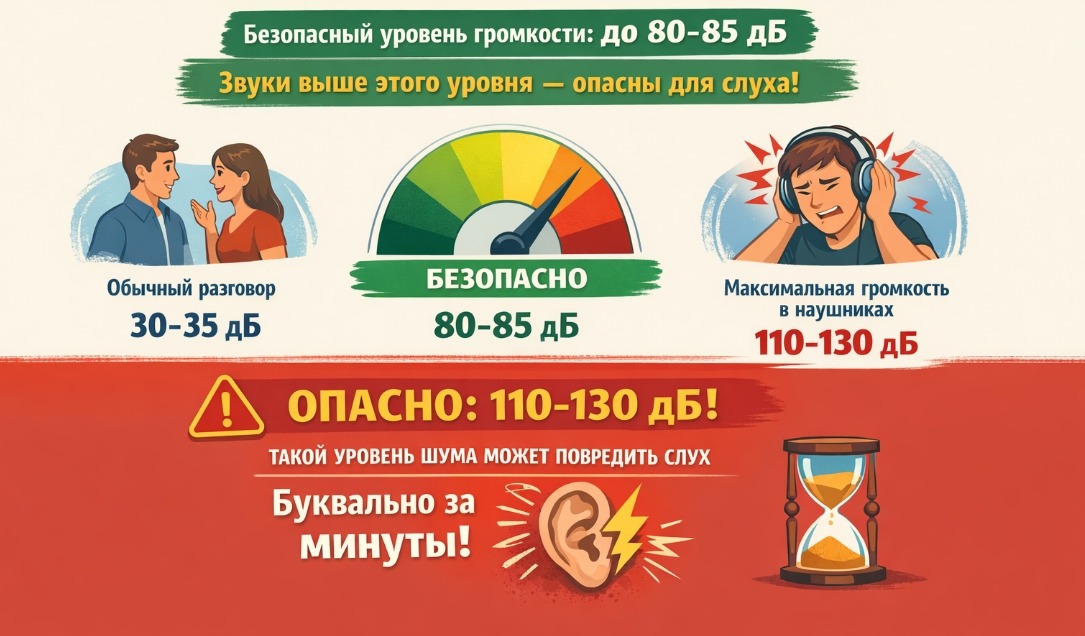
A reminder about dangerous volume levels
What Are the Symptoms of Hearing Loss
The insidiousness of the situation is that hearing problems are virtually unnoticeable at first. A person doesn’t realize they’ve started hearing worse because everything seems fine in quiet environments. With constant use of one earbud, an additional feeling of discomfort, stuffiness, and hearing fatigue may appear.
Here’s what to watch out for:
- After removing the earbud, the ear “rings” or feels stuffed;
- You’ve started asking people to repeat themselves more often;
- Speech in noisy places has started blending into an indistinguishable hum;
- A constant background noise or buzzing has appeared in one ear.
If at least one of these signs is familiar to you, it’s worth thinking about. According to WHO data, more than 1.1 billion young people worldwide are at risk of hearing loss from listening to music at excessively high volumes. And this is not a problem for the elderly: doctors are increasingly diagnosing hearing loss in young people under 30 that is characteristic of 60-year-olds.
How to Listen to Music with Headphones Without Harm
The good news is that you don’t need to give up headphones entirely. There are several specific recommendations that will help preserve your hearing.
- Use over-ear headphones with noise cancellation. They don’t direct sound straight at the eardrum and don’t require turning up the volume in noisy places;
- Stop listening and see an ENT doctor if ringing or stuffiness appears after using headphones;
- Skip headphones at least one day a week, give your ears a rest.
Hearing is a resource we tend to take for granted. But unlike many organs, damaged auditory cells do not regenerate. One earbud during a jog or at the office isn’t scary if it’s a one-time thing. But a daily habit of listening for hours at high volume with one ear is a direct path to the ENT doctor’s office.