Neural networks are no longer just toys for entertainment. ChatGPT, Gemini, Claude, Midjourney, and dozens of other services have long been used for work, study, brainstorming, writing, translation, programming, and even customer communication. That’s why any news about them supposedly being banned in Russia instantly spreads across social media and causes alarm. This is exactly what happened amid the development of a new bill by the Ministry of Digital Development on the use of AI in Russia. It was precisely this bill that sparked discussions about a possible blocking of ChatGPT and other foreign services. What’s actually going to happen, and should we prepare for the worst?

Will ChatGPT and other neural networks be blocked in Russia?
Why Russia Wants to Ban ChatGPT and Other Neural Networks
The main reason isn’t that Russia has decided to ban neural networks. The logic behind the bill is different: the government wants to take control of AI services that influence users, handle sensitive data, and could be used for behavior manipulation, creating deepfakes, or distributing illegal content. The draft materials specifically mention the risks of covert influence on individuals, discriminatory algorithms, and harm caused by AI decisions.

The internet is already flooded with AI slop — low-quality AI-generated content. Photo: infomedia.com
This is precisely why the proposed draft includes a ban on using AI to manipulate human behavior and exploit people’s vulnerabilities. At the same time, AI developers and operators would be required to ensure transparency: notify users about AI usage, label certain synthetic content, and reduce the risk of unlawful use of the technology.
Why Russia Wants to Ban Neural Networks
Theoretically yes, but the wording matters here. The bill doesn’t say that ChatGPT, Gemini, or Claude should be automatically banned. It states that cross-border AI technologies may be prohibited or restricted in cases established by Russian legislation. In other words, the document creates a legal basis for restrictions but doesn’t introduce an immediate block on all foreign neural networks.

Companies will be required to move their data centers to Russia
It’s precisely because of this provision that talk about blocking ChatGPT emerged. Lawyers and media interpret it this way: foreign models where user queries, conversations, and other data leave Russia are primarily at risk of restrictions. Experts note that ChatGPT, Claude, and Gemini could fall under this description. Qwen and DeepSeek are also at risk, though their use within companies is acceptable since Chinese AI models have open source code.
The new bill is a logical continuation of Federal Law 152, which requires localization of Russian citizens’ personal data processing within Russia. In other words, if ChatGPT, Gemini, and others want to operate in Russia, they would need to set up servers in the country. For example, the creators of Roblox took this approach, beginning to adapt to domestic laws.
What Will Happen to ChatGPT in Russia After the New AI Law
The most sensitive issue for major foreign platforms concerns data. Authorities believe that owners of AI services with a daily audience of more than 500,000 people should be required to store user information on Russian territory for at least three years. For global services, this represents a very specific infrastructure and legal requirement. This is happening worldwide: in Europe, the Middle East, and Asia — everywhere has its own requirements for AI operations.
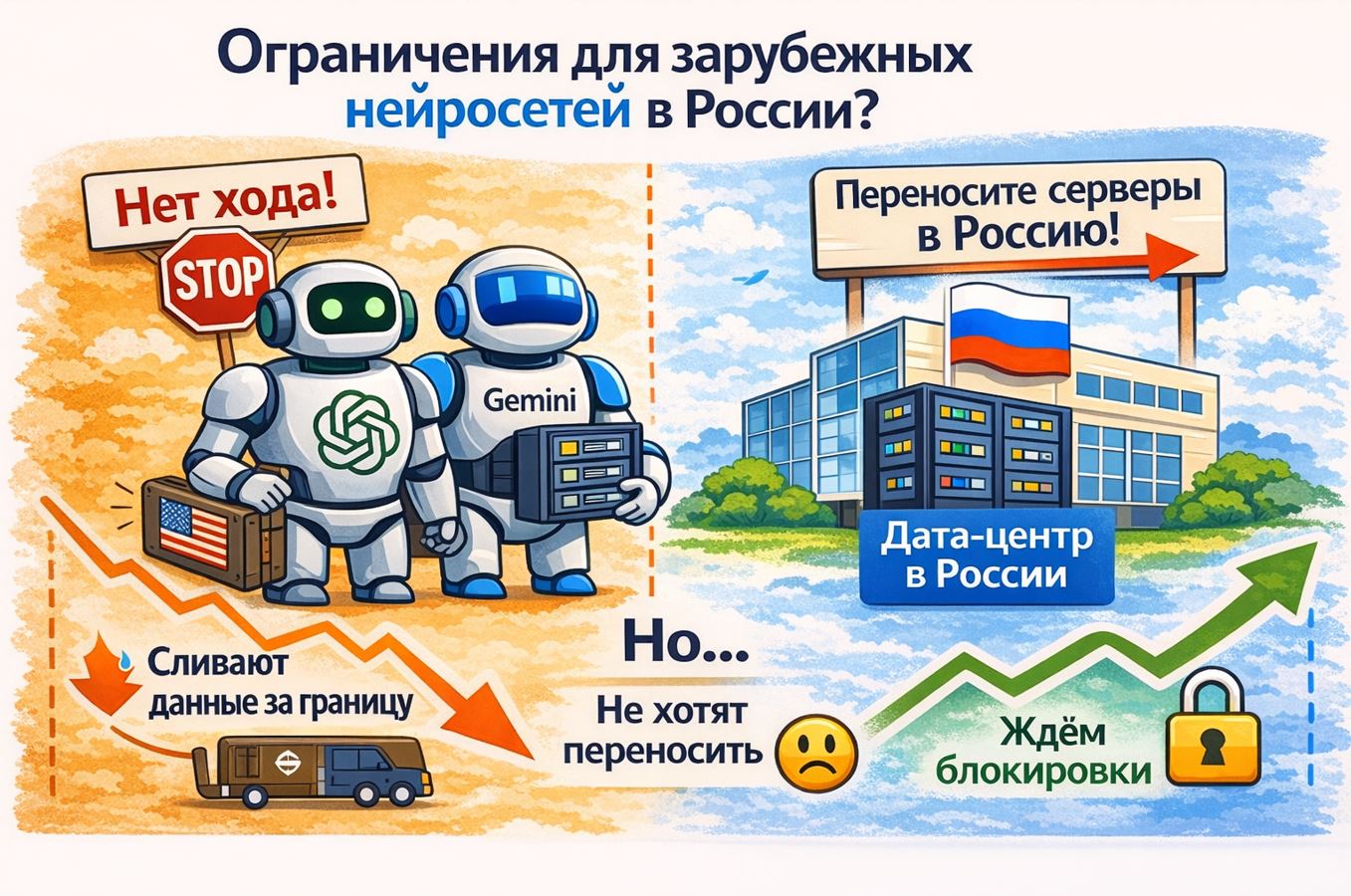
Will OpenAI and Google agree?
And this is where the most important part begins. If a foreign service cannot or does not want to comply with data localization requirements, interact with Russian regulators, and fulfill other obligations, the risk of restrictions increases. Much like what happened with WhatsApp or Telegram. So rumors about blocking ChatGPT didn’t come out of nowhere, but for now this is just a risk stemming from the bill’s framework, not an already-adopted decision to ban anything. Especially since the American AI already doesn’t officially work in Russia due to restrictions imposed by the developer itself.
What AI Law Is Being Prepared in Russia
The document is significantly broader than just a story about foreign services. It introduces basic concepts for the AI market, including categories of sovereign, national, and trusted models. The bill also establishes a framework for regulating AI development and deployment, requirements for labeling certain generated content, and a general logic of liability for harm caused by artificial intelligence systems.
Furthermore, the draft maintains a course not toward a total ban but toward a risk-based approach. Just recently, there were rumors that the government was leaning toward soft AI regulation to avoid scaring off businesses and slowing down industry development. The state wants to simultaneously develop its own models, support AI infrastructure, and control the most sensitive areas — from critical infrastructure to user services with significant influence. It’s obvious that large companies’ data could easily end up in the hands of Western developers and be used for malicious purposes.
Will Neural Networks Be Completely Banned in Russia
There will definitely be no complete ban on neural networks in Russia: domestic ones will remain. The government itself is building regulation around AI development, introducing concepts of sovereign and trusted models, and discussing infrastructure support measures like data centers and supercomputers. This doesn’t align well with the idea of “banning everything.”

Overall, many AI services don’t officially work in Russia anyway
A much more realistic scenario is this: Russian neural networks and locally deployed open-source models will be promoted and considered safer, while foreign cross-border services will face increasing requirements. If they don’t fit within these rules, that’s when access restrictions become possible. So the correct answer right now is: neural networks are not being banned in Russia, but ChatGPT and other foreign AI services are indeed facing additional requirements.