
Tying shoelaces is a classic example of a skill remembered not by muscles, but by the brain
You get on a bicycle after a ten-year break, and suddenly you just ride. You return to the gym after six months off, and your muscles get back in shape suspiciously fast. All of this is usually explained by “muscle memory.” But what actually lies behind this term? Scientists say there are at least two mechanisms, and they work in completely different ways.
What Is Muscle Memory
When we say “muscle memory,” an image comes to mind: fingers automatically finding the right piano keys, hands tying shoelaces on autopilot. According to Science Alert, scientists call this type of memory not “muscle” memory, but procedural memory. And it lives not in the muscles, but in the brain.
Procedural memory is the memory of actions, not words. It belongs to so-called non-declarative memory: you can’t verbally explain the skill, but you can easily perform it. Try explaining to a child in words exactly how to maintain balance on a bicycle, and you’ll feel the difference between “knowing how to do” and “being able to explain.”
But the term “muscle memory” is also used in another, literal sense. Research shows that previously trained muscles can indeed gain volume and strength faster than untrained ones. And here we’re talking not about the brain, but about structural changes within the muscle cells themselves.
How the Brain Turns a New Skill Into an Automatic One
When you first learn something — for example, driving a car — it requires enormous effort. You control every action: the steering wheel, pedals, mirrors, speed. At this point, the prefrontal and frontoparietal regions of the brain are actively engaged — areas responsible for attention, working memory, and conscious thinking.
But with repetition, something interesting happens. Control over the skill gradually shifts to sensorimotor neural circuits — structures that process signals from the senses and select the optimal physical response. Over time, actions become so automatic that you can drive home without remembering which route you took. This isn’t absent-mindedness — it’s a sign that procedural memory is working like clockwork.
Research confirms that repetition is the most reliable and fastest way to strengthen procedural memory. Moreover, it’s better to spread practice across multiple sessions rather than trying to “cram” everything in one go. This forces the brain to actively reconstruct and reorganize the memory each time, making it stronger. And sleep between practice sessions helps consolidate the skill — studies show that it is during sleep that the brain “locks in” what you learned during the day.
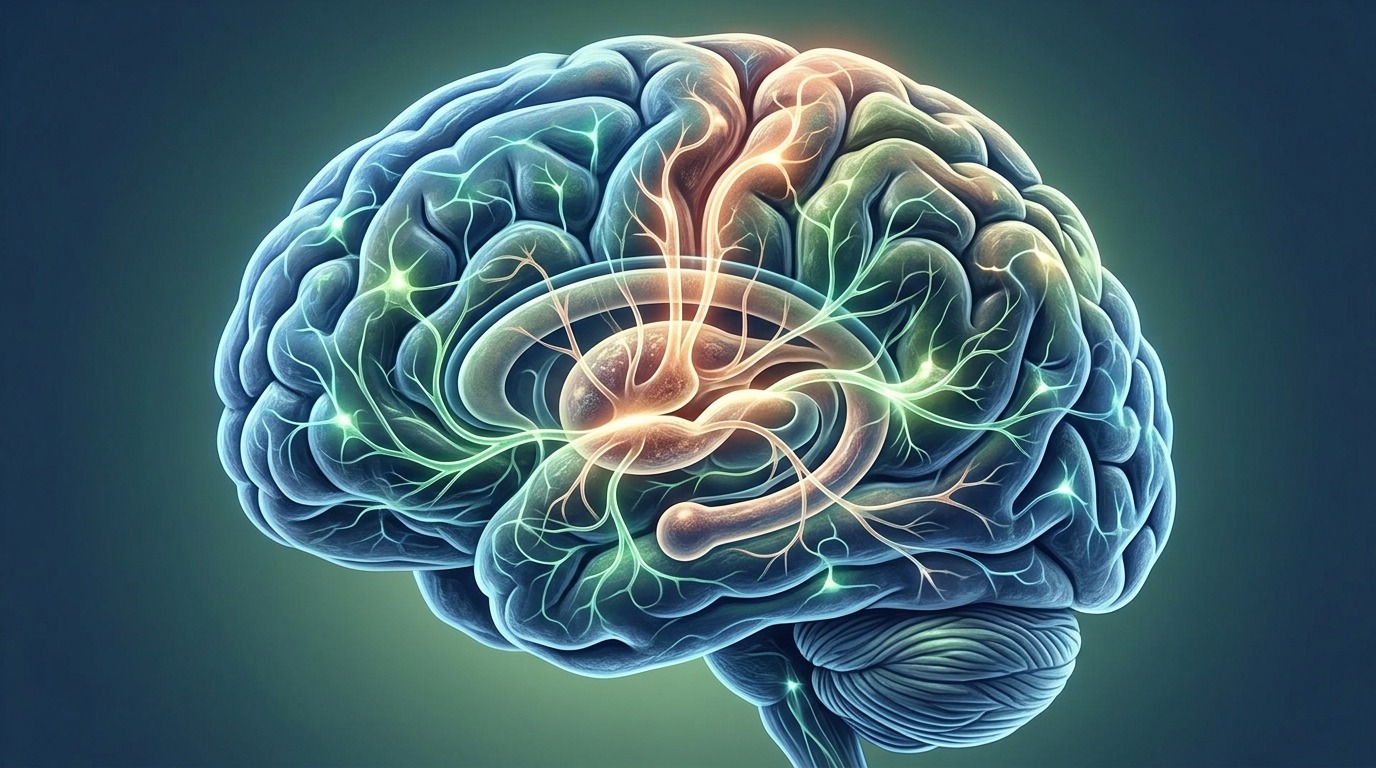
Schematic visualization of neural pathways involved in forming procedural memory
Muscle Memory After a Long Break
And now — about literal muscle memory, the kind that allows you to regain fitness after a training break. Here, the story is truly amazing.
Muscle cells are among the largest in our body. Unlike most other cells, they have not one but many nuclei — sometimes hundreds. When you train and muscles grow, new nuclei are added to the cells, “supplied” by satellite stem cells. Each such nucleus is a small command center that helps produce proteins for muscle fiber growth.
The most interesting part begins when training stops. Muscles shrink — that’s expected. But the accumulated nuclei, according to a number of studies, don’t disappear. They remain inside the cells even when the fibers “shrink.” And when you return to training, these “dormant” nuclei quickly reactivate, launch protein synthesis — and muscles recover faster than the first time around.
However, an important caveat is warranted here. Most of the data on nucleus retention comes from experiments on rodents. Recent human studies showed that nuclei gained over 10 weeks of training were preserved after 16 weeks of inactivity. But scientists emphasize: the question of whether these nuclei remain permanently or gradually disappear has not yet been definitively resolved. There is also another hypothesis — that training changes the epigenetic “settings” of DNA in muscles, making certain genes more accessible for activation during repeated exercise.
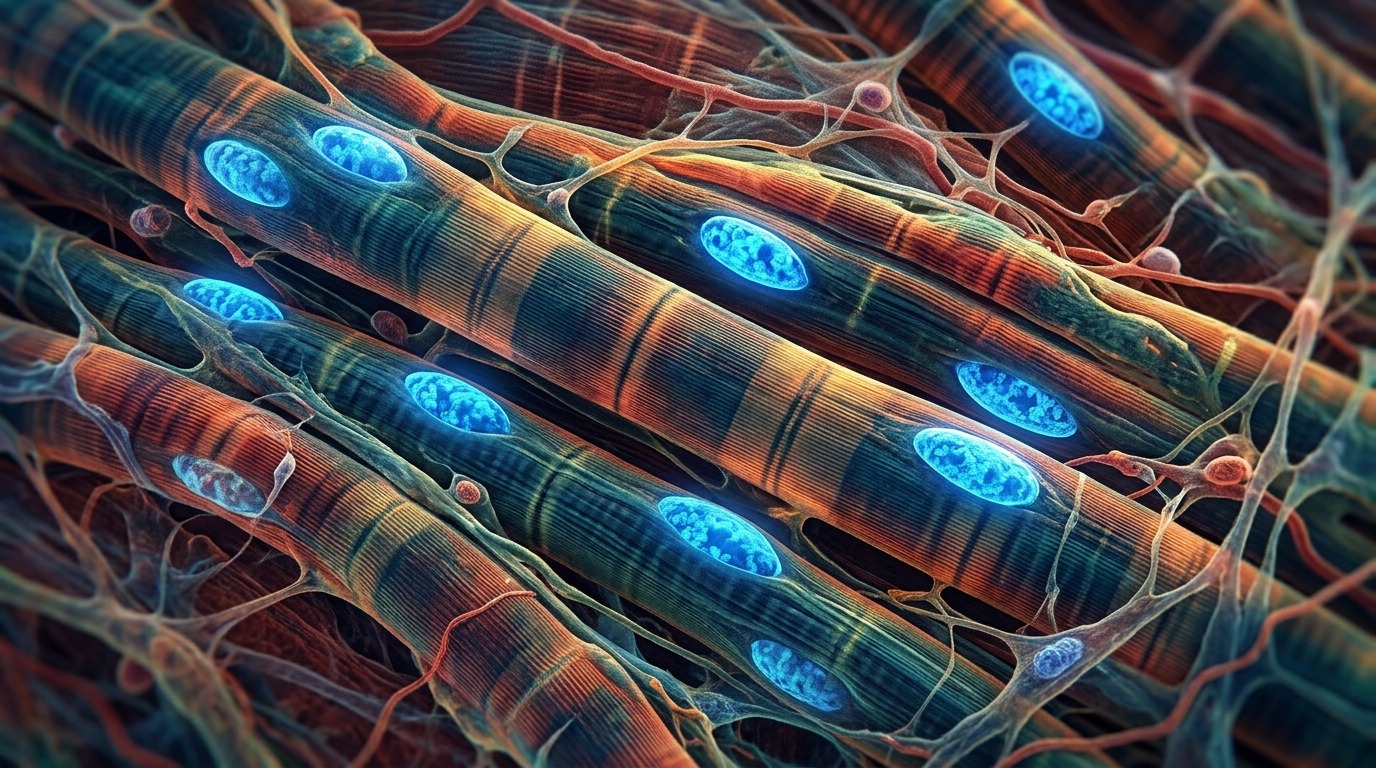
Muscle fibers under a microscope: nuclei (highlighted) are preserved even after training stops
Why People With Dementia Remember Music and Dance
One of the most remarkable properties of procedural memory is its resistance to cognitive decline. People with Alzheimer’s disease gradually lose the ability to recognize loved ones, hold conversations, or navigate their surroundings. Yet they can often still dance the tango, knit, or play the piano — skills honed through decades of practice.
The reason is that procedural memory relies on different brain structures than memory for events or facts. Episodic and semantic memory depend on the hippocampus — the area that is first affected in Alzheimer’s. Procedural memory, however, is supported by the basal ganglia, cerebellum, and sensorimotor cortical areas — which are affected much later.
Research shows that music engages procedural memory particularly deeply. A Canadian study demonstrated that people with Alzheimer’s disease recognized words better when they were sung rather than simply spoken. And in an Australian experiment, a 91-year-old woman with severe Alzheimer’s who had never studied music was able to learn an entirely new song and sing it two weeks later, even though she couldn’t recall the words in a memory test.
This isn’t just a curious fact — it’s practically important knowledge. Music therapy is already used in treating patients with dementia, and understanding the mechanisms of procedural memory helps explain why it works.

Musical skills often persist even in the late stages of dementia
How to Improve Procedural Memory
There’s no quick way to “boost” procedural memory. But there are several principles backed by research:
- Regular repetition — the main tool. It is through repeated practice that the brain shifts skill control from the “slow” frontal lobes to the “fast” motor circuits;
- Spaced practice — sessions spread out over time are more effective than one long marathon. Every time you recall a skill from memory, you strengthen neural connections;
- Sleep between training sessions — research indicates that sleep helps consolidate new motor skills.
These same principles also apply to muscle memory in the literal sense. Strength training with progressive overload stimulates the accumulation of nuclei in muscle cells. And even if life forces you to take a break, the body, based on available data, “remembers” past training — and getting back in shape will be faster.
Both types of “muscle memory” — the brain’s procedural memory and the cellular memory of muscles — work in tandem. When you return to the barbell after a break, the brain quickly restores motor patterns, while muscle cells with preserved nuclei respond to the load more quickly. That’s precisely why “second-time” results come significantly easier than the first.
Perhaps the main takeaway from all of this is that any skill and any training you’ve invested in your body doesn’t disappear without a trace. Procedural memory stays with you even when other types of memory begin to fade. And muscles, it seems, store “records” of past training at the cellular level. So every effort is not just a result in the here and now, but a contribution to a long-term reserve that your body will draw on when the time comes.