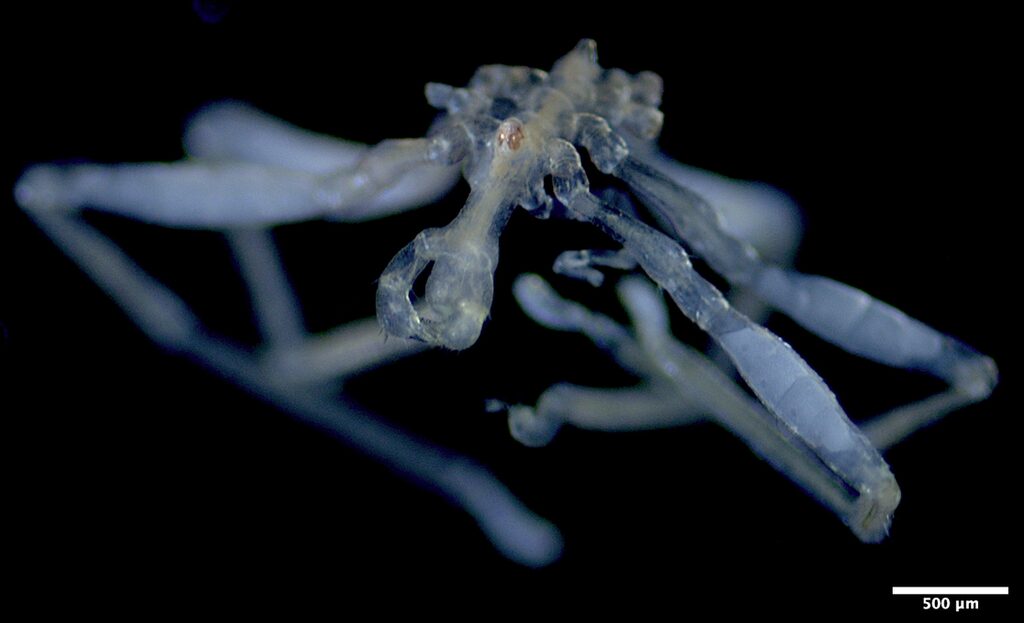
The newly described sea spider Callipallene pilosuspedes under a microscope
Scientists have identified two previously unknown species of sea spider in the Salish Sea, off the coasts of Canada and the United States. Each animal is only about a centimetre long. One has bright red eyes and a mouth divided into three lips. The other carries microscopic single-celled organisms, including parasites. No new species had been described in these waters for nearly a century, even though the area is well studied and lies close to major cities.
What you need to know
- The two new species are Callipallene pilosuspedes and Tanystylum kiixin, each roughly 1 cm in size.
- C. pilosuspedes has red eyes, spiny walking legs and a triangular mouth split into three lips. It was observed grooming its legs with comb-like spines.
- T. kiixin cannot clean itself well. Researchers repeatedly found microscopic single-celled organisms, including parasites, living on it.
- The finds came from dives between September 2023 and August 2024, in which researchers examined seven species in detail.
A red-eyed sea spider with a three-lipped mouth and hairy legs
The first species was named Callipallene pilosuspedes. The second part of the name translates from Latin as “hairy legs,” and the description fits: its walking legs are covered in places with long, curved spines. Add its bright red eyes and the animal looks almost like a Halloween character.
Its most striking feature is its mouth. The mouth sits at the tip of a short proboscis, is triangular and is divided into three lips, with sensory projections around its edges. The animal is tiny, but under a microscope the mouth looks surprisingly formidable.
A sea spider that grooms itself
Sea spiders have special limbs near the head called ovigers, or egg-bearing legs. Males usually carry eggs on them. This species, however, has found another use for them.
Researchers observed the animal bending its highly flexible ovigers around its walking legs and drawing comb-like spines along them. In effect, it always carries its own grooming comb.
The second species is home to parasites
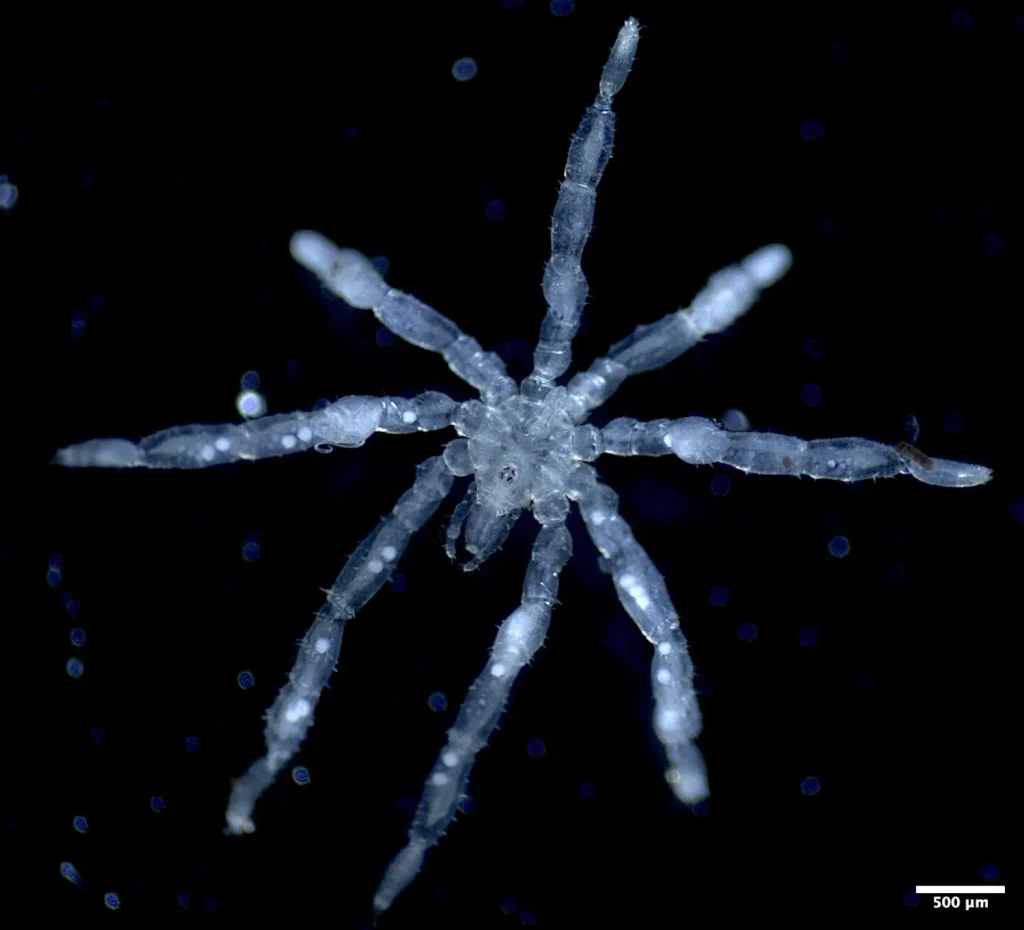
The sea spider Tanystylum kiixin under a microscope
The second new species is Tanystylum kiixin, pronounced roughly “kee-hin.” It is named after Kiixin, the traditional capital of one of the Indigenous peoples of Vancouver Island. Archaeologists believe people lived there for almost 3,000 years, and the site remains sacred to local communities.
This species has much smaller and less dexterous ovigers, so it cannot clean itself properly. Sea spiders often become coated in dirt and debris, and on this species the scientists repeatedly found microscopic single-celled organisms, including parasites.
The authors described this as “an ecosystem within an ecosystem within an ecosystem.” The sea spider lives among other marine organisms while itself serving as a home for even smaller creatures.
Sea spiders are not actually spiders
Despite their name, these animals are not true spiders. They are pycnogonids, an ancient lineage of marine arthropods related to the large group that includes spiders, scorpions and horseshoe crabs. They live only in the ocean and spend most of their lives crawling along the seabed or over other organisms.
Even by arthropod standards, their anatomy is unusual:
- in some species the body is so small that organs extend into the legs;
- in others, the digestive tract branches into the limbs;
- they have no lungs or gills, and oxygen passes directly through their thin body covering;
- males care for the offspring, carrying the eggs after mating until the young hatch.
Despite all this, sea spiders remain one of the most poorly studied groups of animals.
More undiscovered species may be hiding in the Salish Sea
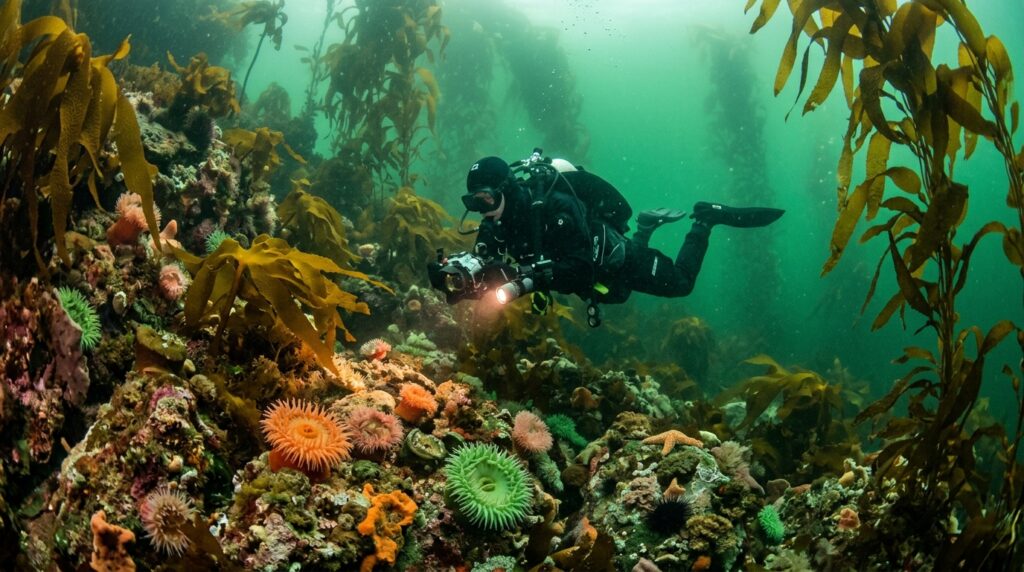
A scuba diver explores the seabed among seaweed and anemones
Between September 2023 and August 2024, researchers dived to depths of around 18 metres near Vancouver, Victoria, Quadra Island and the west coast of Vancouver Island. In total, they studied seven species in detail. Five were already known to science but had long-outdated descriptions. The remaining two turned out to be new.
The work began with a simple question: how are climate change and human activity affecting sea spiders? Invertebrates in the Salish Sea are especially vulnerable. The researchers could not answer that question, however, because so little is known about the local species. It is hard to protect animals that nobody knows exist.
The two new species are unlikely to be a lucky one-off, and more will probably turn up in these waters. That remains an expectation rather than a confirmed finding. Still, the discovery shows that unexplored biodiversity can lie very close at hand, just a few dozen metres from the shore.